 Add to Chrome
 Add to Firefox
 Add to Edge
Seed2GS: Camera-Free, Training-Free Object Extraction from 3D Gaussian Scenes via a Single Reference-View Grounding
Aug 12, 2026
Extracting a target object from a pre-built 3D Gaussian Splatting (3DGS) scene enables interactive 3D editing. Existing methods either train for tens of minutes per scene, sacrifice accuracy, or require original reconstruction cameras that pre-built assets may not include. We present Seed2GS, which achieves the highest reported LERF-MASK accuracy without original reconstruction cameras or scene-specific representation training. Its key insight is to separate target identity from 3D coverage. QD-SAM3 selects one reliable reference mask from several open-vocabulary candidates, fixing identity once. Seed lift and visibility-adaptive virtual orbits then expose the object from new viewpoints, while tracking propagates the seed without repeated detection. Because the scene remains frozen, these masks supervise only one temporary foreground logit per Gaussian. On LERF-MASK, Seed2GS reaches 92.1% mean intersection over union (mIoU) with a measured compute-only latency of 9.3 seconds, 3.7 points above the strongest scene-trained baseline and 7.6 points above the closest camera-free baseline. With one fixed test reference per scene, the complete pipeline retains 91.1% mIoU; replacing its predicted seed with a ground-truth mask improves mIoU by only 0.72 points. On 3D-OVS, Seed2GS reaches 95.7% mIoU.

EventRadar: Long-Range Visual UAV Discovery through Spatiotemporal Event Sensing
Jun 09, 2026Unauthorized unmanned aerial vehicle (UAV) activity around airports, public venues, and other sensitive sites has made protected-airspace monitoring increasingly important. A practical sensing system must search a wide angular region, find small long-range targets, and return both bearing support and UAV-specific evidence before a restricted perimeter is breached. Existing UAV detection paths often rely on spatially organized evidence, such as body extent, silhouette, or track continuity. At long range, however, these cues become difficult to preserve and verify as the target footprint weakens and its image-plane support shrinks. EventRadar follows a complementary cue: propeller-induced temporal periodicity, which recent event-camera sensing studies have shown can reveal UAV-specific motion after appearance becomes weak. We extend this cue to kilometer-scale active sensing with an event-camera prototype. Scene-Anchored Geometry Evidence (SAGE) fuses scanning events with IMU pose to maintain a bearing-indexed scene memory, separating transient candidate support from persistent background clutter. Comb-guided Harmonic-Group Learned Iterative Shrinkage and Thresholding Algorithm (CHG) then treats each candidate as a weak high-rate timing signal and recovers phase-insensitive harmonic evidence with fixed compute. Compared with related event-camera baselines on 700-1500 m UAV event recordings, EventRadar achieves 0.990 mAP$_{.3}$ and 0.949 F1$_{.3}$, reduces FN$_{.3}$ to 0.009, and shows real-time feasibility in prototype profiling.
SleepGMUformer: A gated multimodal temporal neural network for sleep staging
Feb 20, 2025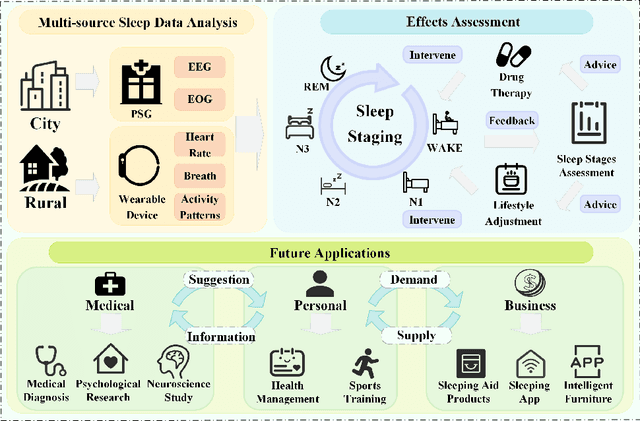
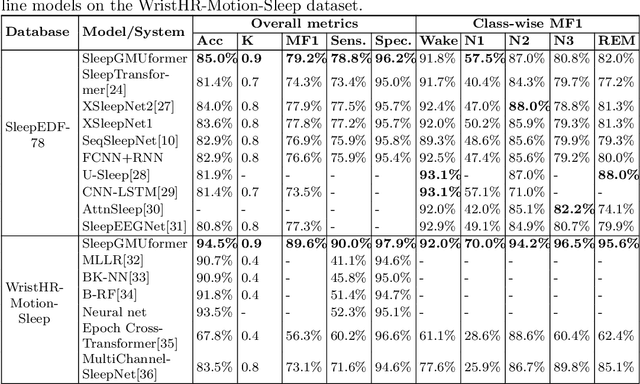
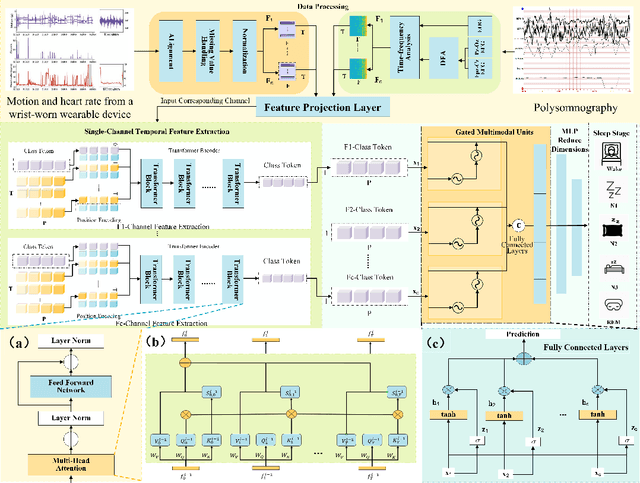
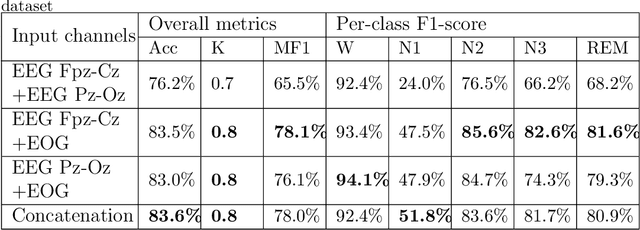
Sleep staging is a key method for assessing sleep quality and diagnosing sleep disorders. However, current deep learning methods face challenges: 1) postfusion techniques ignore the varying contributions of different modalities; 2) unprocessed sleep data can interfere with frequency-domain information. To tackle these issues, this paper proposes a gated multimodal temporal neural network for multidomain sleep data, including heart rate, motion, steps, EEG (Fpz-Cz, Pz-Oz), and EOG from WristHR-Motion-Sleep and SleepEDF-78. The model integrates: 1) a pre-processing module for feature alignment, missing value handling, and EEG de-trending; 2) a feature extraction module for complex sleep features in the time dimension; and 3) a dynamic fusion module for real-time modality weighting.Experiments show classification accuracies of 85.03% on SleepEDF-78 and 94.54% on WristHR-Motion-Sleep datasets. The model handles heterogeneous datasets and outperforms state-of-the-art models by 1.00%-4.00%.