 Add to Chrome
 Add to Firefox
 Add to Edge
Universal computational thermal imaging overcoming the ghosting effect
Apr 02, 2026
Thermal imaging is crucial for night vision but fundamentally hampered by the ghosting effect, a loss of detailed texture in cluttered photon streams. While conventional ghosting mitigation has relied on data post-processing, the recent breakthrough in heat-assisted detection and ranging (HADAR) opens a promising frontier for hyperspectral computational thermal imaging that produces night vision with day-like visibility. However, universal anti-ghosting imaging remains elusive, as state-of-the-art HADAR applies only to limited scenes with uniform materials, whereas material non-uniformity is ubiquitous in the real world. Here, we propose a universal computational thermal imaging framework, TAG (thermal anti-ghosting), to address material non-uniformity and overcome ghosting for high-fidelity night vision. TAG takes hyperspectral photon streams for nonparametric texture recovery, enabling our experimental demonstration of unprecedented expression recovery in thus-far-elusive ghostly human faces -- the archetypal, long-recognized ghosting phenomenon. Strikingly, TAG not only universally outperforms HADAR across various scenes, but also reveals the influence of material non-uniformity, shedding light on HADAR's effectiveness boundary. We extensively test facial texture and expression recovery across day and night, and demonstrate, for the first time, thermal 3D topological alignment and mood detection. This work establishes a universal foundation for high-fidelity computational night vision, with potential applications in autonomous navigation, reconnaissance, healthcare, and wildlife monitoring.

SleepGMUformer: A gated multimodal temporal neural network for sleep staging
Feb 20, 2025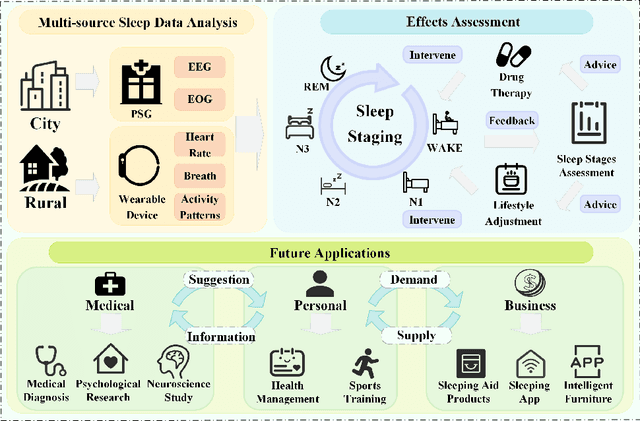
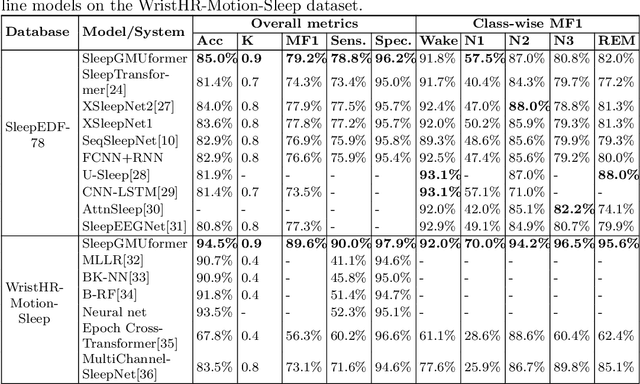
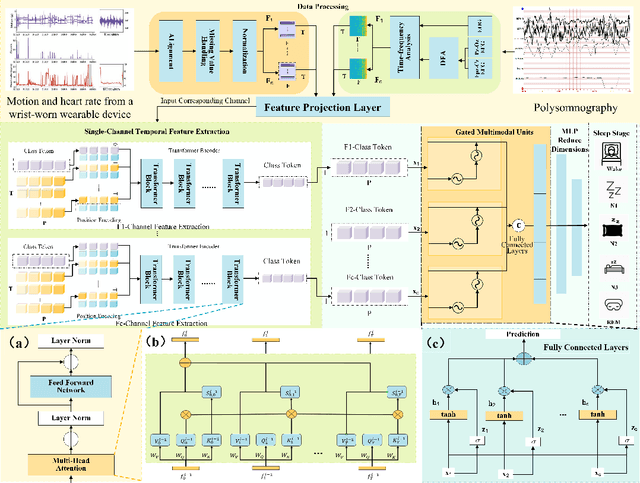
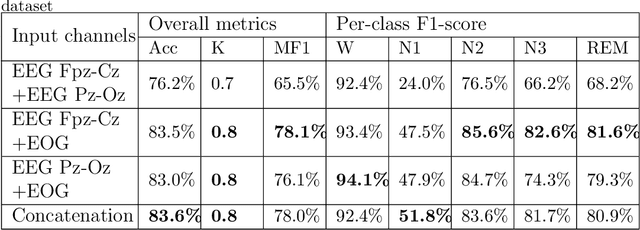
Sleep staging is a key method for assessing sleep quality and diagnosing sleep disorders. However, current deep learning methods face challenges: 1) postfusion techniques ignore the varying contributions of different modalities; 2) unprocessed sleep data can interfere with frequency-domain information. To tackle these issues, this paper proposes a gated multimodal temporal neural network for multidomain sleep data, including heart rate, motion, steps, EEG (Fpz-Cz, Pz-Oz), and EOG from WristHR-Motion-Sleep and SleepEDF-78. The model integrates: 1) a pre-processing module for feature alignment, missing value handling, and EEG de-trending; 2) a feature extraction module for complex sleep features in the time dimension; and 3) a dynamic fusion module for real-time modality weighting.Experiments show classification accuracies of 85.03% on SleepEDF-78 and 94.54% on WristHR-Motion-Sleep datasets. The model handles heterogeneous datasets and outperforms state-of-the-art models by 1.00%-4.00%.