 Add to Chrome
 Add to Firefox
 Add to Edge
SecRespond: Benchmarking AI Agents for Real-World Post-Compromise Incident Response
Jul 29, 2026
Large Language Model (LLM) agents are increasingly adopted in real-world security operations with access to host artifacts and command-line interfaces (CLIs), making it critical to thoroughly assess their security capabilities. However, existing cybersecurity benchmarks focus on pre-compromise settings where agents are placed in a clean and idealized environment before an attack occurs. This leaves the post-compromise setting underexplored. To address this gap, we introduce SecRespond, the first benchmark for evaluating LLM agents on the post-compromise incident-response workflow. Given a forensic disk snapshot of a compromised host together with the alerts, vulnerability scans, and baseline checks reported by a host security product, agents are required to produce forensic reports on intrusions, baseline risks, and vulnerability risks, together with a remediation plan. We instantiate this task across 10 cyber ranges, each constructed from a distinct compromised cloud host, spanning 4 entry-point types, 21 ATT&CK techniques, and 5 operating systems. We evaluate 23 frontier LLMs on the OpenCode agent harness. Experimental results show that although current agents can reliably uncover the problems exposed by alerts, they struggle to proactively investigate the disk for silent intrusions and to produce comprehensive, verified remediation plans, with no model achieving complete detection and remediation on any single range. This reveals a fundamental bottleneck in building agents for real-world incident response. The benchmark is publicly available at https://github.com/Alibaba-NLP/qqr/tree/main/data/secrespond.

Reinforcement Learning for Delivery Drone-Based Participatory Sensing in Dynamic Environments
Jul 21, 2026Using Unmanned Aerial Vehicle (UAV) for urban sensing has emerged as a powerful paradigm to monitor the status of the city, e.g., air quality and noise levels, through agile aerial crowdsourcing. Despite this potential, existing UAV-based sensing approaches overlook environmental disturbances like wind that drastically impact drone velocity and energy efficiency. Consequently, directly applying existing methods to this joint delivery and sensing paradigm in dynamic environments faces two severe challenges: (1) scalability bottlenecks as fleet sizes expand; and (2) multi-timescale decision heterogeneity between macro task dispatching and micro velocity control. To tackle these, we formalize the problem as SensUAV and propose a Two TimeScale Reinforcement Learning framework (TSRL). Specifically, TSRL separates decision-making into two cooperative layers. At the macro level, a task-embedding sensing dispatcher handles scalability by separately encoding distinct task features and sequentially evaluating UAV suitability before task selection. At the micro level, a wind-aware velocity controller learns fine-grained velocity scheduling to adapt to dynamic environmental variations. Extensive experiments on real-world datasets demonstrate that TSRL significantly outperforms baselines, achieving average system profit improvements of 20.1% in Hangzhou and 46.6% in Shanghai.
Enhancing Recommender Systems with Large Language Model Reasoning Graphs
Aug 21, 2023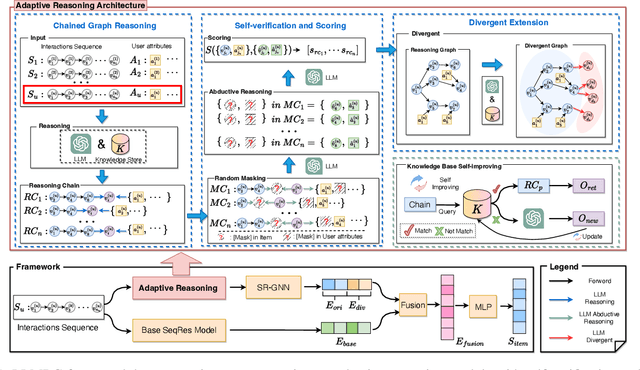
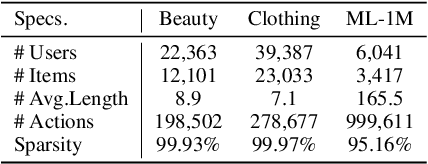
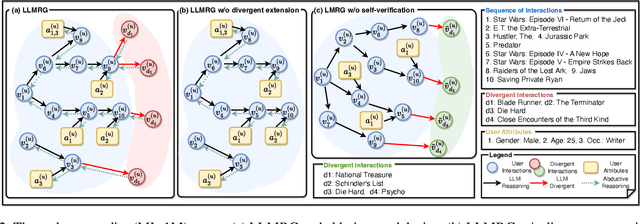
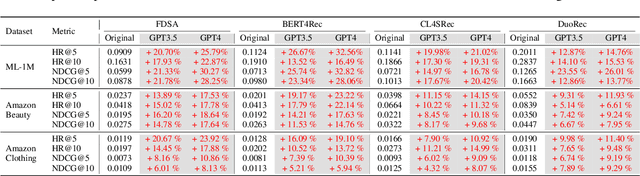
Recommendation systems aim to provide users with relevant suggestions, but often lack interpretability and fail to capture higher-level semantic relationships between user behaviors and profiles. In this paper, we propose a novel approach that leverages large language models (LLMs) to construct personalized reasoning graphs. These graphs link a user's profile and behavioral sequences through causal and logical inferences, representing the user's interests in an interpretable way. Our approach, LLM reasoning graphs (LLMRG), has four components: chained graph reasoning, divergent extension, self-verification and scoring, and knowledge base self-improvement. The resulting reasoning graph is encoded using graph neural networks, which serves as additional input to improve conventional recommender systems, without requiring extra user or item information. Our approach demonstrates how LLMs can enable more logical and interpretable recommender systems through personalized reasoning graphs. LLMRG allows recommendations to benefit from both engineered recommendation systems and LLM-derived reasoning graphs. We demonstrate the effectiveness of LLMRG on benchmarks and real-world scenarios in enhancing base recommendation models.
Leveraging Large Language Models for Pre-trained Recommender Systems
Aug 21, 2023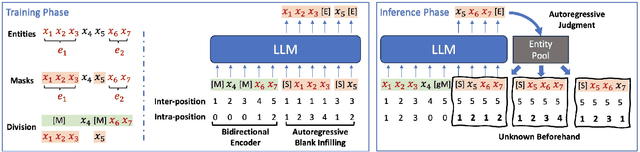
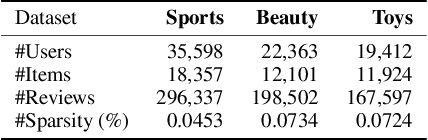
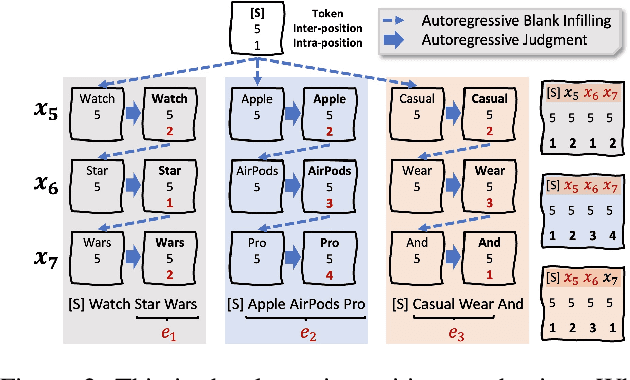
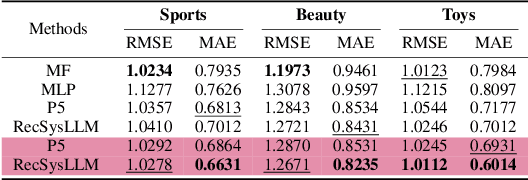
Recent advancements in recommendation systems have shifted towards more comprehensive and personalized recommendations by utilizing large language models (LLM). However, effectively integrating LLM's commonsense knowledge and reasoning abilities into recommendation systems remains a challenging problem. In this paper, we propose RecSysLLM, a novel pre-trained recommendation model based on LLMs. RecSysLLM retains LLM reasoning and knowledge while integrating recommendation domain knowledge through unique designs of data, training, and inference. This allows RecSysLLM to leverage LLMs' capabilities for recommendation tasks in an efficient, unified framework. We demonstrate the effectiveness of RecSysLLM on benchmarks and real-world scenarios. RecSysLLM provides a promising approach to developing unified recommendation systems by fully exploiting the power of pre-trained language models.