 Add to Chrome
 Add to Firefox
 Add to Edge
RoomPilot: Controllable Synthesis of Interactive Indoor Environments via Multimodal Semantic Parsing
Dec 12, 2025
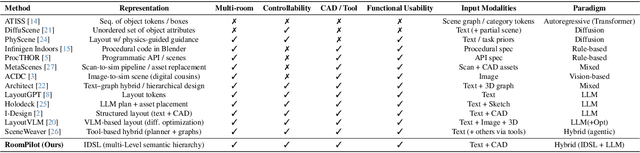
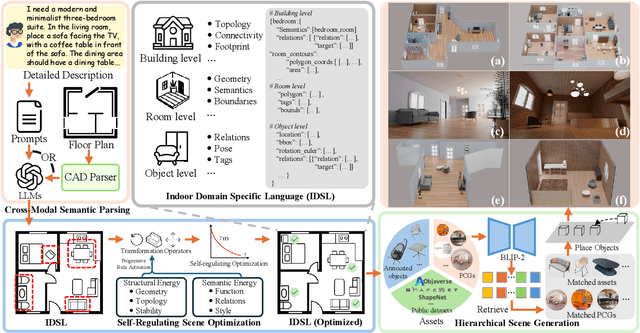
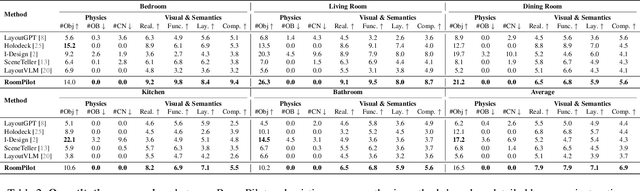
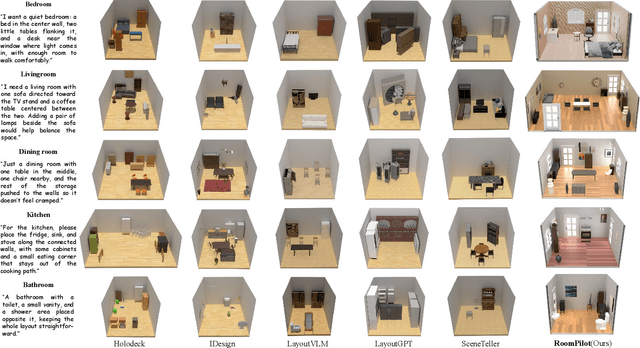
Generating controllable and interactive indoor scenes is fundamental to applications in game development, architectural visualization, and embodied AI training. Yet existing approaches either handle a narrow range of input modalities or rely on stochastic processes that hinder controllability. To overcome these limitations, we introduce RoomPilot, a unified framework that parses diverse multi-modal inputs--textual descriptions or CAD floor plans--into an Indoor Domain-Specific Language (IDSL) for indoor structured scene generation. The key insight is that a well-designed IDSL can act as a shared semantic representation, enabling coherent, high-quality scene synthesis from any single modality while maintaining interaction semantics. In contrast to conventional procedural methods that produce visually plausible but functionally inert layouts, RoomPilot leverages a curated dataset of interaction-annotated assets to synthesize environments exhibiting realistic object behaviors. Extensive experiments further validate its strong multi-modal understanding, fine-grained controllability in scene generation, and superior physical consistency and visual fidelity, marking a significant step toward general-purpose controllable 3D indoor scene generation.

RWKV-PCSSC: Exploring RWKV Model for Point Cloud Semantic Scene Completion
Nov 13, 2025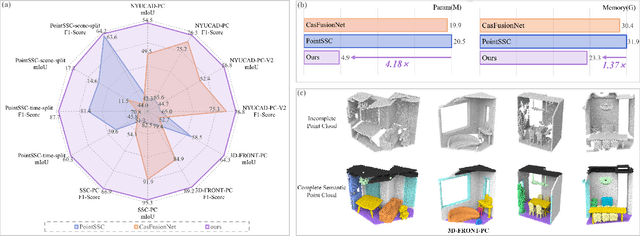

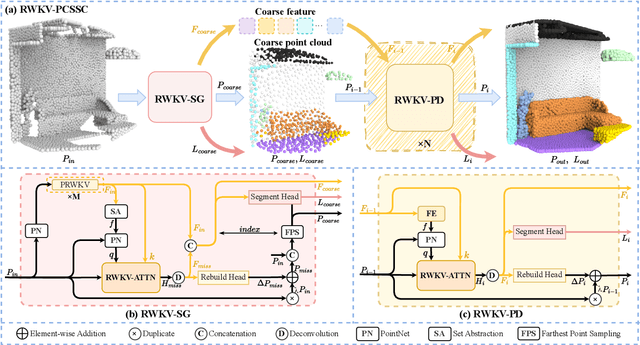
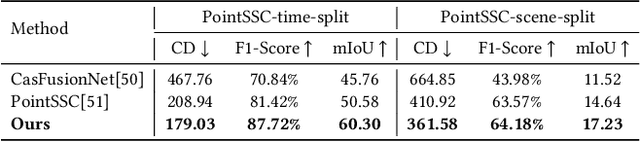
Semantic Scene Completion (SSC) aims to generate a complete semantic scene from an incomplete input. Existing approaches often employ dense network architectures with a high parameter count, leading to increased model complexity and resource demands. To address these limitations, we propose RWKV-PCSSC, a lightweight point cloud semantic scene completion network inspired by the Receptance Weighted Key Value (RWKV) mechanism. Specifically, we introduce a RWKV Seed Generator (RWKV-SG) module that can aggregate features from a partial point cloud to produce a coarse point cloud with coarse features. Subsequently, the point-wise feature of the point cloud is progressively restored through multiple stages of the RWKV Point Deconvolution (RWKV-PD) modules. By leveraging a compact and efficient design, our method achieves a lightweight model representation. Experimental results demonstrate that RWKV-PCSSC reduces the parameter count by 4.18$\times$ and improves memory efficiency by 1.37$\times$ compared to state-of-the-art methods PointSSC. Furthermore, our network achieves state-of-the-art performance on established indoor (SSC-PC, NYUCAD-PC) and outdoor (PointSSC) scene dataset, as well as on our proposed datasets (NYUCAD-PC-V2, 3D-FRONT-PC).
* 13 pages, 8 figures, published to ACM MM