 Add to Chrome
 Add to Firefox
 Add to Edge
ProjFormer: Point Cloud Completion via Geometric-Projective Transformer and Cross-Modal Semantic Constraints
Aug 15, 2026
Point cloud completion is inherently ill-posed due to severe sparsity and ambiguity in partial observations. Existing multi-view methods alleviate this by incorporating 2D semantics, but often rely on learned attention and fixed fusion, which lack geometric consistency and adaptability. We propose ProjFormer, a cross-modal framework that enforces geometry-consistent 2D-3D interaction through explicit projection and adaptive feature routing. A Projective Guided View Attention module aligns 3D points with multi-view features via deterministic projection, enabling efficient and geometrically consistent aggregation. Building on this, a geometry-aware routing network performs point-wise adaptive fusion of structural and observation-driven features for progressive refinement. Experiments show that, under a lightweight design, ProjFormer delivers competitive performance with improved structural completeness.

RayLift: Lifting Complementary Ray-Wise Evidence with 3D Geometry Priors for Semantic Scene Completion
Aug 09, 2026Camera-based 3D semantic scene completion (SSC) provides comprehensive scene understanding for autonomous driving and robotics. However, existing methods often treat stereo depth estimates as deterministic geometric constraints, causing depth uncertainty and local correspondence errors to propagate directly into voxel representations. To address this issue, we propose RayLift, a framework that uses stereo geometry as a metric reference while incorporating complementary ray evidence to recover reliable 3D structures adaptively. RayLift first employs a Complementary Context Encoder that extracts geometry-aware priors from a frozen 3D vision foundation model, thereby enriching the scene context. It then introduces a Depth Ray Evidence Lifter module that jointly models geometric dissimilarity, depth confidence, and spatial uncertainty to adaptively sample and weight candidate surface locations along each camera ray. Finally, a Semantic-Aware Voxel Integrator injects the resulting ray evidence into voxel features by explicitly modeling their spatial support. Extensive experiments on SemanticKITTI and SSCBench-KITTI-360 demonstrate that RayLift achieves competitive performance and consistently outperforms existing methods.
Geospatial-Prior Guidance for 3D Semantic Scene Completion
Aug 04, 2026Inferring complete 3D geometry and semantics from onboard images remains challenging because occlusions and restricted fields of view leave large scene regions underconstrained. Although satellite imagery provides wide-area context, appearance cues alone offer limited structural guidance and may be unreliable because of spatial or temporal discrepancies. We present GeoScene, a geospatially guided framework that jointly uses satellite imagery and structured OpenStreetMap cues as soft priors for 3D semantic scene completion. GeoScene learns complementary voxel-wise reliability weights for onboard observations and geospatial guidance, and uses them to control feature refinement in observed and unobserved regions. This design preserves local visual evidence while exploiting large-scale road and building structure beyond onboard visibility. Experiments on SemanticKITTI and SSCBench-KITTI-360 demonstrate that GeoScene consistently improves both geometric and semantic completion under the geospatial-prior-assisted setting, with the most pronounced benefits for large-scale static and geospatially structured classes.
FPSGen: Flexible Point Cloud Scene Generation with BEV-Supported Transport Flows
Jul 29, 2026Existing point-based generative methods for outdoor scenes primarily focus on LiDAR-conditioned completion. During training, noisy point clouds are constructed by perturbing complete ground-truth scenes, whereas during inference, they are initialized by adding noise to duplicated partial scans. This train-inference mismatch inherits the sparsity and visibility bias of partial scans, leading to sparse distant regions and incomplete geometry in occluded areas. Moreover, the reliance on partial scans restricts generation when LiDAR observations are unavailable or replaced by layout cues. We present FPSGen, a flexible framework that constructs point sources independently of partial scans. FPSGen first predicts a bird's-eye-view (BEV) prior with density, height, and mask channels from the active cues. The density map is then sampled to form a BEV-supported point source, enabling both unconditional and conditioned initialization. A teacher-student approximate optimal transport scheme then uses teacher-predicted endpoints to learn a velocity field that induces straighter transport paths. By integrating BEV point source construction with path-straightening transport, FPSGen provides a unified framework for unconditional and flexible cue-conditioned scene generation. Extensive experiments show that FPSGen achieves state-of-the-art JSD and voxel IoU performance on SemanticKITTI completion while maintaining strong performance with a single point transport step. On KITTI-360 unconditional generation, it also achieves the best Coverage (COV) among the compared methods.
RoomPilot: Controllable Synthesis of Interactive Indoor Environments via Multimodal Semantic Parsing
Dec 12, 2025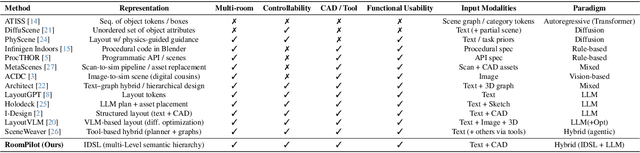
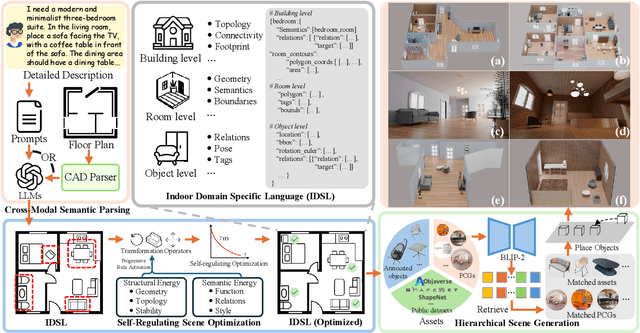
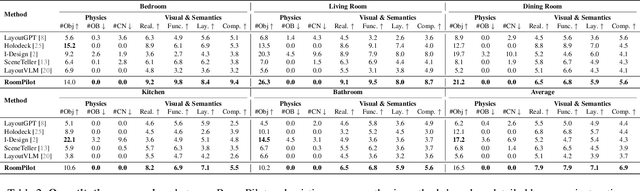
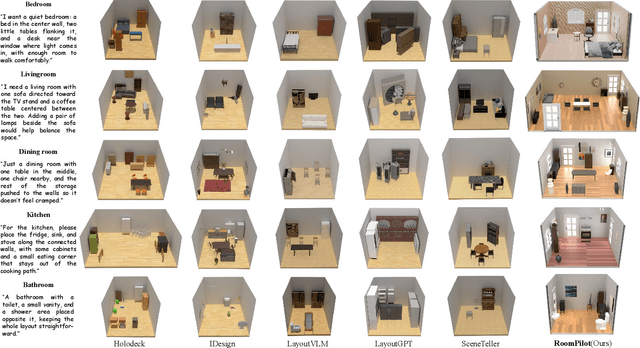
Generating controllable and interactive indoor scenes is fundamental to applications in game development, architectural visualization, and embodied AI training. Yet existing approaches either handle a narrow range of input modalities or rely on stochastic processes that hinder controllability. To overcome these limitations, we introduce RoomPilot, a unified framework that parses diverse multi-modal inputs--textual descriptions or CAD floor plans--into an Indoor Domain-Specific Language (IDSL) for indoor structured scene generation. The key insight is that a well-designed IDSL can act as a shared semantic representation, enabling coherent, high-quality scene synthesis from any single modality while maintaining interaction semantics. In contrast to conventional procedural methods that produce visually plausible but functionally inert layouts, RoomPilot leverages a curated dataset of interaction-annotated assets to synthesize environments exhibiting realistic object behaviors. Extensive experiments further validate its strong multi-modal understanding, fine-grained controllability in scene generation, and superior physical consistency and visual fidelity, marking a significant step toward general-purpose controllable 3D indoor scene generation.
LiNeXt: Revisiting LiDAR Completion with Efficient Non-Diffusion Architectures
Nov 13, 20253D LiDAR scene completion from point clouds is a fundamental component of perception systems in autonomous vehicles. Previous methods have predominantly employed diffusion models for high-fidelity reconstruction. However, their multi-step iterative sampling incurs significant computational overhead, limiting its real-time applicability. To address this, we propose LiNeXt-a lightweight, non-diffusion network optimized for rapid and accurate point cloud completion. Specifically, LiNeXt first applies the Noise-to-Coarse (N2C) Module to denoise the input noisy point cloud in a single pass, thereby obviating the multi-step iterative sampling of diffusion-based methods. The Refine Module then takes the coarse point cloud and its intermediate features from the N2C Module to perform more precise refinement, further enhancing structural completeness. Furthermore, we observe that LiDAR point clouds exhibit a distance-dependent spatial distribution, being densely sampled at proximal ranges and sparsely sampled at distal ranges. Accordingly, we propose the Distance-aware Selected Repeat strategy to generate a more uniformly distributed noisy point cloud. On the SemanticKITTI dataset, LiNeXt achieves a 199.8x speedup in inference, reduces Chamfer Distance by 50.7%, and uses only 6.1% of the parameters compared with LiDiff. These results demonstrate the superior efficiency and effectiveness of LiNeXt for real-time scene completion.
RWKV-PCSSC: Exploring RWKV Model for Point Cloud Semantic Scene Completion
Nov 13, 2025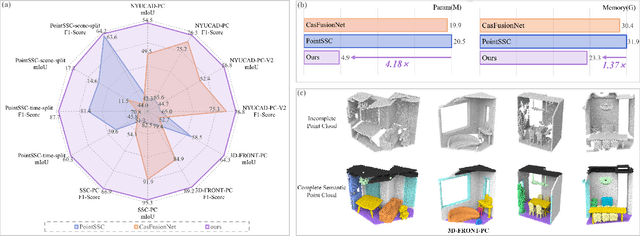

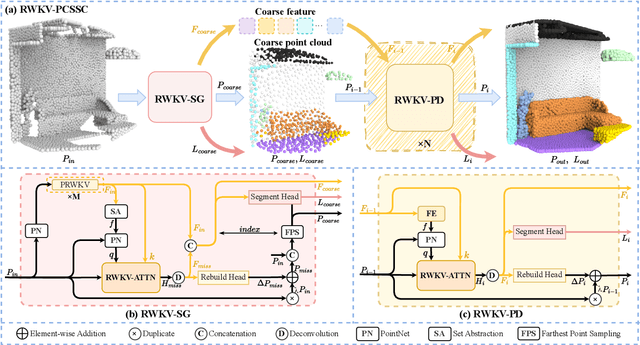
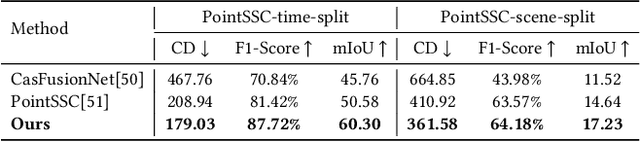
Semantic Scene Completion (SSC) aims to generate a complete semantic scene from an incomplete input. Existing approaches often employ dense network architectures with a high parameter count, leading to increased model complexity and resource demands. To address these limitations, we propose RWKV-PCSSC, a lightweight point cloud semantic scene completion network inspired by the Receptance Weighted Key Value (RWKV) mechanism. Specifically, we introduce a RWKV Seed Generator (RWKV-SG) module that can aggregate features from a partial point cloud to produce a coarse point cloud with coarse features. Subsequently, the point-wise feature of the point cloud is progressively restored through multiple stages of the RWKV Point Deconvolution (RWKV-PD) modules. By leveraging a compact and efficient design, our method achieves a lightweight model representation. Experimental results demonstrate that RWKV-PCSSC reduces the parameter count by 4.18$\times$ and improves memory efficiency by 1.37$\times$ compared to state-of-the-art methods PointSSC. Furthermore, our network achieves state-of-the-art performance on established indoor (SSC-PC, NYUCAD-PC) and outdoor (PointSSC) scene dataset, as well as on our proposed datasets (NYUCAD-PC-V2, 3D-FRONT-PC).
* 13 pages, 8 figures, published to ACM MM
Self-Supervised Point Cloud Completion based on Multi-View Augmentations of Single Partial Point Cloud
Sep 26, 2025Point cloud completion aims to reconstruct complete shapes from partial observations. Although current methods have achieved remarkable performance, they still have some limitations: Supervised methods heavily rely on ground truth, which limits their generalization to real-world datasets due to the synthetic-to-real domain gap. Unsupervised methods require complete point clouds to compose unpaired training data, and weakly-supervised methods need multi-view observations of the object. Existing self-supervised methods frequently produce unsatisfactory predictions due to the limited capabilities of their self-supervised signals. To overcome these challenges, we propose a novel self-supervised point cloud completion method. We design a set of novel self-supervised signals based on multi-view augmentations of the single partial point cloud. Additionally, to enhance the model's learning ability, we first incorporate Mamba into self-supervised point cloud completion task, encouraging the model to generate point clouds with better quality. Experiments on synthetic and real-world datasets demonstrate that our method achieves state-of-the-art results.
VLScene: Vision-Language Guidance Distillation for Camera-Based 3D Semantic Scene Completion
Mar 08, 2025Camera-based 3D semantic scene completion (SSC) provides dense geometric and semantic perception for autonomous driving. However, images provide limited information making the model susceptible to geometric ambiguity caused by occlusion and perspective distortion. Existing methods often lack explicit semantic modeling between objects, limiting their perception of 3D semantic context. To address these challenges, we propose a novel method VLScene: Vision-Language Guidance Distillation for Camera-based 3D Semantic Scene Completion. The key insight is to use the vision-language model to introduce high-level semantic priors to provide the object spatial context required for 3D scene understanding. Specifically, we design a vision-language guidance distillation process to enhance image features, which can effectively capture semantic knowledge from the surrounding environment and improve spatial context reasoning. In addition, we introduce a geometric-semantic sparse awareness mechanism to propagate geometric structures in the neighborhood and enhance semantic information through contextual sparse interactions. Experimental results demonstrate that VLScene achieves rank-1st performance on challenging benchmarks--SemanticKITTI and SSCBench-KITTI-360, yielding remarkably mIoU scores of 17.52 and 19.10, respectively.
Vision-based 3D Semantic Scene Completion via Capture Dynamic Representations
Mar 08, 2025The vision-based semantic scene completion task aims to predict dense geometric and semantic 3D scene representations from 2D images. However, the presence of dynamic objects in the scene seriously affects the accuracy of the model inferring 3D structures from 2D images. Existing methods simply stack multiple frames of image input to increase dense scene semantic information, but ignore the fact that dynamic objects and non-texture areas violate multi-view consistency and matching reliability. To address these issues, we propose a novel method, CDScene: Vision-based Robust Semantic Scene Completion via Capturing Dynamic Representations. First, we leverage a multimodal large-scale model to extract 2D explicit semantics and align them into 3D space. Second, we exploit the characteristics of monocular and stereo depth to decouple scene information into dynamic and static features. The dynamic features contain structural relationships around dynamic objects, and the static features contain dense contextual spatial information. Finally, we design a dynamic-static adaptive fusion module to effectively extract and aggregate complementary features, achieving robust and accurate semantic scene completion in autonomous driving scenarios. Extensive experimental results on the SemanticKITTI, SSCBench-KITTI360, and SemanticKITTI-C datasets demonstrate the superiority and robustness of CDScene over existing state-of-the-art methods.