 Add to Chrome
 Add to Firefox
 Add to Edge
Toward Efficient Membership Inference Attacks against Federated Large Language Models: A Projection Residual Approach
Apr 23, 2026
Federated Large Language Models (FedLLMs) enable multiple parties to collaboratively fine-tune LLMs without sharing raw data, addressing challenges of limited resources and privacy concerns. Despite data localization, shared gradients can still expose sensitive information through membership inference attacks (MIAs). However, FedLLMs' unique properties, i.e. massive parameter scales, rapid convergence, and sparse, non-orthogonal gradients, render existing MIAs ineffective. To address this gap, we propose ProjRes, the first projection residuals-based passive MIA tailored for FedLLMs. ProjRes leverages hidden embedding vectors as sample representations and analyzes their projection residuals on the gradient subspace to uncover the intrinsic link between gradients and inputs. It requires no shadow models, auxiliary classifiers, or historical updates, ensuring efficiency and robustness. Experiments on four benchmarks and four LLMs show that ProjRes achieves near 100% accuracy, outperforming prior methods by up to 75.75%, and remains effective even under strong differential privacy defenses. Our findings reveal a previously overlooked privacy vulnerability in FedLLMs and call for a re-examination of their security assumptions. Our code and data are available at $\href{https://anonymous.4open.science/r/Passive-MIA-5268}{link}$.

Privacy-Preserving Graph Neural Network Training and Inference as a Cloud Service
Feb 16, 2022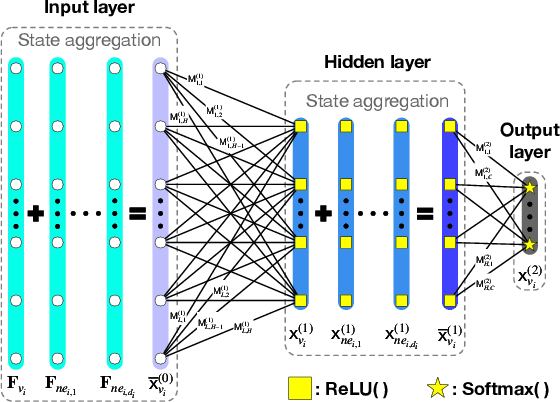
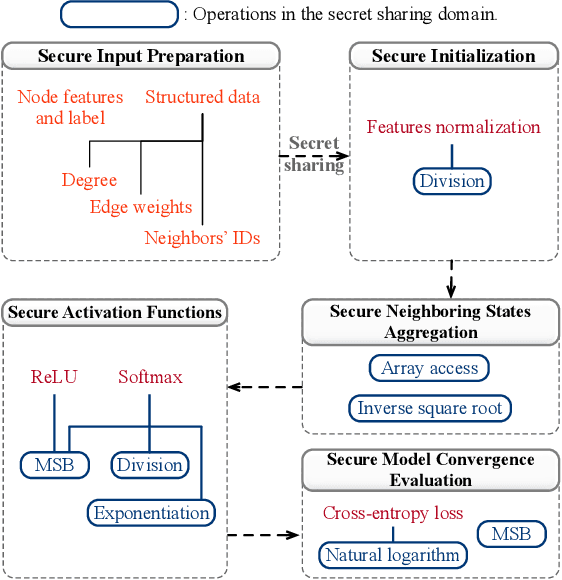

Graphs are widely used to model the complex relationships among entities. As a powerful tool for graph analytics, graph neural networks (GNNs) have recently gained wide attention due to its end-to-end processing capabilities. With the proliferation of cloud computing, it is increasingly popular to deploy the services of complex and resource-intensive model training and inference in the cloud due to its prominent benefits. However, GNN training and inference services, if deployed in the cloud, will raise critical privacy concerns about the information-rich and proprietary graph data (and the resulting model). While there has been some work on secure neural network training and inference, they all focus on convolutional neural networks handling images and text rather than complex graph data with rich structural information. In this paper, we design, implement, and evaluate SecGNN, the first system supporting privacy-preserving GNN training and inference services in the cloud. SecGNN is built from a synergy of insights on lightweight cryptography and machine learning techniques. We deeply examine the procedure of GNN training and inference, and devise a series of corresponding secure customized protocols to support the holistic computation. Extensive experiments demonstrate that SecGNN achieves comparable plaintext training and inference accuracy, with practically affordable performance.