 Add to Chrome
 Add to Firefox
 Add to Edge
$p^2$RAG: Privacy-Preserving RAG Service Supporting Arbitrary Top-$k$ Retrieval
Mar 16, 2026
Retrieval-Augmented Generation (RAG) enables large language models to use external knowledge, but outsourcing the RAG service raises privacy concerns for both data owners and users. Privacy-preserving RAG systems address these concerns by performing secure top-$k$ retrieval, which typically is secure sorting to identify relevant documents. However, existing systems face challenges supporting arbitrary $k$ due to their inability to change $k$, new security issues, or efficiency degradation with large $k$. This is a significant limitation because modern long-context models generally achieve higher accuracy with larger retrieval sets. We propose $p^2$RAG, a privacy-preserving RAG service that supports arbitrary top-$k$ retrieval. Unlike existing systems, $p^2$RAG avoids sorting candidate documents. Instead, it uses an interactive bisection method to determine the set of top-$k$ documents. For security, $p^2$RAG uses secret sharing on two semi-honest non-colluding servers to protect the data owner's database and the user's prompt. It enforces restrictions and verification to defend against malicious users and tightly bound the information leakage of the database. The experiments show that $p^2$RAG is 3--300$\times$ faster than the state-of-the-art PRAG for $k = 16$--$1024$.

CAT: Contrastive Adversarial Training for Evaluating the Robustness of Protective Perturbations in Latent Diffusion Models
Feb 11, 2025Latent diffusion models have recently demonstrated superior capabilities in many downstream image synthesis tasks. However, customization of latent diffusion models using unauthorized data can severely compromise the privacy and intellectual property rights of data owners. Adversarial examples as protective perturbations have been developed to defend against unauthorized data usage by introducing imperceptible noise to customization samples, preventing diffusion models from effectively learning them. In this paper, we first reveal that the primary reason adversarial examples are effective as protective perturbations in latent diffusion models is the distortion of their latent representations, as demonstrated through qualitative and quantitative experiments. We then propose the Contrastive Adversarial Training (CAT) utilizing adapters as an adaptive attack against these protection methods, highlighting their lack of robustness. Extensive experiments demonstrate that our CAT method significantly reduces the effectiveness of protective perturbations in customization configurations, urging the community to reconsider and enhance the robustness of existing protective perturbation methods. Code is available at \hyperlink{here}{https://github.com/senp98/CAT}.
Protective Perturbations against Unauthorized Data Usage in Diffusion-based Image Generation
Dec 25, 2024
Diffusion-based text-to-image models have shown immense potential for various image-related tasks. However, despite their prominence and popularity, customizing these models using unauthorized data also brings serious privacy and intellectual property issues. Existing methods introduce protective perturbations based on adversarial attacks, which are applied to the customization samples. In this systematization of knowledge, we present a comprehensive survey of protective perturbation methods designed to prevent unauthorized data usage in diffusion-based image generation. We establish the threat model and categorize the downstream tasks relevant to these methods, providing a detailed analysis of their designs. We also propose a completed evaluation framework for these perturbation techniques, aiming to advance research in this field.
Embedding Watermarks in Diffusion Process for Model Intellectual Property Protection
Oct 29, 2024

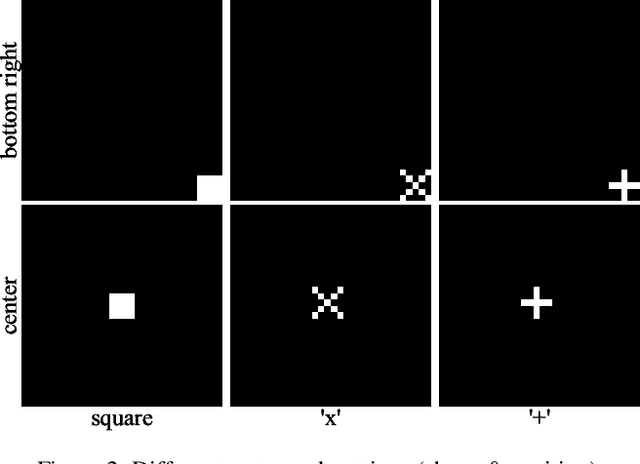
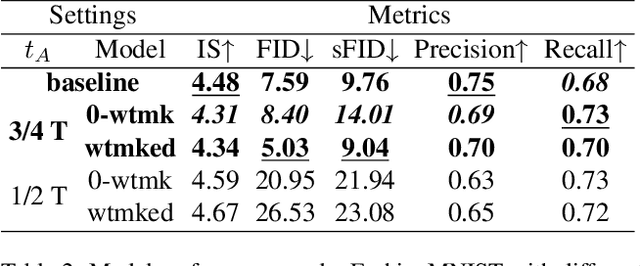
In practical application, the widespread deployment of diffusion models often necessitates substantial investment in training. As diffusion models find increasingly diverse applications, concerns about potential misuse highlight the imperative for robust intellectual property protection. Current protection strategies either employ backdoor-based methods, integrating a watermark task as a simpler training objective with the main model task, or embedding watermarks directly into the final output samples. However, the former approach is fragile compared to existing backdoor defense techniques, while the latter fundamentally alters the expected output. In this work, we introduce a novel watermarking framework by embedding the watermark into the whole diffusion process, and theoretically ensure that our final output samples contain no additional information. Furthermore, we utilize statistical algorithms to verify the watermark from internally generated model samples without necessitating triggers as conditions. Detailed theoretical analysis and experimental validation demonstrate the effectiveness of our proposed method.