 Add to Chrome
 Add to Firefox
 Add to Edge
Boosting Robustness for All-Weather Self-Supervised Depth Estimation in Autonomous Driving
Jul 23, 2026
Self-supervised depth estimation is challenging for safe autonomous driving under various adverse weather conditions due to sensor perception degradation. These challenges arise from two main aspects. Firstly, adverse conditions can distort pixel correspondences and violate the assumptions embedded in the self-supervised loss function, leading to erroneous depth predictions. Secondly, while radar is a widely adopted sensor in adverse weather conditions, the sparse distribution of radar points in the Point of View (POV) poses challenges for self-supervised fusion. To address these issues, we introduce a novel self-training pipeline using unpaired real all-weather data through multi-teacher distillation and robust radar fusion. We propose the Uncertainty-Aware Multi-Teacher Distillation method to generate diverse teacher models with different adverse condition inputs, and then employ uncertainty modeling to weigh the knowledge distillation loss. Additionally, we design the POV-BEV Radar Fusion approach, which leverages camera-pixel ray constraints to establish connections between the camera's Point of View (POV) and the radar's Bird's-Eye View (BEV). This approach enables the utilization of denser radar points, effectively capturing the complementary perspectives of both POV and BEV. Extensive quantitative and qualitative experiments demonstrate the robustness of our proposed method on all-weather datasets, achieving state-of-the-art performance. Our code and models are available at https://github.com/MICLAB-BUPT/RobustDepth.

CritiqueDriveVLM: From Verifier-Guided Reinforcement Learning to Latent Thought Distillation for Autonomous Driving
Jul 05, 2026End-to-end Vision-Language Models (VLMs) show immense potential in autonomous driving. However, standard Supervised Fine-Tuning (SFT) often suffers from reasoning hallucinations and conservative biases. While traditional tool-augmented frameworks and Chain-of-Thought (CoT) approaches mitigate these issues, they incur exorbitant token consumption and unacceptable latency, rendering real-time deployment impractical. To resolve this reliability-efficiency trade-off, we propose CritiqueDriveVLM, a novel unified three-stage framework internalizing reasoning directly into the VLM. First, we introduce Critique-Driven Multi-Turn Reinforcement Learning (RL) guided by a multi-dimensional verifier. By providing granular scalar feedback and a multi-turn penalty, we force the policy to internalize logical deduction, cultivating a robust System-2 Teacher that achieves high accuracy without fragile external tools. Subsequently, we propose Latent Thought Distillation to overcome the latency bottleneck. By aligning the Student's latent representations with the Teacher's fully converged reasoning states, we compress deep logical capabilities into a fast, CoT-free System-1 Student. Extensive experiments on the widely-used DriveLMM-01 benchmark demonstrate remarkable improvements. Compared to the base model, our tool-free Teacher significantly boosts Multiple Choice Quality (MCQ) from 55.54% to a state-of-the-art 76.54%. Crucially, our distilled Student preserves competitive reasoning depth while drastically minimizing generation length to an average of merely 28 tokens. This slashes inference latency by 88% (from 3482 ms to 416 ms), paving a highly robust pathway for low-latency autonomous driving.Our source code is available at https://github.com/MICLAB-BUPT/CritiqueDriveVLM.
SketchKeyAnime: Reference-anchored Sparse Key-Sketch Animation Synthesis
Jun 18, 2026Traditional animation production relies heavily on manual drawing and iterative refinement, particularly for key-pose design, in-betweening, and character coloring. While existing animation and video generation methods have made notable progress, they typically depend on RGB boundary frames, dense frame-wise conditions, or complete sketch sequences, limiting their applicability under low-cost input conditions. We present SketchKeyAnime, a video diffusion framework for generating structurally controllable, appearance-consistent, and temporally coherent animations from sparse key-sketch inputs. Given a single reference RGB image and a few temporally indexed key sketches, SketchKeyAnime introduces a dual-branch conditioning mechanism to encode local geometric constraints alongside semantic-temporal context. It leverages Sketch Cross Attention to fuse reference image and sketch conditions with learnable gating, and incorporates an Adaptive Weighted Loss to strengthen supervision on key-sketch frames and line-art regions. Experimental results on the Aesthetic subset of Sakuga-42M show that our approach consistently outperforms representative animation interpolation and sketch-guided generation baselines. Compared to the best-performing baseline, SketchKeyAnime reduces EDMD by 31.9\% and FVD by 9.5\%, demonstrating superior sketch fidelity and temporal coherence, while achieving the best overall performance across most quantitative metrics. These results validate the proposed framework and highlight its potential for low-cost, highly controllable animation creation.
SGFormer++: Semantic Graph Transformer for Incremental 3D Scene Graph Generation
Jun 13, 2026In this paper, we propose SGFormer++, a novel Semantic Graph Transformer for 3D scene graph generation (SGG), which aims to parse point cloud scenes into semantic structural graphs, where nodes denote detected object instances and edges encode their pairwise relationships, with the core challenge lying in modeling complex global scene structure. While existing graph convolutional network (GCN)-based methods suffer from over-smoothing and limited receptive fields, SGFormer++ leverages Transformer layers as its backbone to enable global message passing. Specifically, we introduce two key components tailored for 3D SGG: (1) a Graph Embedding Layer++ that efficiently integrates edge-aware global context with linear computational complexity, and (2) a Semantic Injection Layer++ that enriches visual features with linguistic priors from large language models (LLMs) and vision-language models (VLMs), boosting semantic representation without introducing extra trainable parameters. To further address the practical challenge of incremental SGG (I-SGG), where new relationship categories arrive sequentially, we equip SGFormer++ with a novel Spatial-guided Feature Adapter, which calibrates predicate features using subject-object spatial geometry to counter scale variation, and a Cascaded Binary Prediction Head that mitigates catastrophic forgetting via task-incremental classifier expansion and logit distillation. Extensive experiments on the 3DSSG benchmark demonstrate that SGFormer++ achieves state-of-the-art performance in both standard and incremental settings: it yields a significant 4.49% absolute improvement in Predicate A@1 under the incremental setting. Code and data are available at: https://github.com/Andy20178/SGFormer.
LASA: A Weak Supervision Method for Open-Vocabulary Scene Sketch Semantic Segmentation
Jun 10, 2026Open-vocabulary scene sketch semantic segmentation aims to assign dense semantic labels to sparse line drawings based on flexible category vocabularies specified at inference time, without relying on pixel-level annotations during training. Unlike natural images, sketches lack texture and color cues, making semantic understanding heavily dependent on stroke layout and spatial configuration, a challenge that renders single-layer vision-language features inherently unstable. Our key observation is that attention maps from different Vision Transformer layers encode complementary spatial cues: shallow layers capture global structural layouts, while deeper layers focus on local stroke intersections and object parts. This suggests that cross-layer aggregation provides a more robust structural prior than any individual layer alone. Leveraging this insight, we propose a structure-aware framework built upon \textbf{L}ayer-wise \textbf{A}ccumulated \textbf{S}tructural \textbf{A}ttention (\textbf{LASA}), which aggregates multi-layer attention to guide hierarchical semantic alignment under weak supervision and refine predictions during inference. Experiments on FS-COCO, SFSD, and FrISS show that LASA improves mIoU by $+3.43$, $+8.01$, and $+15.74$ over the prior weakly supervised baselines, demonstrating consistent gains in both segmentation accuracy and spatial coherence. Our source code will be made publicly available.
Global-Local Monte Carlo Tree Search in Vision-Language Models for Text-to-3D Indoor Scene Generation
Jun 04, 2026Large Vision-Language Models have achieved significant reasoning performance in various tasks.However, there are few studies on text-to-3D indoor scene generation with LVLMs. The main challenge is that prevailing LVLM-based methods employ chain-of-thought sequential decision mechanisms that cannot revise earlier decisions, causing error propagation.In this paper, we consider the task as a planning problem constrained by spatial and layout commonsense.To solve this problem, we model it as a tree search problem with global and local trees, which differs from existing sequential decision-making approaches.In the global tree, we place each object iteratively and explore multiple attempts like humans furnishing a room, where the problem space is represented as a tree.To effectively search the tree, we propose a hierarchical scene representation and a PRM-guided MCTS method.The hierarchical representation abstracts a scene into room level, region level, floor object level, and supported object level.The PRM-guided MCTS method uses the PRM to prune unnecessary branches and the MCTS algorithm to balance exploration and exploitation to get an optimal solution with fewer attempts.In the local tree, it further decomposes the placement of each object into finer sub-steps, including the specific placement parameters.To make the whole appearance of the scene consistent, we leverage pre-trained diffusion image generative models to predict textures for all the objects in the scene.As existing benchmarks for text-to-3D indoor scene generation remain limited in scale and diversity, we collect a new large-scale diverse dataset that contains 65 scene types and 3,250 instructions with diverse sizes, layouts, and styles, named 3DTindo-bench, to better assess the capability of the state-of-the-art models. Our experiments show that our method generates more realistic 3D scenes than state-of-the-art approaches.
Active Exploring like a Pigeon: Reinforcing Spatial Reasoning via Agentic Vision-Language Models
Jun 01, 2026Enabling Vision-Language Models (VLMs) to perform spatial reasoning remains challenging. Existing approaches treat VLMs as passive observers, which is difficult for real-world applications. Moreover, reinforcement learning methods rely on sparse rewards, limiting their effectiveness for complex reasoning tasks. Inspired by pigeons' building and exploiting cognitive maps for navigation, we propose a novel agentic pipeline for spatial reasoning. First, we introduce a new \emph{dynamic cognitive map} parameterizing scene layout as object positions and orientations, serving as persistent memory for new observations. Second, we propose a novel \emph{Spatial Assertion Codes (SAC)}, Python expressions programmatically describing spatial relationships. By collaborating with the dynamic cognitive map, SAC enables verification of intermediate reasoning steps, providing dense reward signals. We optimize the model via supervised and reinforcement finetuning. Experiments on the MindCube benchmark demonstrate state-of-the-art performance with \emph{80.5\%} overall accuracy, outperforming the best current method by \emph{29.5} accuracy points (a relative improvement of \emph{53.2\%}) on the challenging \textsc{Rotation} subset. Our code and data are open-sourced at https://github.com/dw-dengwei/active-spatial-reasoning.git.
TimeWeaver: Age-Consistent Reference-Based Face Restoration with Identity Preservation
Mar 24, 2026Recent progress in face restoration has shifted from visual fidelity to identity fidelity, driving a transition from reference-free to reference-based paradigms that condition restoration on reference images of the same person. However, these methods assume the reference and degraded input are age-aligned. When only cross-age references are available, as in historical restoration or missing-person retrieval, they fail to maintain age fidelity. To address this limitation, we propose TimeWeaver, the first reference-based face restoration framework supporting cross-age references. Given arbitrary reference images and a target-age prompt, TimeWeaver produces restorations with both identity fidelity and age consistency. Specifically, we decouple identity and age conditioning across training and inference. During training, the model learns an age-robust identity representation by fusing a global identity embedding with age-suppressed facial tokens via a transformer-based ID-Fusion module. During inference, two training-free techniques, Age-Aware Gradient Guidance and Token-Targeted Attention Boost, steer sampling toward desired age semantics, enabling precise adherence to the target-age prompt. Extensive experiments show that TimeWeaver surpasses existing methods in visual quality, identity preservation, and age consistency.
MeInTime: Bridging Age Gap in Identity-Preserving Face Restoration
Mar 19, 2026To better preserve an individual's identity, face restoration has evolved from reference-free to reference-based approaches, which leverage high-quality reference images of the same identity to enhance identity fidelity in the restored outputs. However, most existing methods implicitly assume that the reference and degraded input are age-aligned, limiting their effectiveness in real-world scenarios where only cross-age references are available, such as historical photo restoration. This paper proposes MeInTime, a diffusion-based face restoration method that extends reference-based restoration from same-age to cross-age settings. Given one or few reference images along with an age prompt corresponding to the degraded input, MeInTime achieves faithful restoration with both identity fidelity and age consistency. Specifically, we decouple the modeling of identity and age conditions. During training, we focus solely on effectively injecting identity features through a newly introduced attention mechanism and introduce Gated Residual Fusion modules to facilitate the integration between degraded features and identity representations. At inference, we propose Age-Aware Gradient Guidance, a training-free sampling strategy, using an age-driven direction to iteratively nudge the identity-aware denoising latent toward the desired age semantic manifold. Extensive experiments demonstrate that MeInTime outperforms existing face restoration methods in both identity preservation and age consistency. Our code is available at: https://github.com/teer4/MeInTime
Explainable Action Form Assessment by Exploiting Multimodal Chain-of-Thoughts Reasoning
Dec 17, 2025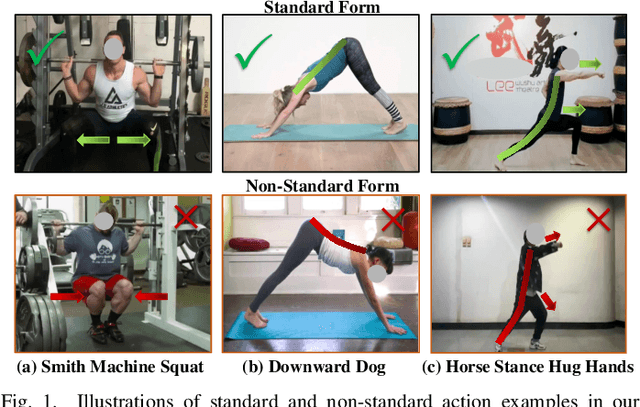
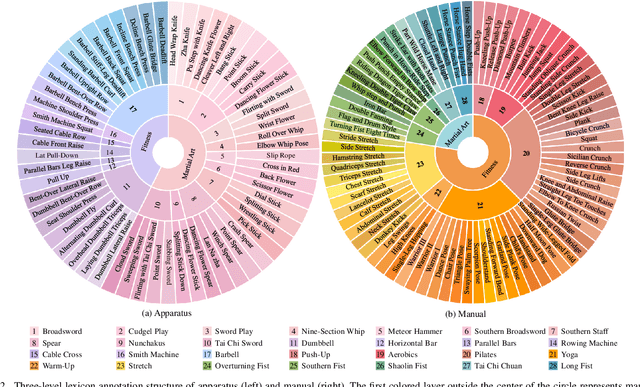

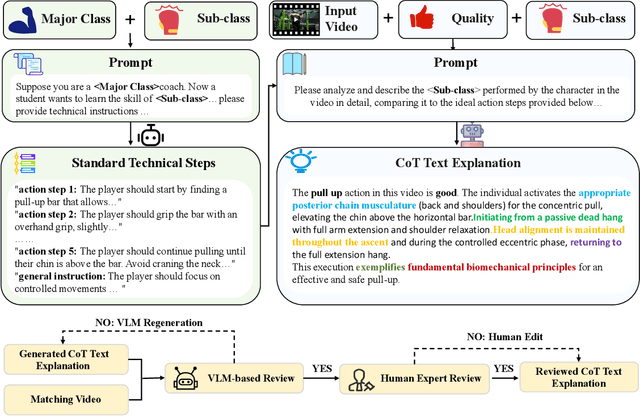
Evaluating whether human action is standard or not and providing reasonable feedback to improve action standardization is very crucial but challenging in real-world scenarios. However, current video understanding methods are mainly concerned with what and where the action is, which is unable to meet the requirements. Meanwhile, most of the existing datasets lack the labels indicating the degree of action standardization, and the action quality assessment datasets lack explainability and detailed feedback. Therefore, we define a new Human Action Form Assessment (AFA) task, and introduce a new diverse dataset CoT-AFA, which contains a large scale of fitness and martial arts videos with multi-level annotations for comprehensive video analysis. We enrich the CoT-AFA dataset with a novel Chain-of-Thought explanation paradigm. Instead of offering isolated feedback, our explanations provide a complete reasoning process--from identifying an action step to analyzing its outcome and proposing a concrete solution. Furthermore, we propose a framework named Explainable Fitness Assessor, which can not only judge an action but also explain why and provide a solution. This framework employs two parallel processing streams and a dynamic gating mechanism to fuse visual and semantic information, thereby boosting its analytical capabilities. The experimental results demonstrate that our method has achieved improvements in explanation generation (e.g., +16.0% in CIDEr), action classification (+2.7% in accuracy) and quality assessment (+2.1% in accuracy), revealing great potential of CoT-AFA for future studies. Our dataset and source code is available at https://github.com/MICLAB-BUPT/EFA.