 Add to Chrome
 Add to Firefox
 Add to Edge
VTO: Visual Tool Orchestration for Video Anomaly Detection
Aug 08, 2026
Video anomaly detection (VAD) is a critical yet challenging task due to the complex and diverse nature of real-world scenarios. Traditional deep learning approaches are fundamentally limited by poor generalization across diverse scenarios. While multimodal agents offer a promising tool-learning paradigm for VAD, current systems relying on supervised fine-tuning struggle with complex orchestration, and standard reinforcement learning often causes premature termination due to coarse-grained outcome rewards. To address these challenges, we propose VTO, a process-supervised reinforcement learning framework. Moving beyond static tool usage, VTO enables the agent to dynamically explore and interact with the environment. Specifically, we introduce a foundation model-driven cognitive evaluator to provide context-aware semantic feedback, which is seamlessly integrated into a Process-Supervised Cognitive Alignment that delivers fine-grained, step-wise supervision. By explicitly penalizing logical truncation and rewarding complete causal chains, the agent optimizes its multi-step reasoning policy for interrelated tool orchestration. To support our proposed framework, we meticulously crafted VAD-Tool, a hierarchical visual tool set comprising 12 specialized vision tools spanning from entity tracking to high-stakes hazard detection, and established the corresponding benchmark for rigorous multi-step reasoning evaluation. Extensive experiments on VAD-Tool demonstrate that VTO significantly outperforms baselines, achieving up to a 10.2\% absolute accuracy improvement in tool scheduling. Code and data are available at https://github.com/MICLAB-BUPT/VTO.

Explainable Action Form Assessment by Exploiting Multimodal Chain-of-Thoughts Reasoning
Dec 17, 2025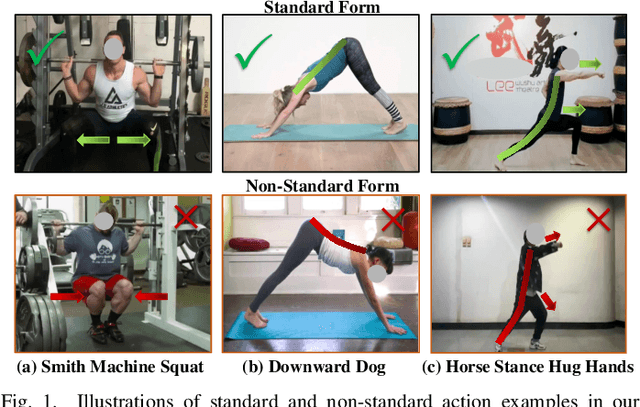
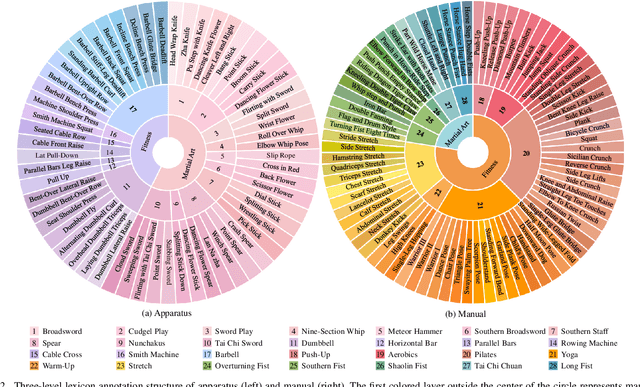

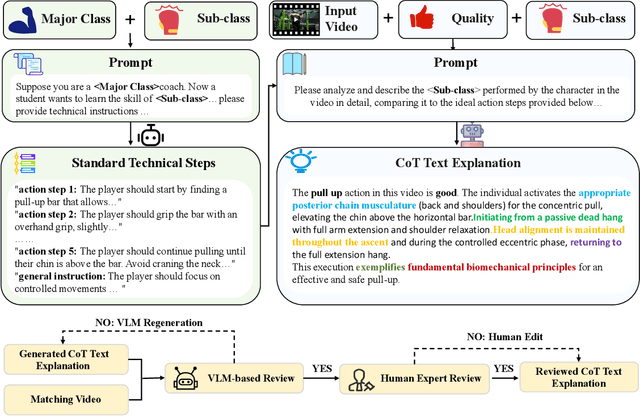
Evaluating whether human action is standard or not and providing reasonable feedback to improve action standardization is very crucial but challenging in real-world scenarios. However, current video understanding methods are mainly concerned with what and where the action is, which is unable to meet the requirements. Meanwhile, most of the existing datasets lack the labels indicating the degree of action standardization, and the action quality assessment datasets lack explainability and detailed feedback. Therefore, we define a new Human Action Form Assessment (AFA) task, and introduce a new diverse dataset CoT-AFA, which contains a large scale of fitness and martial arts videos with multi-level annotations for comprehensive video analysis. We enrich the CoT-AFA dataset with a novel Chain-of-Thought explanation paradigm. Instead of offering isolated feedback, our explanations provide a complete reasoning process--from identifying an action step to analyzing its outcome and proposing a concrete solution. Furthermore, we propose a framework named Explainable Fitness Assessor, which can not only judge an action but also explain why and provide a solution. This framework employs two parallel processing streams and a dynamic gating mechanism to fuse visual and semantic information, thereby boosting its analytical capabilities. The experimental results demonstrate that our method has achieved improvements in explanation generation (e.g., +16.0% in CIDEr), action classification (+2.7% in accuracy) and quality assessment (+2.1% in accuracy), revealing great potential of CoT-AFA for future studies. Our dataset and source code is available at https://github.com/MICLAB-BUPT/EFA.