 Add to Chrome
 Add to Firefox
 Add to Edge
AdaForensics: Learning A Characteristic-aware Adaptive Deepfake Detector
Aug 03, 2026
In this paper, we propose a characteristic-aware adaptive network named AdaForensics for deepfake detection. Most existing methods learn a fixed network to detect deepfakes based on carefully-designed network architectures. However, these methods employ the same deepfake detector for all the images despite of various facial characteristic, which fail to provide customized forgery detection for different individuals. To address this, our AdaForensics simultaneously learns characteristic-agnostic and characteristic-specific embeddings, where the detector dynamically adapts to varying faces with our designed hypernetwork on the fly. More specifically, our AdaForensics not only explores the shareable abstractions from various deepfake images, but also adapts the detector to the given characteristic at test time. To achieve this, we propose a two-branch HyperNetwork to learn an adaptive deepfake detector, which automatically adjusts the parameters based on characteristic of the input. Extensive experiments on widely-used datasets including FaceForensics, Celeb-DF and DFDC demonstrate our AdaForensics outperforms the state-of-the-art works.

The Easy, the Hard, and the Learnable: Confidence and Difficulty-Adaptive Policy Optimization for LLM Reasoning
Jun 06, 2026RL with verifiable rewards can substantially improve LLM reasoning, yet standard GRPO-style training often treats easy, hard, and learnable questions alike through uniform sampling and weighting, leading to inefficient compute allocation. We study GRPO by tracking token log-probabilities, group-normalized advantages, and the induced token-level update weights. This reveals three recurring dynamics as training proceeds: (1) confidence inflation, (2) advantage contraction, and (3) hierarchical convergence. These findings suggest that the utility of each update depends strongly on both question difficulty and the model's current competence. Motivated by this, we propose Confidence and Difficulty-adaptive Policy Optimization (CoDaPO), which assigns each question a bounded value from rollout confidence and empirical difficulty. CoDaPO then uses this value to reweight policy updates and resample high-value learnable questions within mini-batches, thereby increasing discovery within the learnable band under a fixed compute budget. Across twelve benchmarks, CoDaPO consistently improves accuracy over existing RL methods. Our code is publicly available at https://github.com/tmlr-group/CoDaPO.
Cosmos 3: Omnimodal World Models for Physical AI
Jun 01, 2026We introduce Cosmos 3, a family of omnimodal world models designed to jointly process and generate language, image, video, audio, and action sequences within a unified mixture-of-transformers architecture. By supporting highly flexible input-output configurations, Cosmos 3 seamlessly unifies critical modalities for Physical AI -- effectively subsuming vision-language models, video generators, world simulators, and world-action models into a single framework. Our evaluation demonstrates that Cosmos 3 establishes a new state-of-the-art across a diverse suite of understanding and generation tasks, demonstrating omnimodal world models as scalable, general-purpose backbones for embodied agents. Our post-trained Cosmos 3 models were ranked as the best open-source Text-to-Image and Image-to-Video models by Artificial Analysis, and the best policy model by RoboArena at the time the technical report was written. To accelerate open research and deployment in Physical AI, we make our code, model checkpoints, curated synthetic datasets, and evaluation benchmark available under the Linux Foundation's OpenMDW-1.1 https://openmdw.ai/license/1-1/ License at https://github.com/nvidia/cosmos}{github.com/nvidia/cosmos and https://huggingface.co/collections/nvidia/cosmos3 . The project website is available at https://research.nvidia.com/labs/cosmos-lab/cosmos3 .
NTIRE 2025 Challenge on Day and Night Raindrop Removal for Dual-Focused Images: Methods and Results
Apr 19, 2025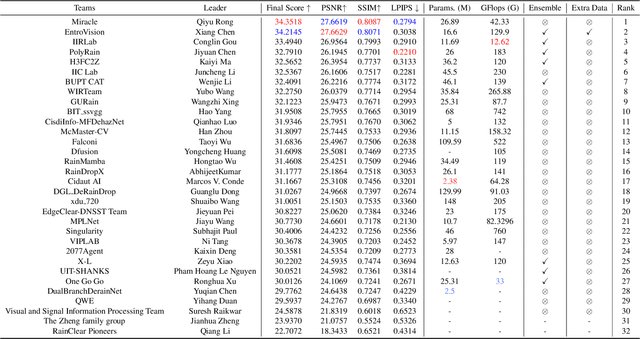
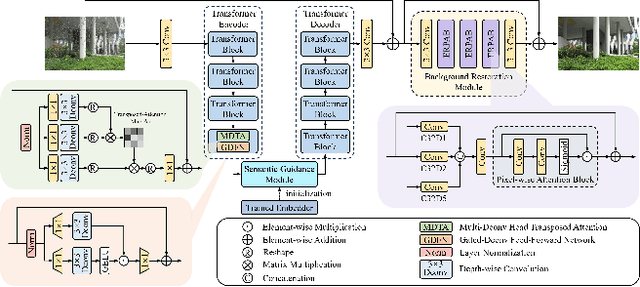
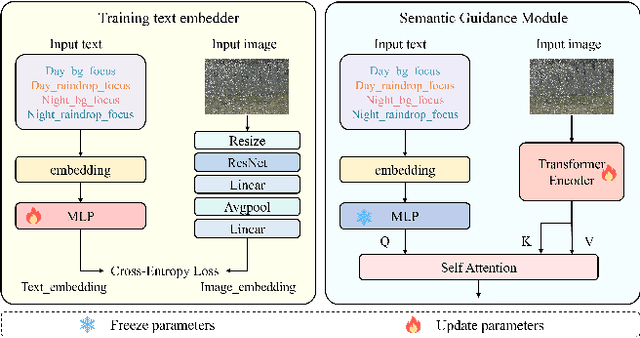
This paper reviews the NTIRE 2025 Challenge on Day and Night Raindrop Removal for Dual-Focused Images. This challenge received a wide range of impressive solutions, which are developed and evaluated using our collected real-world Raindrop Clarity dataset. Unlike existing deraining datasets, our Raindrop Clarity dataset is more diverse and challenging in degradation types and contents, which includes day raindrop-focused, day background-focused, night raindrop-focused, and night background-focused degradations. This dataset is divided into three subsets for competition: 14,139 images for training, 240 images for validation, and 731 images for testing. The primary objective of this challenge is to establish a new and powerful benchmark for the task of removing raindrops under varying lighting and focus conditions. There are a total of 361 participants in the competition, and 32 teams submitting valid solutions and fact sheets for the final testing phase. These submissions achieved state-of-the-art (SOTA) performance on the Raindrop Clarity dataset. The project can be found at https://lixinustc.github.io/CVPR-NTIRE2025-RainDrop-Competition.github.io/.
LoRA-drop: Efficient LoRA Parameter Pruning based on Output Evaluation
Feb 12, 2024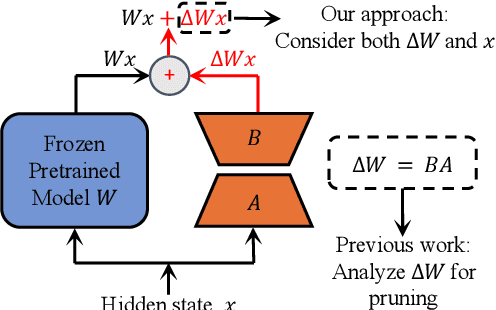
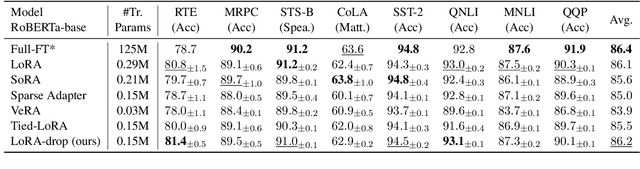
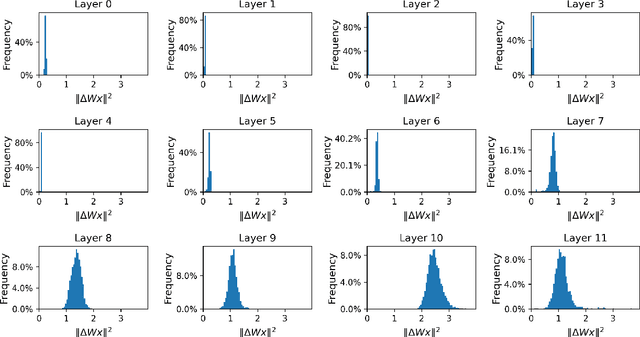
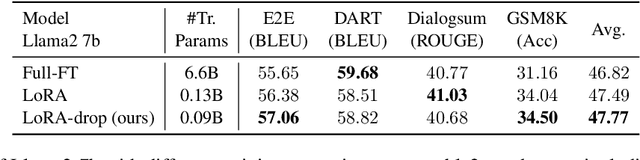
Low-Rank Adaptation (LoRA) introduces auxiliary parameters for each layer to fine-tune the pre-trained model under limited computing resources. But it still faces challenges of resource consumption when scaling up to larger models. Previous studies employ pruning techniques by evaluating the importance of LoRA parameters for different layers to address the problem. However, these efforts only analyzed parameter features to evaluate their importance. Indeed, the output of LoRA related to the parameters and data is the factor that directly impacts the frozen model. To this end, we propose LoRA-drop which evaluates the importance of the parameters by analyzing the LoRA output. We retain LoRA for important layers and the LoRA of the other layers share the same parameters. Abundant experiments on NLU and NLG tasks demonstrate the effectiveness of LoRA-drop.