 Add to Chrome
 Add to Firefox
 Add to Edge
UniSHARP: Universal Sharp Monocular View Synthesis
Jun 05, 2026
In this work, we focus on extending SHARP, the popular photorealistic view synthesis method, for universal monocular rendering across a continuum of camera systems, from conventional perspective cameras to wide-field-of-view, fisheye and omnidirectional panoramic settings. To overcome the pinhole-specific assumptions of SHARP, our key idea is to align various images in a unified omnidirectional latent space. Thus, we propose UniSHARP, which performs implicit alignment in both feature and Gaussian spaces. Specifically, Gaussian primitives are arranged along rays and radial distances in a ray-based universal representation, while 2D semantic and 3D spatial features extracted from UniK3D-inspired encoders are jointly decoded to generate the complete Gaussian cloud. To comprehensively evaluate our method, we construct a benchmark covering diverse imaging systems across various scenes. The benchmark is further stratified by field of view (FoV) to enable fine-grained assessment of the universal monocular rendering task. Extensive experiments on the proposed benchmark demonstrate the effectiveness of UniSHARP, outperforming alternative methods by a large margin. The project page can be found at: https://insta360-research-team.github.io/Unisharp-website/

NTIRE 2026 3D Restoration and Reconstruction in Real-world Adverse Conditions: RealX3D Challenge Results
Apr 05, 2026This paper presents a comprehensive review of the NTIRE 2026 3D Restoration and Reconstruction (3DRR) Challenge, detailing the proposed methods and results. The challenge seeks to identify robust reconstruction pipelines that are robust under real-world adverse conditions, specifically extreme low-light and smoke-degraded environments, as captured by our RealX3D benchmark. A total of 279 participants registered for the competition, of whom 33 teams submitted valid results. We thoroughly evaluate the submitted approaches against state-of-the-art baselines, revealing significant progress in 3D reconstruction under adverse conditions. Our analysis highlights shared design principles among top-performing methods and provides insights into effective strategies for handling 3D scene degradation.
Depth Any Panoramas: A Foundation Model for Panoramic Depth Estimation
Dec 18, 2025
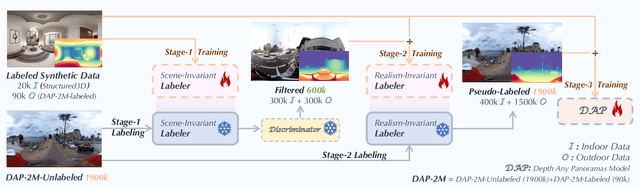
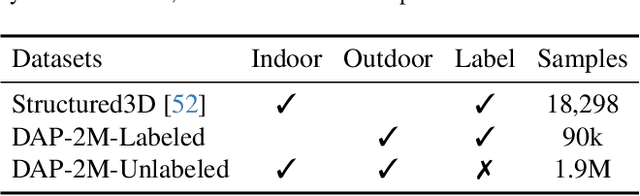
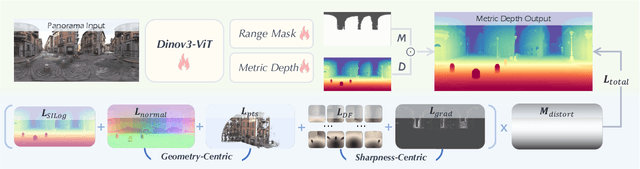
In this work, we present a panoramic metric depth foundation model that generalizes across diverse scene distances. We explore a data-in-the-loop paradigm from the view of both data construction and framework design. We collect a large-scale dataset by combining public datasets, high-quality synthetic data from our UE5 simulator and text-to-image models, and real panoramic images from the web. To reduce domain gaps between indoor/outdoor and synthetic/real data, we introduce a three-stage pseudo-label curation pipeline to generate reliable ground truth for unlabeled images. For the model, we adopt DINOv3-Large as the backbone for its strong pre-trained generalization, and introduce a plug-and-play range mask head, sharpness-centric optimization, and geometry-centric optimization to improve robustness to varying distances and enforce geometric consistency across views. Experiments on multiple benchmarks (e.g., Stanford2D3D, Matterport3D, and Deep360) demonstrate strong performance and zero-shot generalization, with particularly robust and stable metric predictions in diverse real-world scenes. The project page can be found at: \href{https://insta360-research-team.github.io/DAP_website/} {https://insta360-research-team.github.io/DAP\_website/}