 Add to Chrome
 Add to Firefox
 Add to Edge
Utilizing Improper Gaussian Signaling for Downlink Rate-Splitting Multiple Access with Imperfect Successive Interference Cancellation
Apr 16, 2026
To mitigate the residual interference from imperfect successive interference cancellation (SIC) in Rate-Splitting Multiple Access (RSMA), this paper incorporates improper Gaussian signaling (IGS) into the downlink RSMA framework. Unlike existing RSMA--IGS works that embed impropriety within IQ-imbalanced frameworks, we show that IGS alone effectively counters SIC-induced residual interference. For a basic SISO setup with IGS on the common stream and PGS on private streams, we establish three key results: the optimal impropriety degree for private rate maximization attains its maximum; closed-form optimal solutions with rigorous monotonicity conditions are derived for common rate maximization; and a soft actor-critic (SAC) algorithm is developed for the non-convex sum rate problem. Numerical results show that IGS consistently outperforms PGS, with the gain widening as SIC imperfection increases.

ASFD: Automatic and Scalable Face Detector
Mar 31, 2020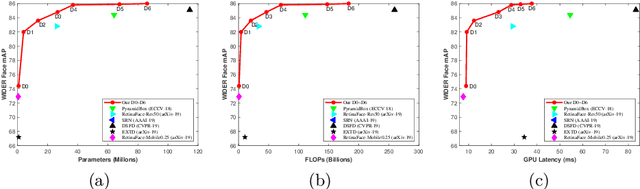
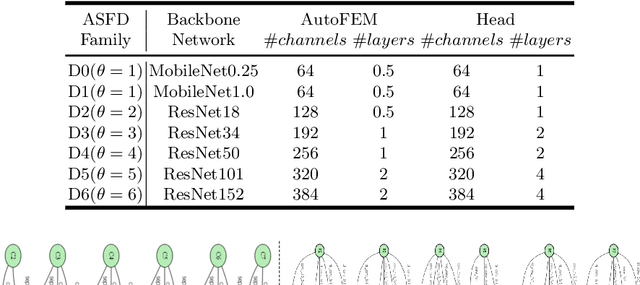
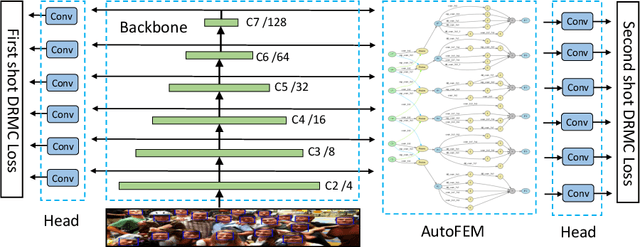
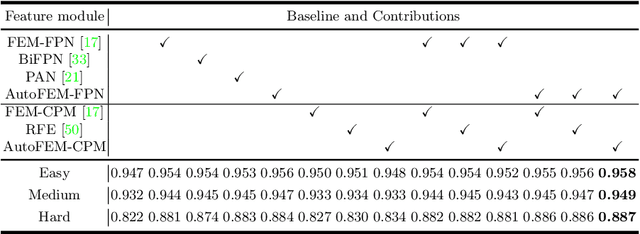
In this paper, we propose a novel Automatic and Scalable Face Detector (ASFD), which is based on a combination of neural architecture search techniques as well as a new loss design. First, we propose an automatic feature enhance module named Auto-FEM by improved differential architecture search, which allows efficient multi-scale feature fusion and context enhancement. Second, we use Distance-based Regression and Margin-based Classification (DRMC) multi-task loss to predict accurate bounding boxes and learn highly discriminative deep features. Third, we adopt compound scaling methods and uniformly scale the backbone, feature modules, and head networks to develop a family of ASFD, which are consistently more efficient than the state-of-the-art face detectors. Extensive experiments conducted on popular benchmarks, e.g. WIDER FACE and FDDB, demonstrate that our ASFD-D6 outperforms the prior strong competitors, and our lightweight ASFD-D0 runs at more than 120 FPS with Mobilenet for VGA-resolution images.