 Add to Chrome
 Add to Firefox
 Add to Edge
Specula: Scaling formal specifications for autonomous model checking of system code
Jul 28, 2026
Specula is a push-button agentic system that generates high-quality formal specifications for large, complex system code and uses the specifications for highly effective model checking and bug finding. Specula employs large language model (LLM) based coding agents to autonomously develop TLA+ specifications, including invariants that describe correctness properties of the target system and formal models that describe the system implementation with the right level of abstractions. Specula is fully autonomous and thus eliminates the barrier of applying formal methods to real-world system code (as in traditional human-centric approaches). Meanwhile, Specula addresses limitations of LLM-driven techniques like reward hacking and hallucinations through self-evolving loops that iteratively improve specification quality by enabling the agents to deepen their understanding of system code and its behaviors. We have used Specula to check 48 open-source system projects; Specula found 249 bugs including many deep bugs that are hard to find by existing approaches. Specula has been used by several companies and is maintained at https://github.com/specula-org/Specula.

Learning What to Remember: A Cognitively Grounded Multi-Factor Value Model for Agentic Memory
Jun 11, 2026Long-running LLM agents accumulate interaction histories far larger than any context window, forcing a standing decision: what to encode deeply, what to forget, and what to retrieve under a fixed memory budget. Production systems answer with semantic similarity or recency -- both mis-specified for the forgetting decision, which is made at consolidation time before the future query is known. We propose a multi-factor memory value function V(m)=\sum_i w_i f_i(m) over seven interpretable factors (emotional intensity, goal relevance, value alignment, self/user relevance, task utility, reliability, and usage history) drawn from cognitive psychology, whose weights are learned from a downstream objective by a gradient-free optimiser, and whose single scalar uniformly controls encoding depth, forget risk, and retrieval rank. We make a methodological point: on LongMemEval, scoring goal relevance against the held-out evaluation question saturates gold-evidence retention at \approx 0.98 -- this measures retrieval, not forgetting. In the realistic blind regime, a learned multi-factor value retains 0.770 \pm 0.011 of gold evidence across 479 usable cases, versus 0.657 for uniform weights, 0.518 for the best single factor, and 0.368 for recency; every paired gap's 95% bootstrap CI is above zero, and a neural network over the same factors ties the linear model. The learned weights are interpretable -- reliability, emotional intensity, and self/user relevance dominate, while query-time goal similarity is correctly down-weighted for the forgetting decision. A controlled synthetic task with planted confounds confirms the learner recovers a separating weighting (1.00 retention) where uniform weighting fails (0.62). The substrate is open-source; all experiments run on a single CPU with no API calls.
GaussianDream: A Feed-Forward 3D Gaussian World Model for Robotic Manipulation
May 20, 2026Vision-language-action (VLA) policies have advanced language-conditioned robotic manipulation by transferring semantic priors from pretrained vision-language models to action generation. Yet, standard action-imitation training often provides limited explicit supervision for 3D geometry, dense visual structure, and short-horizon environment evolution, which are critical for physically precise manipulation. We introduce \textbf{GaussianDream}, a feed-forward 3D Gaussian world-model plug-in that turns robot trajectories into structured spatial-temporal supervision. The key idea is to couple current Gaussian reconstruction with horizon-conditioned future Gaussian prediction during training, forcing a compact spatio-temporal prefix to be decodable into renderable 3D Gaussian states. This enables dense RGB rendering, depth, and pseudo 3D scene-flow supervision without requiring test-time Gaussian decoding. At inference, GaussianDream discards all auxiliary decoding heads and retains only the learned prefix to condition action generation, avoiding rendering, video rollout, or additional planning during closed-loop control. Experiments on LIBERO, RoboCasa Human-50, and real-robot tasks demonstrate strong and highly competitive performance, achieving \textbf{98.4\%} average success on LIBERO, \textbf{52.6\%} on RoboCasa Human-50, and \textbf{50.0\%} in real-world evaluation.
LSRE: Latent Semantic Rule Encoding for Real-Time Semantic Risk Detection in Autonomous Driving
Dec 31, 2025Real-world autonomous driving must adhere to complex human social rules that extend beyond legally codified traffic regulations. Many of these semantic constraints, such as yielding to emergency vehicles, complying with traffic officers' gestures, or stopping for school buses, are intuitive for humans yet difficult to encode explicitly. Although large vision-language models (VLMs) can interpret such semantics, their inference cost makes them impractical for real-time deployment.This work proposes LSRE, a Latent Semantic Rule Encoding framework that converts sparsely sampled VLM judgments into decision boundaries within the latent space of a recurrent world model. By encoding language-defined safety semantics into a lightweight latent classifier, LSRE enables real-time semantic risk assessment at 10 Hz without per-frame VLM queries. Experiments on six semantic-failure scenarios in CARLA demonstrate that LSRE attains semantic risk detection accuracy comparable to a large VLM baseline, while providing substantially earlier hazard anticipation and maintaining low computational latency. LSRE further generalizes to rarely seen semantic-similar test cases, indicating that language-guided latent classification offers an effective and deployable mechanism for semantic safety monitoring in autonomous driving.
Are All Data Necessary? Efficient Data Pruning for Large-scale Autonomous Driving Dataset via Trajectory Entropy Maximization
Dec 22, 2025Collecting large-scale naturalistic driving data is essential for training robust autonomous driving planners. However, real-world datasets often contain a substantial amount of repetitive and low-value samples, which lead to excessive storage costs and bring limited benefits to policy learning. To address this issue, we propose an information-theoretic data pruning method that effectively reduces the training data volume without compromising model performance. Our approach evaluates the trajectory distribution information entropy of driving data and iteratively selects high-value samples that preserve the statistical characteristics of the original dataset in a model-agnostic manner. From a theoretical perspective, we show that maximizing trajectory entropy effectively constrains the Kullback-Leibler divergence between the pruned subset and the original data distribution, thereby maintaining generalization ability. Comprehensive experiments on the NuPlan benchmark with a large-scale imitation learning framework demonstrate that the proposed method can reduce the dataset size by up to 40% while maintaining closed-loop performance. This work provides a lightweight and theoretically grounded approach for scalable data management and efficient policy learning in autonomous driving systems.
Robot Learning in the Era of Foundation Models: A Survey
Nov 24, 2023The proliferation of Large Language Models (LLMs) has s fueled a shift in robot learning from automation towards general embodied Artificial Intelligence (AI). Adopting foundation models together with traditional learning methods to robot learning has increasingly gained recent interest research community and showed potential for real-life application. However, there are few literatures comprehensively reviewing the relatively new technologies combined with robotics. The purpose of this review is to systematically assess the state-of-the-art foundation model techniques in the robot learning and to identify future potential areas. Specifically, we first summarized the technical evolution of robot learning and identified the necessary preliminary preparations for foundation models including the simulators, datasets, foundation model framework. In addition, we focused on the following four mainstream areas of robot learning including manipulation, navigation, planning, and reasoning and demonstrated how the foundation model techniques can be adopted in the above scenarios. Furthermore, critical issues which are neglected in the current literatures including robot hardware and software decoupling, dynamic data, generalization performance with the presence of human, etc. were discussed. This review highlights the state-of-the-art progress of foundation models in robot learning and future research should focus on multimodal interaction especially dynamics data, exclusive foundation models for robots, and AI alignment, etc.
AI for IT Operations on Cloud Platforms: Reviews, Opportunities and Challenges
Apr 10, 2023
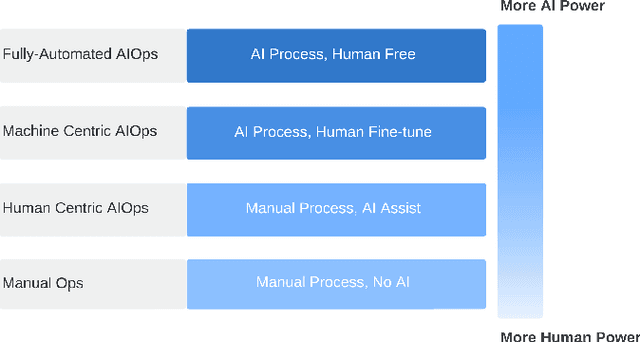

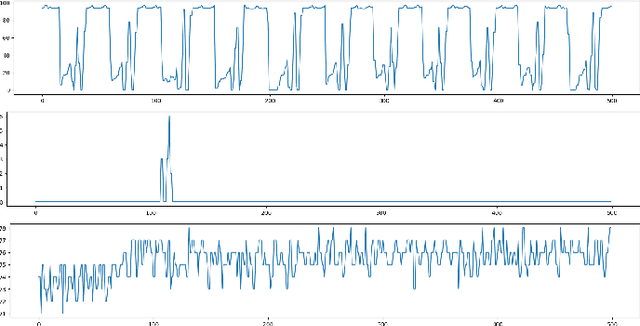
Artificial Intelligence for IT operations (AIOps) aims to combine the power of AI with the big data generated by IT Operations processes, particularly in cloud infrastructures, to provide actionable insights with the primary goal of maximizing availability. There are a wide variety of problems to address, and multiple use-cases, where AI capabilities can be leveraged to enhance operational efficiency. Here we provide a review of the AIOps vision, trends challenges and opportunities, specifically focusing on the underlying AI techniques. We discuss in depth the key types of data emitted by IT Operations activities, the scale and challenges in analyzing them, and where they can be helpful. We categorize the key AIOps tasks as - incident detection, failure prediction, root cause analysis and automated actions. We discuss the problem formulation for each task, and then present a taxonomy of techniques to solve these problems. We also identify relatively under explored topics, especially those that could significantly benefit from advances in AI literature. We also provide insights into the trends in this field, and what are the key investment opportunities.
LogAI: A Library for Log Analytics and Intelligence
Jan 31, 2023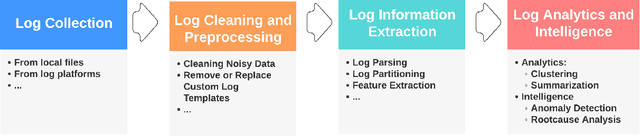
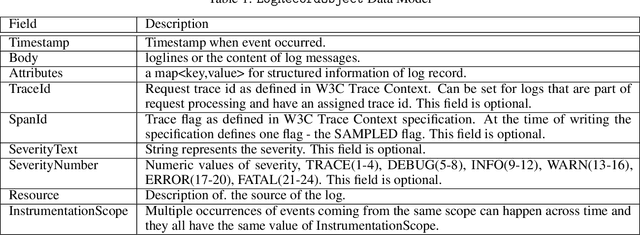
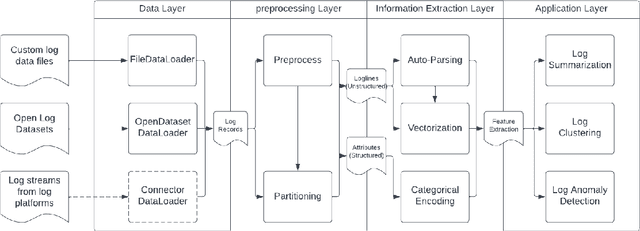
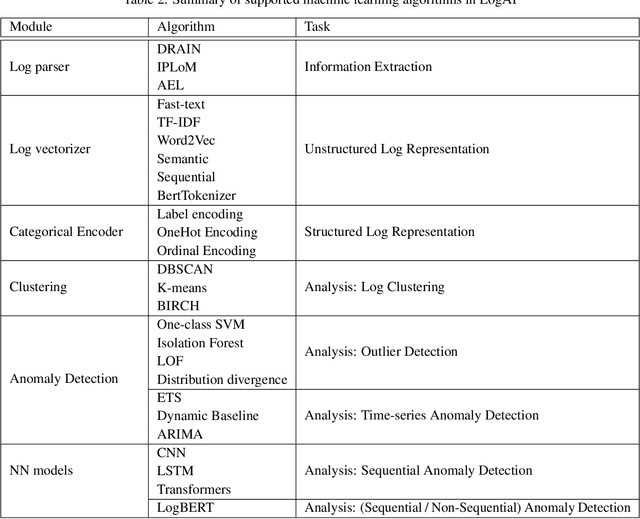
Software and System logs record runtime information about processes executing within a system. These logs have become the most critical and ubiquitous forms of observability data that help developers understand system behavior, monitor system health and resolve issues. However, the volume of logs generated can be humongous (of the order of petabytes per day) especially for complex distributed systems, such as cloud, search engine, social media, etc. This has propelled a lot of research on developing AI-based log based analytics and intelligence solutions that can process huge volume of raw logs and generate insights. In order to enable users to perform multiple types of AI-based log analysis tasks in a uniform manner, we introduce LogAI (https://github.com/salesforce/logai), a one-stop open source library for log analytics and intelligence. LogAI supports tasks such as log summarization, log clustering and log anomaly detection. It adopts the OpenTelemetry data model, to enable compatibility with different log management platforms. LogAI provides a unified model interface and provides popular time-series, statistical learning and deep learning models. Alongside this, LogAI also provides an out-of-the-box GUI for users to conduct interactive analysis. With LogAI, we can also easily benchmark popular deep learning algorithms for log anomaly detection without putting in redundant effort to process the logs. We have opensourced LogAI to cater to a wide range of applications benefiting both academic research and industrial prototyping.