 Add to Chrome
 Add to Firefox
 Add to Edge
OxygenREC: An Instruction-Following Generative Framework for E-commerce Recommendation
Dec 31, 2025
Traditional recommendation systems suffer from inconsistency in multi-stage optimization objectives. Generative Recommendation (GR) mitigates them through an end-to-end framework; however, existing methods still rely on matching mechanisms based on inductive patterns. Although responsive, they lack the ability to uncover complex user intents that require deductive reasoning based on world knowledge. Meanwhile, LLMs show strong deep reasoning capabilities, but their latency and computational costs remain challenging for industrial applications. More critically, there are performance bottlenecks in multi-scenario scalability: as shown in Figure 1, existing solutions require independent training and deployment for each scenario, leading to low resource utilization and high maintenance costs-a challenge unaddressed in GR literature. To address these, we present OxygenREC, an industrial recommendation system that leverages Fast-Slow Thinking to deliver deep reasoning with strict latency and multi-scenario requirements of real-world environments. First, we adopt a Fast-Slow Thinking architecture. Slow thinking uses a near-line LLM pipeline to synthesize Contextual Reasoning Instructions, while fast thinking employs a high-efficiency encoder-decoder backbone for real-time generation. Second, to ensure reasoning instructions effectively enhance recommendation generation, we introduce a semantic alignment mechanism with Instruction-Guided Retrieval (IGR) to filter intent-relevant historical behaviors and use a Query-to-Item (Q2I) loss for instruction-item consistency. Finally, to resolve multi-scenario scalability, we transform scenario information into controllable instructions, using unified reward mapping and Soft Adaptive Group Clip Policy Optimization (SA-GCPO) to align policies with diverse business objectives, realizing a train-once-deploy-everywhere paradigm.

Divide and Conquer: Towards Better Embedding-based Retrieval for Recommender Systems From a Multi-task Perspective
Feb 06, 2023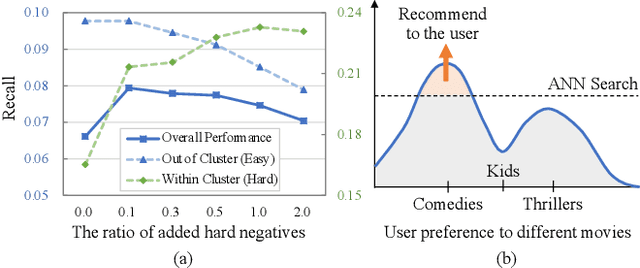
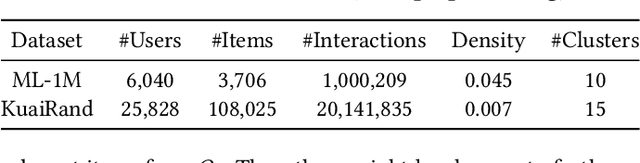
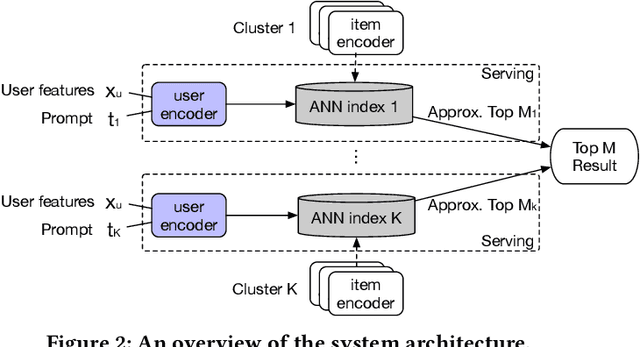
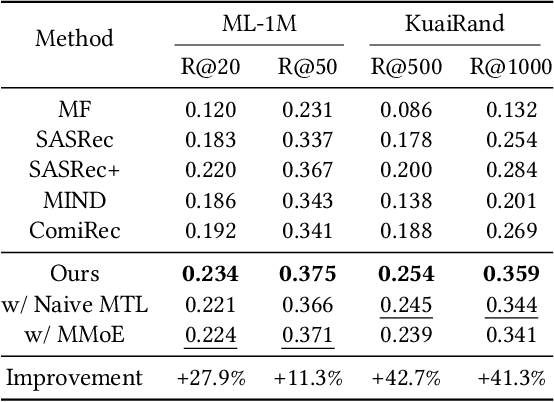
Embedding-based retrieval (EBR) methods are widely used in modern recommender systems thanks to its simplicity and effectiveness. However, along the journey of deploying and iterating on EBR in production, we still identify some fundamental issues in existing methods. First, when dealing with large corpus of candidate items, EBR models often have difficulties in balancing the performance on distinguishing highly relevant items (positives) from both irrelevant ones (easy negatives) and from somewhat related yet not competitive ones (hard negatives). Also, we have little control in the diversity and fairness of the retrieval results because of the ``greedy'' nature of nearest vector search. These issues compromise the performance of EBR methods in large-scale industrial scenarios. This paper introduces a simple and proven-in-production solution to overcome these issues. The proposed solution takes a divide-and-conquer approach: the whole set of candidate items are divided into multiple clusters and we run EBR to retrieve relevant candidates from each cluster in parallel; top candidates from each cluster are then combined by some controllable merging strategies. This approach allows our EBR models to only concentrate on discriminating positives from mostly hard negatives. It also enables further improvement from a multi-tasking learning (MTL) perspective: retrieval problems within each cluster can be regarded as individual tasks; inspired by recent successes in prompting and prefix-tuning, we propose an efficient task adaption technique further boosting the retrieval performance within each cluster with negligible overheads.
Real-time Short Video Recommendation on Mobile Devices
Aug 20, 2022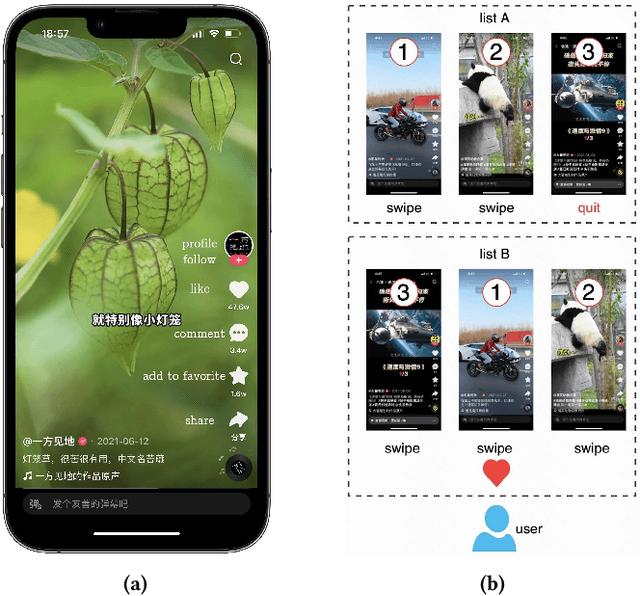
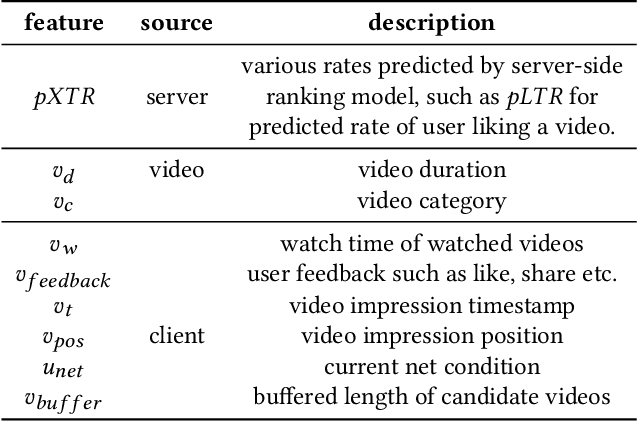
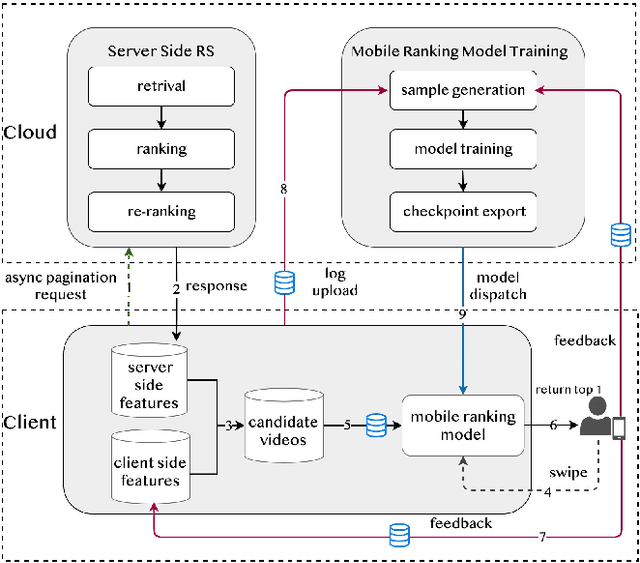
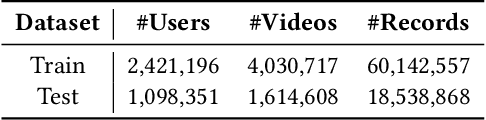
Short video applications have attracted billions of users in recent years, fulfilling their various needs with diverse content. Users usually watch short videos on many topics on mobile devices in a short period of time, and give explicit or implicit feedback very quickly to the short videos they watch. The recommender system needs to perceive users' preferences in real-time in order to satisfy their changing interests. Traditionally, recommender systems deployed at server side return a ranked list of videos for each request from client. Thus it cannot adjust the recommendation results according to the user's real-time feedback before the next request. Due to client-server transmitting latency, it is also unable to make immediate use of users' real-time feedback. However, as users continue to watch videos and feedback, the changing context leads the ranking of the server-side recommendation system inaccurate. In this paper, we propose to deploy a short video recommendation framework on mobile devices to solve these problems. Specifically, we design and deploy a tiny on-device ranking model to enable real-time re-ranking of server-side recommendation results. We improve its prediction accuracy by exploiting users' real-time feedback of watched videos and client-specific real-time features. With more accurate predictions, we further consider interactions among candidate videos, and propose a context-aware re-ranking method based on adaptive beam search. The framework has been deployed on Kuaishou, a billion-user scale short video application, and improved effective view, like and follow by 1.28\%, 8.22\% and 13.6\% respectively.