 Add to Chrome
 Add to Firefox
 Add to Edge
Semantic Cache Distillation: Efficient State Transfer via Reuse and Selective Patching
Jun 05, 2026
Disaggregated serving alleviates memory bottlenecks in Large Language Model (LLM) inference but creates a severe communication bottleneck: transmitting high-dimensional Key-Value (KV) caches often dominates time-to-first-token (TTFT). Moreover, reusing caches across heterogeneous models (e.g., base and fine-tuned variants) causes semantic misalignment that accumulates over layers, degrading generation quality. We propose Semantic Cache Distillation (SCD), a loss-constrained framework that replaces raw KV transmission with compact semantic codes. SCD addresses these challenges via two mechanisms: (1) Reuse, which reconstructs most layers from low-rank subspaces to minimize transfer cost, and (2) Patch, which predicts normalized inputs at sparse transition layers to truncate error propagation. Empirically, SCD delivers up to 2.65 $\times$ TTFT speedup over the oracle consumer prefill and dominates quantization and selective recomputation baselines on the quality--latency Pareto frontier in bandwidth-constrained regimes, while keeping generation quality within 5\% F1 of the oracle.

ODTQA-FoRe: An Open-Domain Tabular Question Answering Dataset for Future Data Forecasting and Reasoning
Jun 01, 2026The rapid development of LLMs has significantly advanced tabular question answering, but most systems cannot perform future-oriented numerical prediction. To address this gap, we introduce a novel task, Open-Domain Tabular Question Answering for Future Data Forecasting and Reasoning, and propose the first dataset to cover time-series forecasting and forecast-based reasoning scenarios using real estate data. This task poses challenges in retrieving precise historical data, overcoming the forecasting limitations of LLMs, and standardizing responses for diverse queries. To solve the above challenges, we propose TimeFore, an LLM agent-based framework that decomposes the problem into three collaborative roles: a Retriever autonomously generates SQL to fetch data, a Forecaster invokes external time-series models for higher accuracy, and an Analyzer synthesizes the results to construct a precise and consistent final answer. Extensive experiments demonstrate the effectiveness of our TimeFore.
ReCoQA: A Benchmark for Tool-Augmented and Multi-Step Reasoning in Real Estate Question and Answering
Apr 20, 2026Developing agents capable of navigating fragmented, multi-source information remains challenging, primarily due to the scarcity of benchmarks reflecting hybrid workflows combining database querying with external APIs. To bridge this gap, we introduce ReCoQA, a large-scale benchmark of 29,270 real-estate instances featuring machine-verifiable supervision for intermediate steps, including structured intent labels, SQL queries, and API calls. Complementarily, we propose HIRE-Agent, a hierarchical framework instantiating an understand-plan-execute architecture as a strong baseline. By orchestrating a Front-end parser, a planning Supervisor, and execution Specialists, HIRE-Agent effectively integrates heterogeneous evidence. Extensive experiments demonstrate that HIRE-Agent constitutes a strong baseline and substantiates the necessity of hierarchical collaboration for complex, real-world reasoning tasks.
Automatic Slide Updating with User-Defined Dynamic Templates and Natural Language Instructions
Apr 20, 2026Presentation slides are a primary medium for data-driven reporting, yet keeping complex, analytics-style decks up to date remains labor-intensive. Existing automation methods mostly follow fixed template filling and cannot support dynamic updates for diverse, user-authored slide decks. We therefore define "Dynamic Slide Update via Natural Language Instructions on User-provided Templates" and introduce DynaSlide, a large-scale benchmark with 20,036 real-world instruction-execution triples (source slide, user instruction, target slide) grounded in a shared external database and built from business reporting slides under bring-your-own-template (BYO-template) conditions. To tackle this task, we propose SlideAgent, an agent-based framework that combines multimodal slide parsing, natural language instruction grounding, and tool-augmented reasoning for tables, charts, and textual conclusions. SlideAgent updates content while preserving layout and style, providing a strong reference baseline on DynaSlide. We further design end-to-end and component-level evaluation protocols that reveal key challenges and opportunities for future research. The dataset and code are available at https://github.com/XiaoZhou2024/SlideAgent.
ODUTQA-MDC: A Task for Open-Domain Underspecified Tabular QA with Multi-turn Dialogue-based Clarification
Apr 11, 2026The advancement of large language models (LLMs) has enhanced tabular question answering (Tabular QA), yet they struggle with open-domain queries exhibiting underspecified or uncertain expressions. To address this, we introduce the ODUTQA-MDC task and the first comprehensive benchmark to tackle it. This benchmark includes: (1) a large-scale ODUTQA dataset with 209 tables and 25,105 QA pairs; (2) a fine-grained labeling scheme for detailed evaluation; and (3) a dynamic clarification interface that simulates user feedback for interactive assessment. We also propose MAIC-TQA, a multi-agent framework that excels at detecting ambiguities, clarifying them through dialogue, and refining answers. Experiments validate our benchmark and framework, establishing them as a key resource for advancing conversational, underspecification-aware Tabular QA research.
Not All Frames Deserve Full Computation: Accelerating Autoregressive Video Generation via Selective Computation and Predictive Extrapolation
Apr 03, 2026Autoregressive (AR) video diffusion models enable long-form video generation but remain expensive due to repeated multi-step denoising. Existing training-free acceleration methods rely on binary cache-or-recompute decisions, overlooking intermediate cases where direct reuse is too coarse yet full recomputation is unnecessary. Moreover, asynchronous AR schedules assign different noise levels to co-generated frames, yet existing methods process the entire valid interval uniformly. To address these AR-specific inefficiencies, we present SCOPE, a training-free framework for efficient AR video diffusion. SCOPE introduces a tri-modal scheduler over cache, predict, and recompute, where prediction via noise-level Taylor extrapolation fills the gap between reuse and recomputation with explicit stability controls backed by error propagation analysis. It further introduces selective computation that restricts execution to the active frame interval. On MAGI-1 and SkyReels-V2, SCOPE achieves up to 4.73x speedup while maintaining quality comparable to the original output, outperforming all training-free baselines.
Geometric Manifold Rectification for Imbalanced Learning
Feb 13, 2026Imbalanced classification presents a formidable challenge in machine learning, particularly when tabular datasets are plagued by noise and overlapping class boundaries. From a geometric perspective, the core difficulty lies in the topological intrusion of the majority class into the minority manifold, which obscures the true decision boundary. Traditional undersampling techniques, such as Edited Nearest Neighbours (ENN), typically employ symmetric cleaning rules and uniform voting, failing to capture the local manifold structure and often inadvertently removing informative minority samples. In this paper, we propose GMR (Geometric Manifold Rectification), a novel framework designed to robustly handle imbalanced structured data by exploiting local geometric priors. GMR makes two contributions: (1) Geometric confidence estimation that uses inverse-distance weighted kNN voting with an adaptive distance metric to capture local reliability; and (2) asymmetric cleaning that is strict on majority samples while conservatively protecting minority samples via a safe-guarding cap on minority removal. Extensive experiments on multiple benchmark datasets show that GMR is competitive with strong sampling baselines.
Meta-Sel: Efficient Demonstration Selection for In-Context Learning via Supervised Meta-Learning
Feb 12, 2026Demonstration selection is a practical bottleneck in in-context learning (ICL): under a tight prompt budget, accuracy can change substantially depending on which few-shot examples are included, yet selection must remain cheap enough to run per query over large candidate pools. We propose Meta-Sel, a lightweight supervised meta-learning approach for intent classification that learns a fast, interpretable scoring function for (candidate, query) pairs from labeled training data. Meta-Sel constructs a meta-dataset by sampling pairs from the training split and using class agreement as supervision, then trains a calibrated logistic regressor on two inexpensive meta-features: TF--IDF cosine similarity and a length-compatibility ratio. At inference time, the selector performs a single vectorized scoring pass over the full candidate pool and returns the top-k demonstrations, requiring no model fine-tuning, no online exploration, and no additional LLM calls. This yields deterministic rankings and makes the selection mechanism straightforward to audit via interpretable feature weights. Beyond proposing Meta-Sel, we provide a broad empirical study of demonstration selection, benchmarking 12 methods -- spanning prompt engineering baselines, heuristic selection, reinforcement learning, and influence-based approaches -- across four intent datasets and five open-source LLMs. Across this benchmark, Meta-Sel consistently ranks among the top-performing methods, is particularly effective for smaller models where selection quality can partially compensate for limited model capacity, and maintains competitive selection-time overhead.
RSHallu: Dual-Mode Hallucination Evaluation for Remote-Sensing Multimodal Large Language Models with Domain-Tailored Mitigation
Feb 11, 2026Multimodal large language models (MLLMs) are increasingly adopted in remote sensing (RS) and have shown strong performance on tasks such as RS visual grounding (RSVG), RS visual question answering (RSVQA), and multimodal dialogue. However, hallucinations, which are responses inconsistent with the input RS images, severely hinder their deployment in high-stakes scenarios (e.g., emergency management and agricultural monitoring) and remain under-explored in RS. In this work, we present RSHallu, a systematic study with three deliverables: (1) we formalize RS hallucinations with an RS-oriented taxonomy and introduce image-level hallucination to capture RS-specific inconsistencies beyond object-centric errors (e.g., modality, resolution, and scene-level semantics); (2) we build a hallucination benchmark RSHalluEval (2,023 QA pairs) and enable dual-mode checking, supporting high-precision cloud auditing and low-cost reproducible local checking via a compact checker fine-tuned on RSHalluCheck dataset (15,396 QA pairs); and (3) we introduce a domain-tailored dataset RSHalluShield (30k QA pairs) for training-friendly mitigation and further propose training-free plug-and-play strategies, including decoding-time logit correction and RS-aware prompting. Across representative RS-MLLMs, our mitigation improves the hallucination-free rate by up to 21.63 percentage points under a unified protocol, while maintaining competitive performance on downstream RS tasks (RSVQA/RSVG). Code and datasets will be released.
TLCCSP: A Scalable Framework for Enhancing Time Series Forecasting with Time-Lagged Cross-Correlations
Aug 09, 2025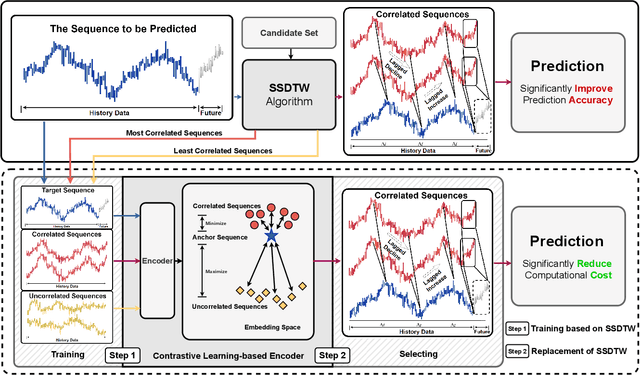
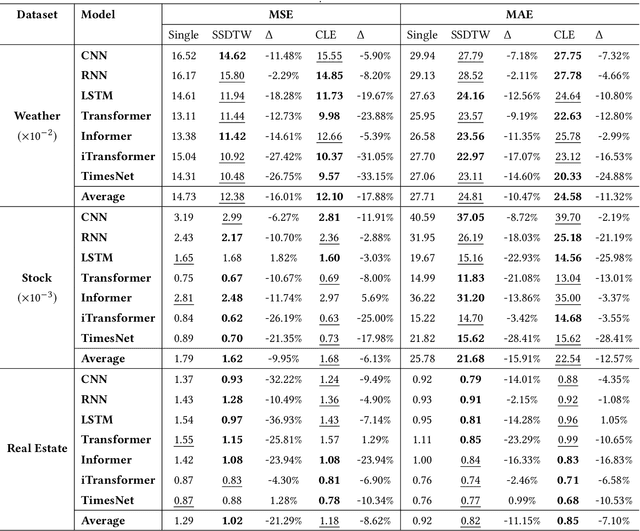
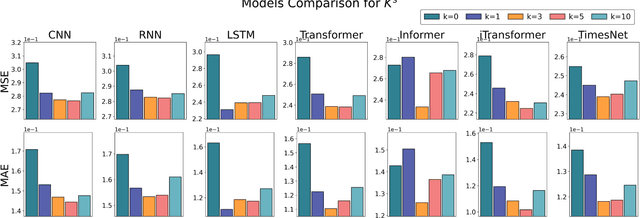
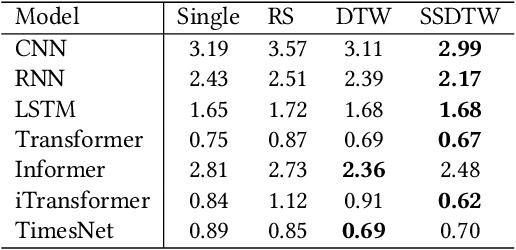
Time series forecasting is critical across various domains, such as weather, finance and real estate forecasting, as accurate forecasts support informed decision-making and risk mitigation. While recent deep learning models have improved predictive capabilities, they often overlook time-lagged cross-correlations between related sequences, which are crucial for capturing complex temporal relationships. To address this, we propose the Time-Lagged Cross-Correlations-based Sequence Prediction framework (TLCCSP), which enhances forecasting accuracy by effectively integrating time-lagged cross-correlated sequences. TLCCSP employs the Sequence Shifted Dynamic Time Warping (SSDTW) algorithm to capture lagged correlations and a contrastive learning-based encoder to efficiently approximate SSDTW distances. Experimental results on weather, finance and real estate time series datasets demonstrate the effectiveness of our framework. On the weather dataset, SSDTW reduces mean squared error (MSE) by 16.01% compared with single-sequence methods, while the contrastive learning encoder (CLE) further decreases MSE by 17.88%. On the stock dataset, SSDTW achieves a 9.95% MSE reduction, and CLE reduces it by 6.13%. For the real estate dataset, SSDTW and CLE reduce MSE by 21.29% and 8.62%, respectively. Additionally, the contrastive learning approach decreases SSDTW computational time by approximately 99%, ensuring scalability and real-time applicability across multiple time series forecasting tasks.