 Add to Chrome
 Add to Firefox
 Add to Edge
RedVTP: Training-Free Acceleration of Diffusion Vision-Language Models Inference via Masked Token-Guided Visual Token Pruning
Nov 16, 2025
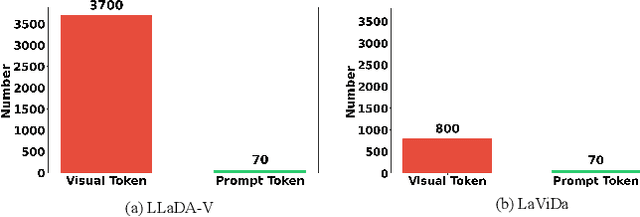
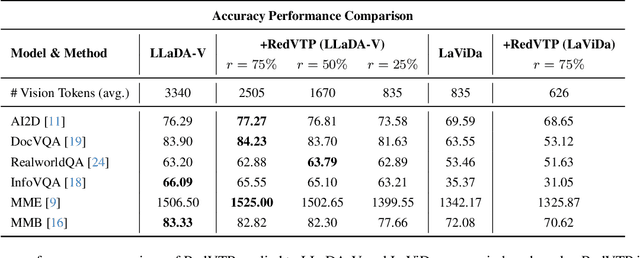
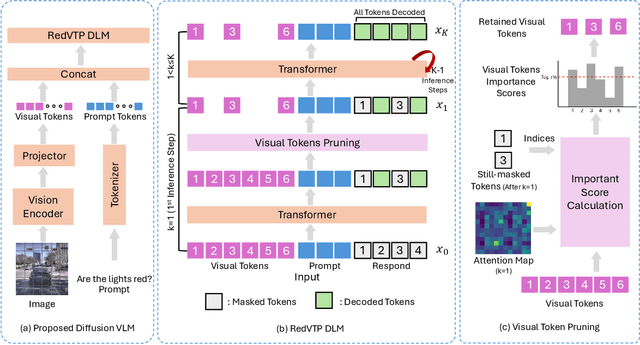
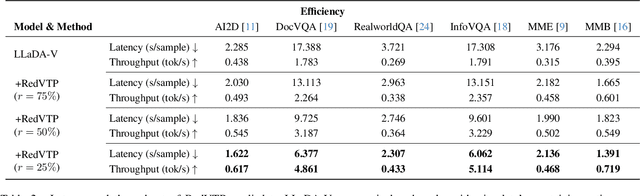
Vision-Language Models (VLMs) have achieved remarkable progress in multimodal reasoning and generation, yet their high computational demands remain a major challenge. Diffusion Vision-Language Models (DVLMs) are particularly attractive because they enable parallel token decoding, but the large number of visual tokens still significantly hinders their inference efficiency. While visual token pruning has been extensively studied for autoregressive VLMs (AVLMs), it remains largely unexplored for DVLMs. In this work, we propose RedVTP, a response-driven visual token pruning strategy that leverages the inference dynamics of DVLMs. Our method estimates visual token importance using attention from the masked response tokens. Based on the observation that these importance scores remain consistent across steps, RedVTP prunes the less important visual tokens from the masked tokens after the first inference step, thereby maximizing inference efficiency. Experiments show that RedVTP improves token generation throughput of LLaDA-V and LaViDa by up to 186% and 28.05%, respectively, and reduces inference latency by up to 64.97% and 21.87%, without compromising-and in some cases improving-accuracy.

Hybrid Learning for Cold-Start-Aware Microservice Scheduling in Dynamic Edge Environments
May 28, 2025With the rapid growth of IoT devices and their diverse workloads, container-based microservices deployed at edge nodes have become a lightweight and scalable solution. However, existing microservice scheduling algorithms often assume static resource availability, which is unrealistic when multiple containers are assigned to an edge node. Besides, containers suffer from cold-start inefficiencies during early-stage training in currently popular reinforcement learning (RL) algorithms. In this paper, we propose a hybrid learning framework that combines offline imitation learning (IL) with online Soft Actor-Critic (SAC) optimization to enable a cold-start-aware microservice scheduling with dynamic allocation for computing resources. We first formulate a delay-and-energy-aware scheduling problem and construct a rule-based expert to generate demonstration data for behavior cloning. Then, a GRU-enhanced policy network is designed in the policy network to extract the correlation among multiple decisions by separately encoding slow-evolving node states and fast-changing microservice features, and an action selection mechanism is given to speed up the convergence. Extensive experiments show that our method significantly accelerates convergence and achieves superior final performance. Compared with baselines, our algorithm improves the total objective by $50\%$ and convergence speed by $70\%$, and demonstrates the highest stability and robustness across various edge configurations.