 Add to Chrome
 Add to Firefox
 Add to Edge
Tail-Aware Information-Theoretic Generalization for RLHF and SGLD
Apr 12, 2026
Classical information-theoretic generalization bounds typically control the generalization gap through KL-based mutual information and therefore rely on boundedness or sub-Gaussian tails via the moment generating function (MGF). In many modern pipelines, such as robust learning, RLHF, and stochastic optimization, losses and rewards can be heavy-tailed, and MGFs may not exist, rendering KL-based tools ineffective. We develop a tail-dependent information-theoretic framework for sub-Weibull data, where the tail parameter $θ$ controls the tail heaviness: $θ=2$ corresponds to sub-Gaussian, $θ=1$ to sub-exponential, and $0<θ<1$ to genuinely heavy tails. Our key technical ingredient is a decorrelation lemma that bounds change-of-measure expectations using a shifted-log $f_θ$-divergence, which admits explicit comparisons to Rényi divergence without MGF arguments. On the empirical-process side, we establish sharp maximal inequalities and a Dudley-type chaining bound for sub-Weibull processes with tail index $θ$, with complexity scaling as $\log^{1/θ}$ and entropy$^{1/θ}$. These tools yield expected and high-probability PAC-Bayes generalization bounds, as well as an information-theoretic chaining inequality based on multiscale Rényi mutual information. We illustrate the consequences in Rényi-regularized RLHF under heavy-tailed rewards and in stochastic gradient Langevin dynamics with heavy-tailed gradient noise.

Machine Learning-Assisted High-Dimensional Matrix Estimation
Mar 30, 2026Efficient estimation of high-dimensional matrices-including covariance and precision matrices-is a cornerstone of modern multivariate statistics. Most existing studies have focused primarily on the theoretical properties of the estimators (e.g., consistency and sparsity), while largely overlooking the computational challenges inherent in high-dimensional settings. Motivated by recent advances in learning-based optimization method-which integrate data-driven structures with classical optimization algorithms-we explore high-dimensional matrix estimation assisted by machine learning. Specifically, for the optimization problem of high-dimensional matrix estimation, we first present a solution procedure based on the Linearized Alternating Direction Method of Multipliers (LADMM). We then introduce learnable parameters and model the proximal operators in the iterative scheme with neural networks, thereby improving estimation accuracy and accelerating convergence. Theoretically, we first prove the convergence of LADMM, and then establish the convergence, convergence rate, and monotonicity of its reparameterized counterpart; importantly, we show that the reparameterized LADMM enjoys a faster convergence rate. Notably, the proposed reparameterization theory and methodology are applicable to the estimation of both high-dimensional covariance and precision matrices. We validate the effectiveness of our method by comparing it with several classical optimization algorithms across different structures and dimensions of high-dimensional matrices.
Counterfactual Credit Policy Optimization for Multi-Agent Collaboration
Mar 23, 2026Collaborative multi-agent large language models (LLMs) can solve complex reasoning tasks by decomposing roles and aggregating diverse hypotheses. Yet, reinforcement learning (RL) for such systems is often undermined by credit assignment: a shared global reward obscures individual contributions, inflating update variance and encouraging free-riding. We introduce Counterfactual Credit Policy Optimization (CCPO), a framework that assigns agent-specific learning signals by estimating each agent's marginal contribution through counterfactual trajectories. CCPO builds dynamic counterfactual baselines that simulate outcomes with an agent's contribution removed, yielding role-sensitive advantages for policy optimization. To further improve stability under heterogeneous tasks and data distributions, we propose a global-history-aware normalization scheme that calibrates advantages using global rollout statistics. We evaluate CCPO on two collaboration topologies: a sequential Think--Reason dyad and multi-agent voting. Across mathematical and logical reasoning benchmarks, CCPO mitigates free-riding and outperforms strong multi-agent RL baselines, yielding finer-grained and more effective credit assignment for collaborative LLM training. Our code is available at https://github.com/bhai114/ccpo.
Sharper Generalization Bounds for Transformer
Mar 23, 2026This paper studies generalization error bounds for Transformer models. Based on the offset Rademacher complexity, we derive sharper generalization bounds for different Transformer architectures, including single-layer single-head, single-layer multi-head, and multi-layer Transformers. We first express the excess risk of Transformers in terms of the offset Rademacher complexity. By exploiting its connection with the empirical covering numbers of the corresponding hypothesis spaces, we obtain excess risk bounds that achieve optimal convergence rates up to constant factors. We then derive refined excess risk bounds by upper bounding the covering numbers of Transformer hypothesis spaces using matrix ranks and matrix norms, leading to precise, architecture-dependent generalization bounds. Finally, we relax the boundedness assumption on feature mappings and extend our theoretical results to settings with unbounded (sub-Gaussian) features and heavy-tailed distributions.
Adaptive Robust Estimator for Multi-Agent Reinforcement Learning
Mar 23, 2026Multi-agent collaboration has emerged as a powerful paradigm for enhancing the reasoning capabilities of large language models, yet it suffers from interaction-level ambiguity that blurs generation, critique, and revision, making credit assignment across agents difficult. Moreover, policy optimization in this setting is vulnerable to heavy-tailed and noisy rewards, which can bias advantage estimation and trigger unstable or even divergent training. To address both issues, we propose a robust multi-agent reinforcement learning framework for collaborative reasoning, consisting of two components: Dual-Agent Answer-Critique-Rewrite (DACR) and an Adaptive Robust Estimator (ARE). DACR decomposes reasoning into a structured three-stage pipeline: answer, critique, and rewrite, while enabling explicit attribution of each agent's marginal contribution to its partner's performance. ARE provides robust estimation of batch experience means during multi-agent policy optimization. Across mathematical reasoning and embodied intelligence benchmarks, even under noisy rewards, our method consistently outperforms the baseline in both homogeneous and heterogeneous settings. These results indicate stronger robustness to reward noise and more stable training dynamics, effectively preventing optimization failures caused by noisy reward signals.
Interval-Valued Time Series Classification Using $D_K$-Distance
Apr 07, 2025In recent years, modeling and analysis of interval-valued time series have garnered increasing attention in econometrics, finance, and statistics. However, these studies have predominantly focused on statistical inference in the forecasting of univariate and multivariate interval-valued time series, overlooking another important aspect: classification. In this paper, we introduce a classification approach that treats intervals as unified entities, applicable to both univariate and multivariate interval-valued time series. Specifically, we first extend the point-valued time series imaging methods to interval-valued scenarios using the $D_K$-distance, enabling the imaging of interval-valued time series. Then, we employ suitable deep learning model for classification on the obtained imaging dataset, aiming to achieve classification for interval-valued time series. In theory, we derived a sharper excess risk bound for deep multiclassifiers based on offset Rademacher complexity. Finally, we validate the superiority of the proposed method through comparisons with various existing point-valued time series classification methods in both simulation studies and real data applications.
Adaptive Classification of Interval-Valued Time Series
Apr 04, 2025In recent years, the modeling and analysis of interval-valued time series have garnered significant attention in the fields of econometrics and statistics. However, the existing literature primarily focuses on regression tasks while neglecting classification aspects. In this paper, we propose an adaptive approach for interval-valued time series classification. Specifically, we represent interval-valued time series using convex combinations of upper and lower bounds of intervals and transform these representations into images based on point-valued time series imaging methods. We utilize a fine-grained image classification neural network to classify these images, to achieve the goal of classifying the original interval-valued time series. This proposed method is applicable to both univariate and multivariate interval-valued time series. On the optimization front, we treat the convex combination coefficients as learnable parameters similar to the parameters of the neural network and provide an efficient estimation method based on the alternating direction method of multipliers (ADMM). On the theoretical front, under specific conditions, we establish a margin-based multiclass generalization bound for generic CNNs composed of basic blocks involving convolution, pooling, and fully connected layers. Through simulation studies and real data applications, we validate the effectiveness of the proposed method and compare its performance against a wide range of point-valued time series classification methods.
Block Toeplitz Sparse Precision Matrix Estimation for Large-Scale Interval-Valued Time Series Forecasting
Apr 04, 2025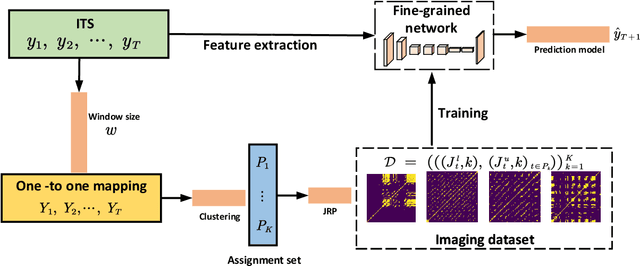
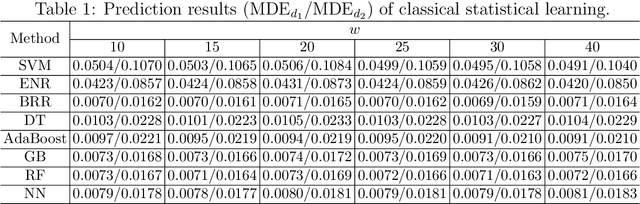
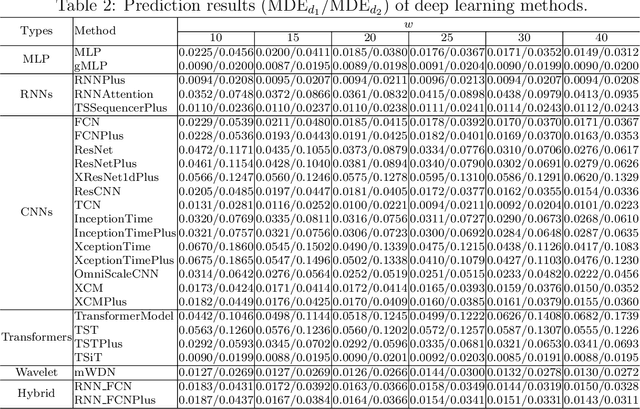
Modeling and forecasting interval-valued time series (ITS) have attracted considerable attention due to their growing presence in various contexts. To the best of our knowledge, there have been no efforts to model large-scale ITS. In this paper, we propose a feature extraction procedure for large-scale ITS, which involves key steps such as auto-segmentation and clustering, and feature transfer learning. This procedure can be seamlessly integrated with any suitable prediction models for forecasting purposes. Specifically, we transform the automatic segmentation and clustering of ITS into the estimation of Toeplitz sparse precision matrices and assignment set. The majorization-minimization algorithm is employed to convert this highly non-convex optimization problem into two subproblems. We derive efficient dynamic programming and alternating direction method to solve these two subproblems alternately and establish their convergence properties. By employing the Joint Recurrence Plot (JRP) to image subsequence and assigning a class label to each cluster, an image dataset is constructed. Then, an appropriate neural network is chosen to train on this image dataset and used to extract features for the next step of forecasting. Real data applications demonstrate that the proposed method can effectively obtain invariant representations of the raw data and enhance forecasting performance.