 Add to Chrome
 Add to Firefox
 Add to Edge
SLAD : Shared LoRA Adapters for Task Specific Distillation
May 28, 2026
In the context of resource-constrained environments such as embedded systems, adapting reduced-size foundation models to downstream tasks has become increasingly popular. This has recently motivated the emerging setting of task-specific distillation, where a larger and a smaller version of the same foundation model are both adapted to the same downstream task, with the goal of transferring knowledge from the former to the latter. Recent work has demonstrated the benefits of using a larger version of the same foundation model to assist the adaptation of a smaller one. Typically, the larger model (teacher) is first adapted via fine-tuning or linear probing before its knowledge is distilled into the smaller model (student). While fine-tuning the teacher often increases its performance, recent work showed that probing it leads to better knowledge distillation to the student. Our findings show that this is mainly due to a mis-alignment in feature representation between the teacher and the student which occurs during the teacher's fine-tuning. Inspired by existing efforts to preserve previously learned knowledge, we first propose leveraging low-rank adaptation, resulting in better feature alignment and therefore better knowledge transfer. Drawing from this insight, we further enhance the feature alignment through a parameter-sharing strategy of the adapters between the two encoders during joint training. Our proposed method, SLAD, shows better feature alignment between the teacher and student, which results in increased performance for not only the student but also the teacher model, while being 2x faster to train than fine-tuning. Through extensive experiments on multiple classification and segmentation datasets, we demonstrate the improved accuracy and transfer efficiency of our method, achieving state-of-the-art performance in the task-specific distillation framework.

Efficient Few-Shot Learning for Edge AI via Knowledge Distillation on MobileViT
Mar 27, 2026Efficient and adaptable deep learning models are an important area of deep learning research, driven by the need for highly efficient models on edge devices. Few-shot learning enables the use of deep learning models in low-data regimes, a capability that is highly sought after in real-world applications where collecting large annotated datasets is costly or impractical. This challenge is particularly relevant in edge scenarios, where connectivity may be limited, low-latency responses are required, or energy consumption constraints are critical. We propose and evaluate a pre-training method for the MobileViT backbone designed for edge computing. Specifically, we employ knowledge distillation, which transfers the generalization ability of a large-scale teacher model to a lightweight student model. This method achieves accuracy improvements of 14% and 6.7% for one-shot and five-shot classification, respectively, on the MiniImageNet benchmark, compared to the ResNet12 baseline, while reducing by 69% the number of parameters and by 88% the computational complexity of the model, in FLOPs. Furthermore, we deployed the proposed models on a Jetson Orin Nano platform and measured power consumption directly at the power supply, showing that the dynamic energy consumption is reduced by 37% with a latency of 2.6 ms. These results demonstrate that the proposed method is a promising and practical solution for deploying few-shot learning models on edge AI hardware.
D5P4: Partition Determinantal Point Process for Diversity in Parallel Discrete Diffusion Decoding
Mar 19, 2026Discrete diffusion models are promising alternatives to autoregressive approaches for text generation, yet their decoding methods remain under-studied. Standard decoding methods for autoregressive models, such as beam search, do not directly apply to iterative denoising, and existing diffusion decoding techniques provide limited control over in-batch diversity. To bridge this gap, we introduce a generalized beam-search framework for discrete diffusion that generates candidates in parallel and supports modular beam-selection objectives. As a diversity-focused instantiation, we propose D5P4, which formulates the selection step as MAP inference over a Determinantal Point Process. Leveraging a scalable greedy solver, D5P4 maintains multi-GPU compatibility and enables an explicit trade-off between model probability and target diversity with near-zero compute overhead. Experiments on free-form generation and question answering demonstrate that D5P4 improves diversity over strong baselines while maintaining competitive generation quality.
MONET: Modeling and Optimization of neural NEtwork Training from Edge to Data Centers
Mar 16, 2026While hardware-software co-design has significantly improved the efficiency of neural network inference, modeling the training phase remains a critical yet underexplored challenge. Training workloads impose distinct constraints, particularly regarding memory footprint and backpropagation complexity, which existing inference-focused tools fail to capture. This paper introduces MONET, a framework designed to model the training of neural networks on heterogeneous dataflow accelerators. MONET builds upon Stream, an experimentally verified framework that that models the inference of neural networks on heterogeneous dataflow accelerators with layer fusion. Using MONET, we explore the design space of ResNet-18 and a small GPT-2, demonstrating the framework's capability to model training workflows and find better hardware architectures. We then further examine problems that become more complex in neural network training due to the larger design space, such as determining the best layer-fusion configuration. Additionally, we use our framework to find interesting trade-offs in activation checkpointing, with the help of a genetic algorithm. Our findings highlight the importance of a holistic approach to hardware-software co-design for scalable and efficient deep learning deployment.
Residual Connections and the Causal Shift: Uncovering a Structural Misalignment in Transformers
Feb 16, 2026Large Language Models (LLMs) are trained with next-token prediction, implemented in autoregressive Transformers via causal masking for parallelism. This creates a subtle misalignment: residual connections tie activations to the current token, while supervision targets the next token, potentially propagating mismatched information if the current token is not the most informative for prediction. In this work, we empirically localize this input-output alignment shift in pretrained LLMs, using decoding trajectories over tied embedding spaces and similarity-based metrics. Our experiments reveal that the hidden token representations switch from input alignment to output alignment deep within the network. Motivated by this observation, we propose a lightweight residual-path mitigation based on residual attenuation, implemented either as a fixed-layer intervention or as a learnable gating mechanism. Experiments on multiple benchmarks show that these strategies alleviate the representation misalignment and yield improvements, providing an efficient and general architectural enhancement for autoregressive Transformers.
Inner Loop Inference for Pretrained Transformers: Unlocking Latent Capabilities Without Training
Feb 16, 2026Deep Learning architectures, and in particular Transformers, are conventionally viewed as a composition of layers. These layers are actually often obtained as the sum of two contributions: a residual path that copies the input and the output of a Transformer block. As a consequence, the inner representations (i.e. the input of these blocks) can be interpreted as iterative refinement of a propagated latent representation. Under this lens, many works suggest that the inner space is shared across layers, meaning that tokens can be decoded at early stages. Mechanistic interpretability even goes further by conjecturing that some layers act as refinement layers. Following this path, we propose inference-time inner looping, which prolongs refinement in pretrained off-the-shelf language models by repeatedly re-applying a selected block range. Across multiple benchmarks, inner looping yields modest but consistent accuracy improvements. Analyses of the resulting latent trajectories suggest more stable state evolution and continued semantic refinement. Overall, our results suggest that additional refinement can be obtained through simple test-time looping, extending computation in frozen pretrained models.
REVE: A Foundation Model for EEG -- Adapting to Any Setup with Large-Scale Pretraining on 25,000 Subjects
Oct 24, 2025Foundation models have transformed AI by reducing reliance on task-specific data through large-scale pretraining. While successful in language and vision, their adoption in EEG has lagged due to the heterogeneity of public datasets, which are collected under varying protocols, devices, and electrode configurations. Existing EEG foundation models struggle to generalize across these variations, often restricting pretraining to a single setup, resulting in suboptimal performance, in particular under linear probing. We present REVE (Representation for EEG with Versatile Embeddings), a pretrained model explicitly designed to generalize across diverse EEG signals. REVE introduces a novel 4D positional encoding scheme that enables it to process signals of arbitrary length and electrode arrangement. Using a masked autoencoding objective, we pretrain REVE on over 60,000 hours of EEG data from 92 datasets spanning 25,000 subjects, representing the largest EEG pretraining effort to date. REVE achieves state-of-the-art results on 10 downstream EEG tasks, including motor imagery classification, seizure detection, sleep staging, cognitive load estimation, and emotion recognition. With little to no fine-tuning, it demonstrates strong generalization, and nuanced spatio-temporal modeling. We release code, pretrained weights, and tutorials to support standardized EEG research and accelerate progress in clinical neuroscience.
Anomalous Samples for Few-Shot Anomaly Detection
Jul 31, 2025
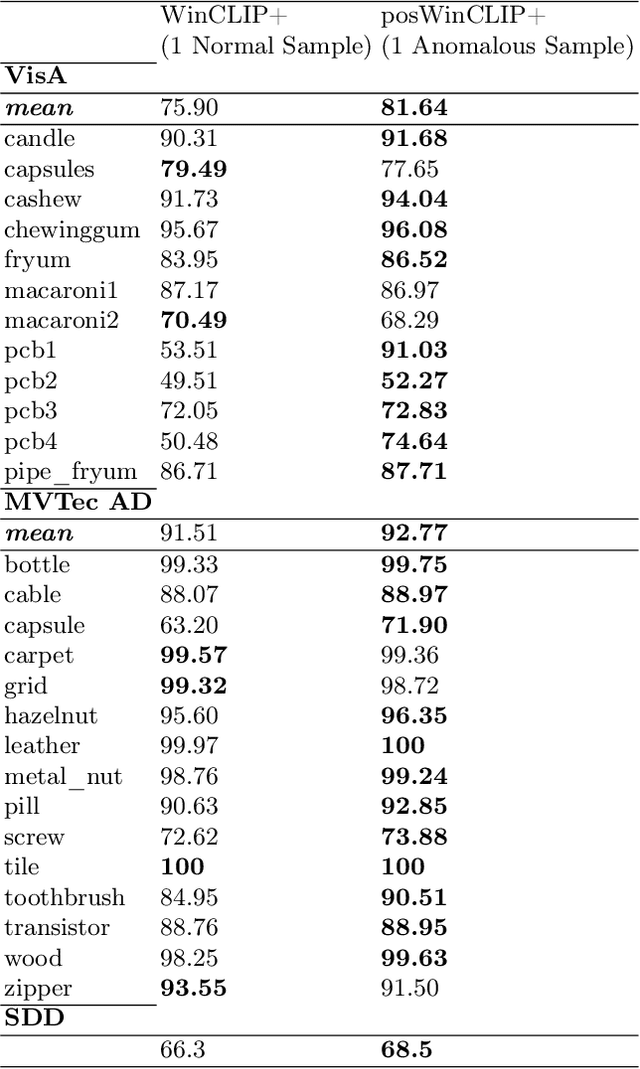
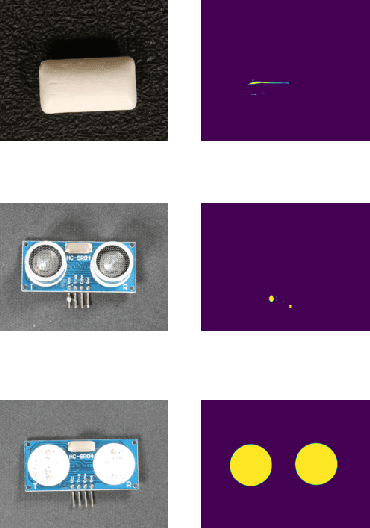
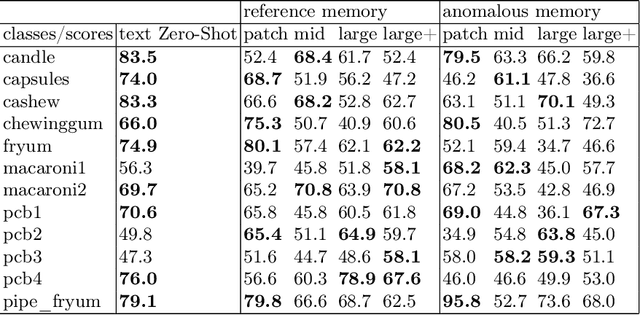
Several anomaly detection and classification methods rely on large amounts of non-anomalous or "normal" samples under the assump- tion that anomalous data is typically harder to acquire. This hypothesis becomes questionable in Few-Shot settings, where as little as one anno- tated sample can make a significant difference. In this paper, we tackle the question of utilizing anomalous samples in training a model for bi- nary anomaly classification. We propose a methodology that incorporates anomalous samples in a multi-score anomaly detection score leveraging recent Zero-Shot and memory-based techniques. We compare the utility of anomalous samples to that of regular samples and study the benefits and limitations of each. In addition, we propose an augmentation-based validation technique to optimize the aggregation of the different anomaly scores and demonstrate its effectiveness on popular industrial anomaly detection datasets.
Object-Centric Cropping for Visual Few-Shot Classification
Jul 31, 2025In the domain of Few-Shot Image Classification, operating with as little as one example per class, the presence of image ambiguities stemming from multiple objects or complex backgrounds can significantly deteriorate performance. Our research demonstrates that incorporating additional information about the local positioning of an object within its image markedly enhances classification across established benchmarks. More importantly, we show that a significant fraction of the improvement can be achieved through the use of the Segment Anything Model, requiring only a pixel of the object of interest to be pointed out, or by employing fully unsupervised foreground object extraction methods.
ProKeR: A Kernel Perspective on Few-Shot Adaptation of Large Vision-Language Models
Jan 19, 2025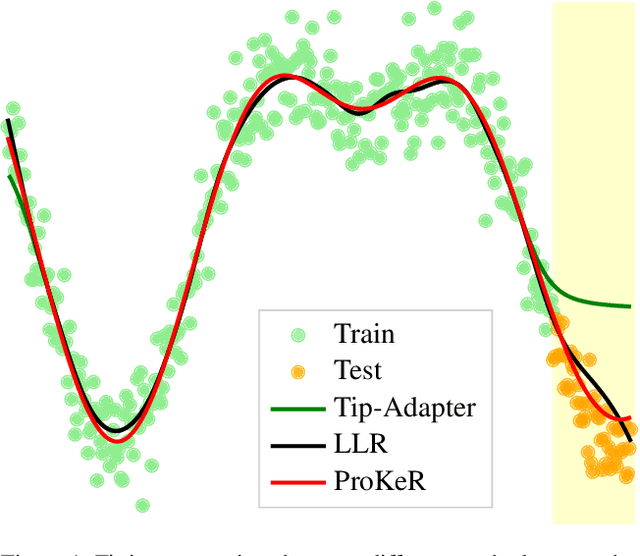
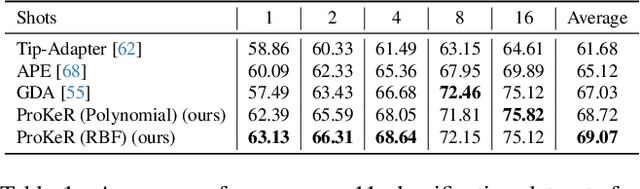
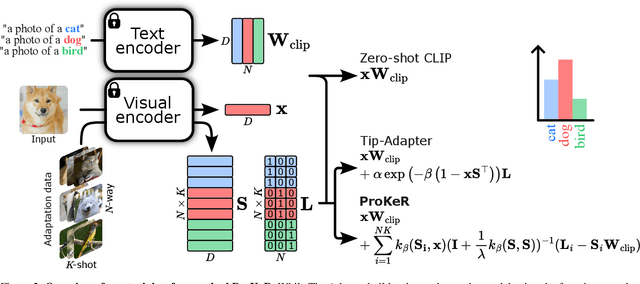
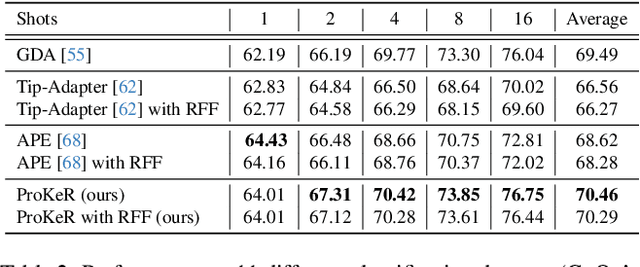
The growing popularity of Contrastive Language-Image Pretraining (CLIP) has led to its widespread application in various visual downstream tasks. To enhance CLIP's effectiveness and versatility, efficient few-shot adaptation techniques have been widely adopted. Among these approaches, training-free methods, particularly caching methods exemplified by Tip-Adapter, have gained attention for their lightweight adaptation without the need for additional fine-tuning. In this paper, we revisit Tip-Adapter from a kernel perspective, showing that caching methods function as local adapters and are connected to a well-established kernel literature. Drawing on this insight, we offer a theoretical understanding of how these methods operate and suggest multiple avenues for enhancing the Tip-Adapter baseline. Notably, our analysis shows the importance of incorporating global information in local adapters. Therefore, we subsequently propose a global method that learns a proximal regularizer in a reproducing kernel Hilbert space (RKHS) using CLIP as a base learner. Our method, which we call ProKeR (Proximal Kernel ridge Regression), has a closed form solution and achieves state-of-the-art performances across 11 datasets in the standard few-shot adaptation benchmark.