 Add to Chrome
 Add to Firefox
 Add to Edge
D5P4: Partition Determinantal Point Process for Diversity in Parallel Discrete Diffusion Decoding
Mar 19, 2026
Discrete diffusion models are promising alternatives to autoregressive approaches for text generation, yet their decoding methods remain under-studied. Standard decoding methods for autoregressive models, such as beam search, do not directly apply to iterative denoising, and existing diffusion decoding techniques provide limited control over in-batch diversity. To bridge this gap, we introduce a generalized beam-search framework for discrete diffusion that generates candidates in parallel and supports modular beam-selection objectives. As a diversity-focused instantiation, we propose D5P4, which formulates the selection step as MAP inference over a Determinantal Point Process. Leveraging a scalable greedy solver, D5P4 maintains multi-GPU compatibility and enables an explicit trade-off between model probability and target diversity with near-zero compute overhead. Experiments on free-form generation and question answering demonstrate that D5P4 improves diversity over strong baselines while maintaining competitive generation quality.

Residual Connections and the Causal Shift: Uncovering a Structural Misalignment in Transformers
Feb 16, 2026Large Language Models (LLMs) are trained with next-token prediction, implemented in autoregressive Transformers via causal masking for parallelism. This creates a subtle misalignment: residual connections tie activations to the current token, while supervision targets the next token, potentially propagating mismatched information if the current token is not the most informative for prediction. In this work, we empirically localize this input-output alignment shift in pretrained LLMs, using decoding trajectories over tied embedding spaces and similarity-based metrics. Our experiments reveal that the hidden token representations switch from input alignment to output alignment deep within the network. Motivated by this observation, we propose a lightweight residual-path mitigation based on residual attenuation, implemented either as a fixed-layer intervention or as a learnable gating mechanism. Experiments on multiple benchmarks show that these strategies alleviate the representation misalignment and yield improvements, providing an efficient and general architectural enhancement for autoregressive Transformers.
Inner Loop Inference for Pretrained Transformers: Unlocking Latent Capabilities Without Training
Feb 16, 2026Deep Learning architectures, and in particular Transformers, are conventionally viewed as a composition of layers. These layers are actually often obtained as the sum of two contributions: a residual path that copies the input and the output of a Transformer block. As a consequence, the inner representations (i.e. the input of these blocks) can be interpreted as iterative refinement of a propagated latent representation. Under this lens, many works suggest that the inner space is shared across layers, meaning that tokens can be decoded at early stages. Mechanistic interpretability even goes further by conjecturing that some layers act as refinement layers. Following this path, we propose inference-time inner looping, which prolongs refinement in pretrained off-the-shelf language models by repeatedly re-applying a selected block range. Across multiple benchmarks, inner looping yields modest but consistent accuracy improvements. Analyses of the resulting latent trajectories suggest more stable state evolution and continued semantic refinement. Overall, our results suggest that additional refinement can be obtained through simple test-time looping, extending computation in frozen pretrained models.
SAFT: Towards Out-of-Distribution Generalization in Fine-Tuning
Jul 03, 2024
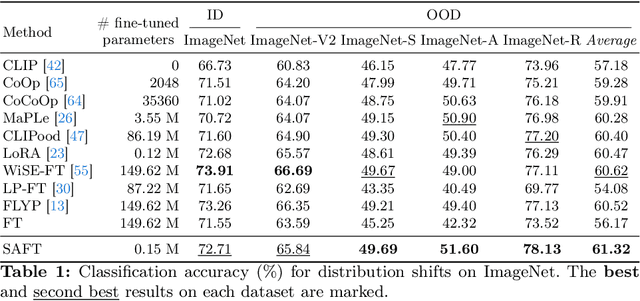

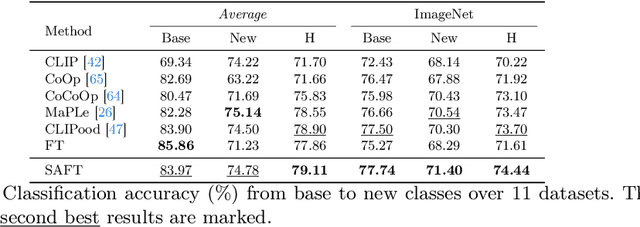
Handling distribution shifts from training data, known as out-of-distribution (OOD) generalization, poses a significant challenge in the field of machine learning. While a pre-trained vision-language model like CLIP has demonstrated remarkable zero-shot performance, further adaptation of the model to downstream tasks leads to undesirable degradation for OOD data. In this work, we introduce Sparse Adaptation for Fine-Tuning (SAFT), a method that prevents fine-tuning from forgetting the general knowledge in the pre-trained model. SAFT only updates a small subset of important parameters whose gradient magnitude is large, while keeping the other parameters frozen. SAFT is straightforward to implement and conceptually simple. Extensive experiments show that with only 0.1% of the model parameters, SAFT can significantly improve the performance of CLIP. It consistently outperforms baseline methods across several benchmarks. On the few-shot learning benchmark of ImageNet and its variants, SAFT gives a gain of 5.15% on average over the conventional fine-tuning method in OOD settings.
LLM meets Vision-Language Models for Zero-Shot One-Class Classification
Apr 02, 2024We consider the problem of zero-shot one-class visual classification. In this setting, only the label of the target class is available, and the goal is to discriminate between positive and negative query samples without requiring any validation example from the target task. We propose a two-step solution that first queries large language models for visually confusing objects and then relies on vision-language pre-trained models (e.g., CLIP) to perform classification. By adapting large-scale vision benchmarks, we demonstrate the ability of the proposed method to outperform adapted off-the-shelf alternatives in this setting. Namely, we propose a realistic benchmark where negative query samples are drawn from the same original dataset as positive ones, including a granularity-controlled version of iNaturalist, where negative samples are at a fixed distance in the taxonomy tree from the positive ones. Our work shows that it is possible to discriminate between a single category and other semantically related ones using only its label
A Novel Benchmark for Few-Shot Semantic Segmentation in the Era of Foundation Models
Jan 20, 2024
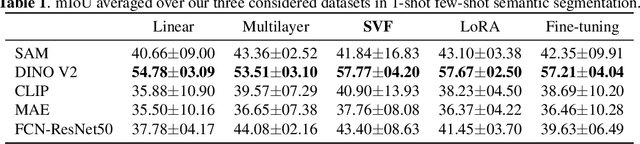
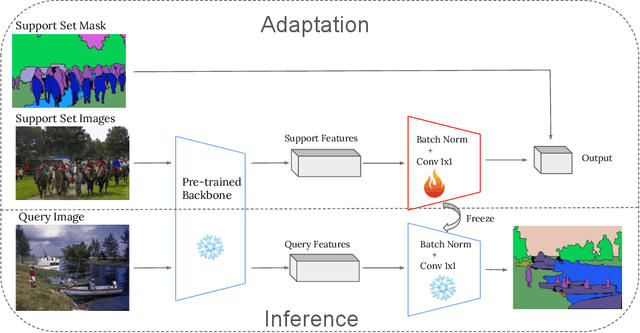
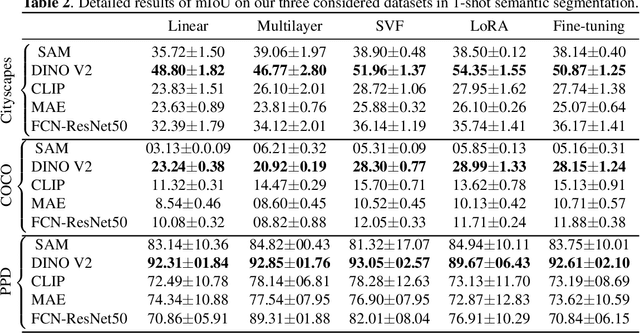
In recent years, the rapid evolution of computer vision has seen the emergence of various vision foundation models, each tailored to specific data types and tasks. While large language models often share a common pretext task, the diversity in vision foundation models arises from their varying training objectives. In this study, we delve into the quest for identifying the most effective vision foundation models for few-shot semantic segmentation, a critical task in computer vision. Specifically, we conduct a comprehensive comparative analysis of four prominent foundation models: DINO V2, Segment Anything, CLIP, Masked AutoEncoders, and a straightforward ResNet50 pre-trained on the COCO dataset. Our investigation focuses on their adaptability to new semantic segmentation tasks, leveraging only a limited number of segmented images. Our experimental findings reveal that DINO V2 consistently outperforms the other considered foundation models across a diverse range of datasets and adaptation methods. This outcome underscores DINO V2's superior capability to adapt to semantic segmentation tasks compared to its counterparts. Furthermore, our observations indicate that various adapter methods exhibit similar performance, emphasizing the paramount importance of selecting a robust feature extractor over the intricacies of the adaptation technique itself. This insight sheds light on the critical role of feature extraction in the context of few-shot semantic segmentation. This research not only contributes valuable insights into the comparative performance of vision foundation models in the realm of few-shot semantic segmentation but also highlights the significance of a robust feature extractor in this domain.
Inferring Latent Class Statistics from Text for Robust Visual Few-Shot Learning
Nov 24, 2023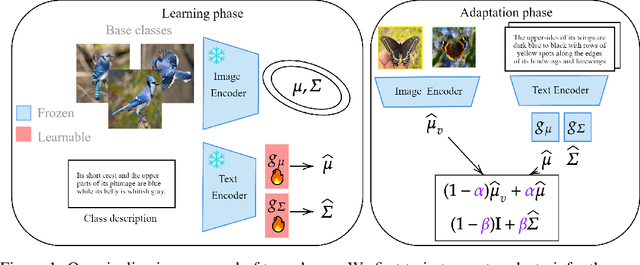
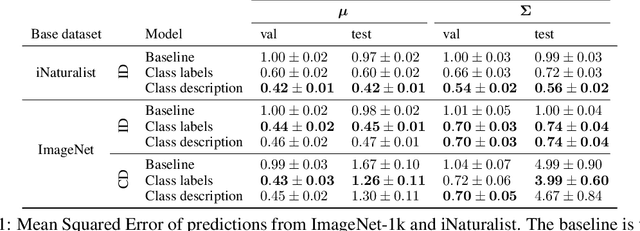
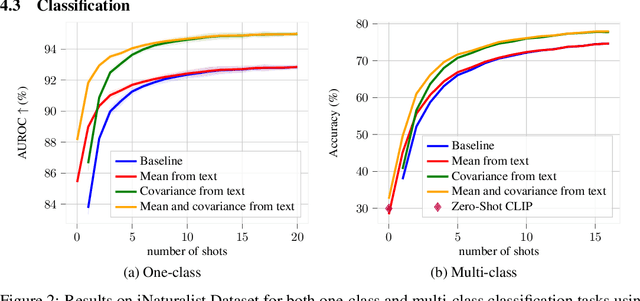
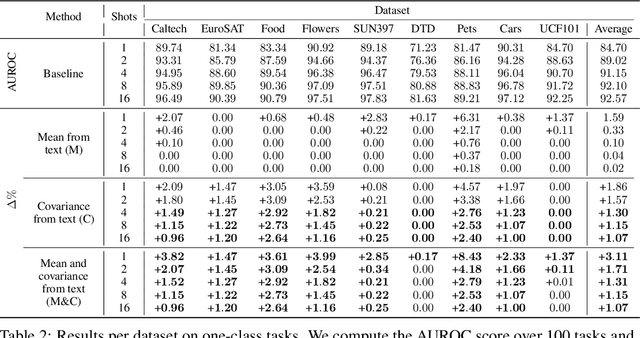
In the realm of few-shot learning, foundation models like CLIP have proven effective but exhibit limitations in cross-domain robustness especially in few-shot settings. Recent works add text as an extra modality to enhance the performance of these models. Most of these approaches treat text as an auxiliary modality without fully exploring its potential to elucidate the underlying class visual features distribution. In this paper, we present a novel approach that leverages text-derived statistics to predict the mean and covariance of the visual feature distribution for each class. This predictive framework enriches the latent space, yielding more robust and generalizable few-shot learning models. We demonstrate the efficacy of incorporating both mean and covariance statistics in improving few-shot classification performance across various datasets. Our method shows that we can use text to predict the mean and covariance of the distribution offering promising improvements in few-shot learning scenarios.
DBsurf: A Discrepancy Based Method for Discrete Stochastic Gradient Estimation
Sep 07, 2023Computing gradients of an expectation with respect to the distributional parameters of a discrete distribution is a problem arising in many fields of science and engineering. Typically, this problem is tackled using Reinforce, which frames the problem of gradient estimation as a Monte Carlo simulation. Unfortunately, the Reinforce estimator is especially sensitive to discrepancies between the true probability distribution and the drawn samples, a common issue in low sampling regimes that results in inaccurate gradient estimates. In this paper, we introduce DBsurf, a reinforce-based estimator for discrete distributions that uses a novel sampling procedure to reduce the discrepancy between the samples and the actual distribution. To assess the performance of our estimator, we subject it to a diverse set of tasks. Among existing estimators, DBsurf attains the lowest variance in a least squares problem commonly used in the literature for benchmarking. Furthermore, DBsurf achieves the best results for training variational auto-encoders (VAE) across different datasets and sampling setups. Finally, we apply DBsurf to build a simple and efficient Neural Architecture Search (NAS) algorithm with state-of-the-art performance.
Towards Robust FastSpeech 2 by Modelling Residual Multimodality
Jun 02, 2023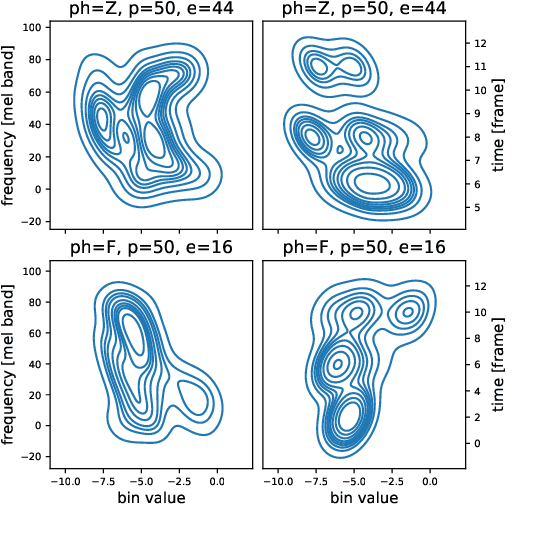
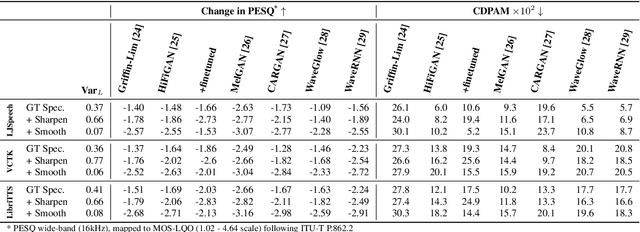
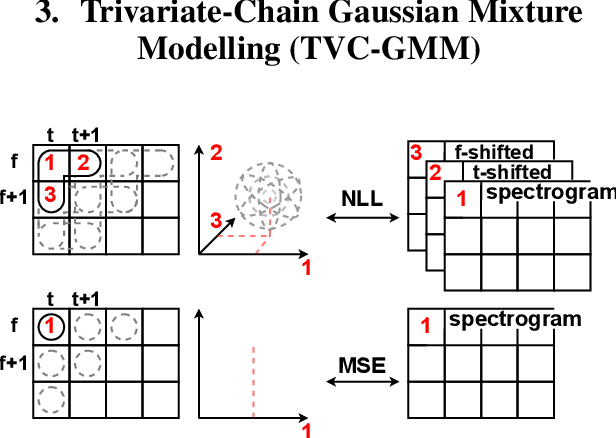
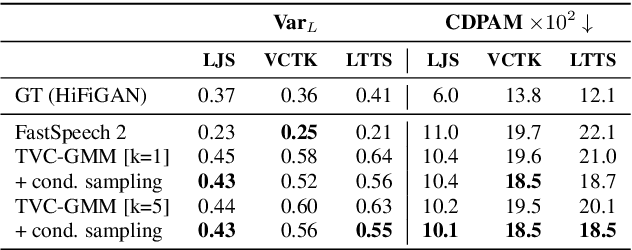
State-of-the-art non-autoregressive text-to-speech (TTS) models based on FastSpeech 2 can efficiently synthesise high-fidelity and natural speech. For expressive speech datasets however, we observe characteristic audio distortions. We demonstrate that such artefacts are introduced to the vocoder reconstruction by over-smooth mel-spectrogram predictions, which are induced by the choice of mean-squared-error (MSE) loss for training the mel-spectrogram decoder. With MSE loss FastSpeech 2 is limited to learn conditional averages of the training distribution, which might not lie close to a natural sample if the distribution still appears multimodal after all conditioning signals. To alleviate this problem, we introduce TVC-GMM, a mixture model of Trivariate-Chain Gaussian distributions, to model the residual multimodality. TVC-GMM reduces spectrogram smoothness and improves perceptual audio quality in particular for expressive datasets as shown by both objective and subjective evaluation.
Improving Self-Supervised Learning for Audio Representations by Feature Diversity and Decorrelation
Mar 07, 2023Self-supervised learning (SSL) has recently shown remarkable results in closing the gap between supervised and unsupervised learning. The idea is to learn robust features that are invariant to distortions of the input data. Despite its success, this idea can suffer from a collapsing issue where the network produces a constant representation. To this end, we introduce SELFIE, a novel Self-supervised Learning approach for audio representation via Feature Diversity and Decorrelation. SELFIE avoids the collapsing issue by ensuring that the representation (i) maintains a high diversity among embeddings and (ii) decorrelates the dependencies between dimensions. SELFIE is pre-trained on the large-scale AudioSet dataset and its embeddings are validated on nine audio downstream tasks, including speech, music, and sound event recognition. Experimental results show that SELFIE outperforms existing SSL methods in several tasks.