 Add to Chrome
 Add to Firefox
 Add to Edge
SLAD : Shared LoRA Adapters for Task Specific Distillation
May 28, 2026
In the context of resource-constrained environments such as embedded systems, adapting reduced-size foundation models to downstream tasks has become increasingly popular. This has recently motivated the emerging setting of task-specific distillation, where a larger and a smaller version of the same foundation model are both adapted to the same downstream task, with the goal of transferring knowledge from the former to the latter. Recent work has demonstrated the benefits of using a larger version of the same foundation model to assist the adaptation of a smaller one. Typically, the larger model (teacher) is first adapted via fine-tuning or linear probing before its knowledge is distilled into the smaller model (student). While fine-tuning the teacher often increases its performance, recent work showed that probing it leads to better knowledge distillation to the student. Our findings show that this is mainly due to a mis-alignment in feature representation between the teacher and the student which occurs during the teacher's fine-tuning. Inspired by existing efforts to preserve previously learned knowledge, we first propose leveraging low-rank adaptation, resulting in better feature alignment and therefore better knowledge transfer. Drawing from this insight, we further enhance the feature alignment through a parameter-sharing strategy of the adapters between the two encoders during joint training. Our proposed method, SLAD, shows better feature alignment between the teacher and student, which results in increased performance for not only the student but also the teacher model, while being 2x faster to train than fine-tuning. Through extensive experiments on multiple classification and segmentation datasets, we demonstrate the improved accuracy and transfer efficiency of our method, achieving state-of-the-art performance in the task-specific distillation framework.

Efficient Few-Shot Learning for Edge AI via Knowledge Distillation on MobileViT
Mar 27, 2026Efficient and adaptable deep learning models are an important area of deep learning research, driven by the need for highly efficient models on edge devices. Few-shot learning enables the use of deep learning models in low-data regimes, a capability that is highly sought after in real-world applications where collecting large annotated datasets is costly or impractical. This challenge is particularly relevant in edge scenarios, where connectivity may be limited, low-latency responses are required, or energy consumption constraints are critical. We propose and evaluate a pre-training method for the MobileViT backbone designed for edge computing. Specifically, we employ knowledge distillation, which transfers the generalization ability of a large-scale teacher model to a lightweight student model. This method achieves accuracy improvements of 14% and 6.7% for one-shot and five-shot classification, respectively, on the MiniImageNet benchmark, compared to the ResNet12 baseline, while reducing by 69% the number of parameters and by 88% the computational complexity of the model, in FLOPs. Furthermore, we deployed the proposed models on a Jetson Orin Nano platform and measured power consumption directly at the power supply, showing that the dynamic energy consumption is reduced by 37% with a latency of 2.6 ms. These results demonstrate that the proposed method is a promising and practical solution for deploying few-shot learning models on edge AI hardware.
A Novel Benchmark for Few-Shot Semantic Segmentation in the Era of Foundation Models
Jan 20, 2024
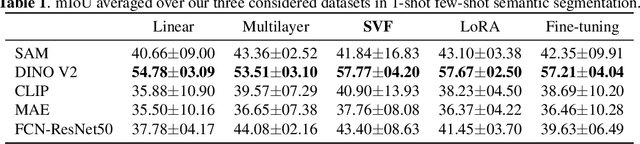
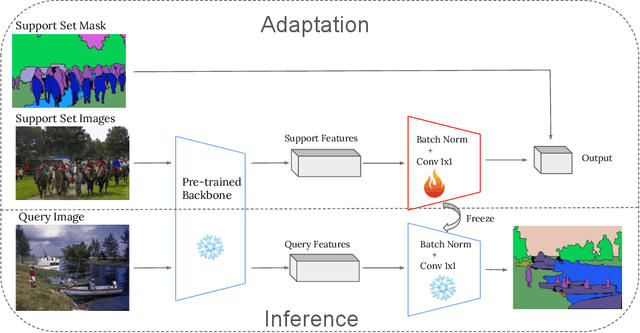
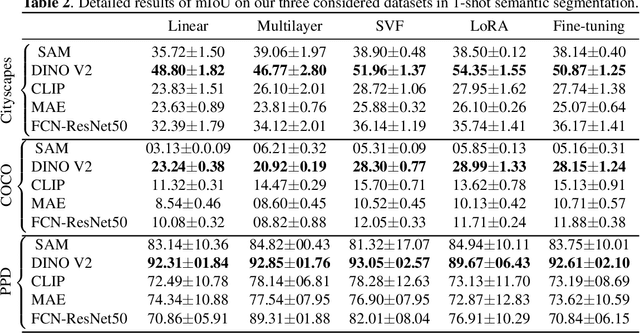
In recent years, the rapid evolution of computer vision has seen the emergence of various vision foundation models, each tailored to specific data types and tasks. While large language models often share a common pretext task, the diversity in vision foundation models arises from their varying training objectives. In this study, we delve into the quest for identifying the most effective vision foundation models for few-shot semantic segmentation, a critical task in computer vision. Specifically, we conduct a comprehensive comparative analysis of four prominent foundation models: DINO V2, Segment Anything, CLIP, Masked AutoEncoders, and a straightforward ResNet50 pre-trained on the COCO dataset. Our investigation focuses on their adaptability to new semantic segmentation tasks, leveraging only a limited number of segmented images. Our experimental findings reveal that DINO V2 consistently outperforms the other considered foundation models across a diverse range of datasets and adaptation methods. This outcome underscores DINO V2's superior capability to adapt to semantic segmentation tasks compared to its counterparts. Furthermore, our observations indicate that various adapter methods exhibit similar performance, emphasizing the paramount importance of selecting a robust feature extractor over the intricacies of the adaptation technique itself. This insight sheds light on the critical role of feature extraction in the context of few-shot semantic segmentation. This research not only contributes valuable insights into the comparative performance of vision foundation models in the realm of few-shot semantic segmentation but also highlights the significance of a robust feature extractor in this domain.