 Add to Chrome
 Add to Firefox
 Add to Edge
MONET: Modeling and Optimization of neural NEtwork Training from Edge to Data Centers
Mar 16, 2026
While hardware-software co-design has significantly improved the efficiency of neural network inference, modeling the training phase remains a critical yet underexplored challenge. Training workloads impose distinct constraints, particularly regarding memory footprint and backpropagation complexity, which existing inference-focused tools fail to capture. This paper introduces MONET, a framework designed to model the training of neural networks on heterogeneous dataflow accelerators. MONET builds upon Stream, an experimentally verified framework that that models the inference of neural networks on heterogeneous dataflow accelerators with layer fusion. Using MONET, we explore the design space of ResNet-18 and a small GPT-2, demonstrating the framework's capability to model training workflows and find better hardware architectures. We then further examine problems that become more complex in neural network training due to the larger design space, such as determining the best layer-fusion configuration. Additionally, we use our framework to find interesting trade-offs in activation checkpointing, with the help of a genetic algorithm. Our findings highlight the importance of a holistic approach to hardware-software co-design for scalable and efficient deep learning deployment.

Precision-Scalable Microscaling Datapaths with Optimized Reduction Tree for Efficient NPU Integration
Nov 09, 2025Emerging continual learning applications necessitate next-generation neural processing unit (NPU) platforms to support both training and inference operations. The promising Microscaling (MX) standard enables narrow bit-widths for inference and large dynamic ranges for training. However, existing MX multiply-accumulate (MAC) designs face a critical trade-off: integer accumulation requires expensive conversions from narrow floating-point products, while FP32 accumulation suffers from quantization losses and costly normalization. To address these limitations, we propose a hybrid precision-scalable reduction tree for MX MACs that combines the benefits of both approaches, enabling efficient mixed-precision accumulation with controlled accuracy relaxation. Moreover, we integrate an 8x8 array of these MACs into the state-of-the-art (SotA) NPU integration platform, SNAX, to provide efficient control and data transfer to our optimized precision-scalable MX datapath. We evaluate our design both on MAC and system level and compare it to the SotA. Our integrated system achieves an energy efficiency of 657, 1438-1675, and 4065 GOPS/W, respectively, for MXINT8, MXFP8/6, and MXFP4, with a throughput of 64, 256, and 512 GOPS.
Efficient Precision-Scalable Hardware for Microscaling (MX) Processing in Robotics Learning
May 28, 2025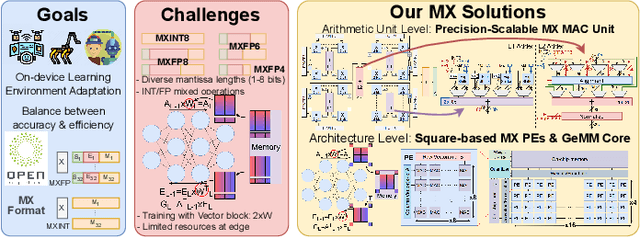
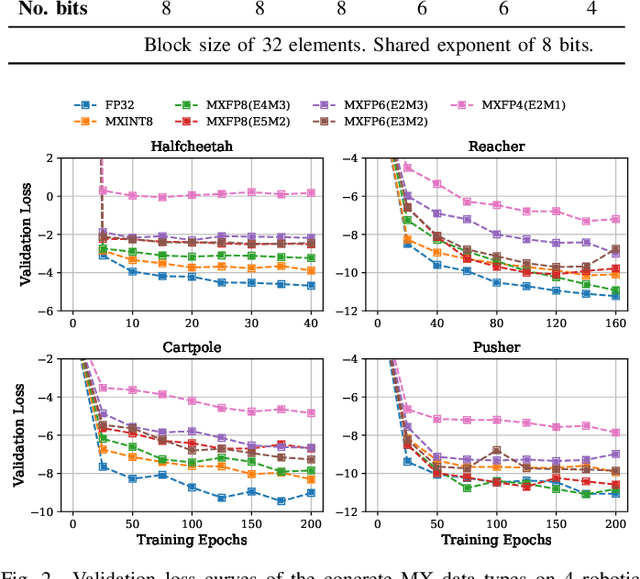
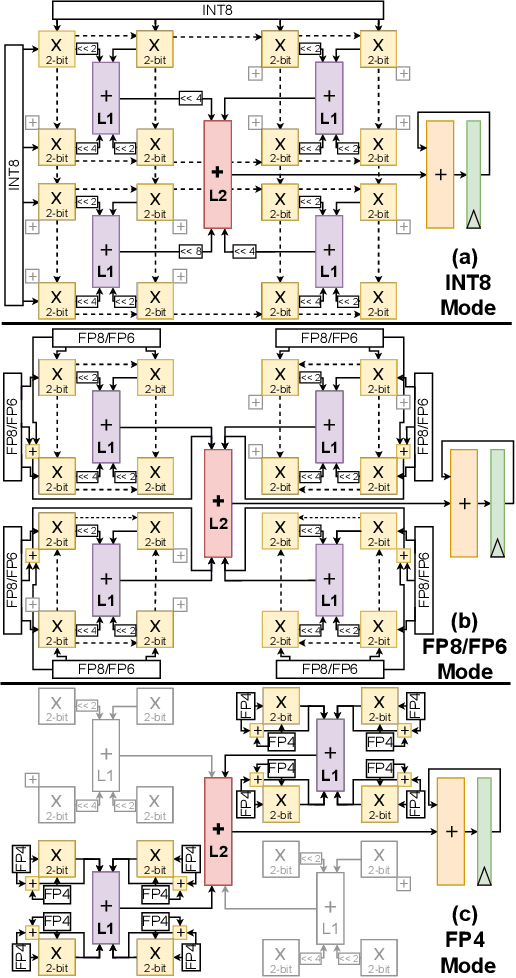
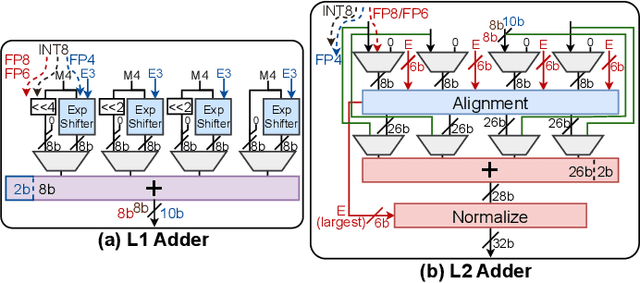
Autonomous robots require efficient on-device learning to adapt to new environments without cloud dependency. For this edge training, Microscaling (MX) data types offer a promising solution by combining integer and floating-point representations with shared exponents, reducing energy consumption while maintaining accuracy. However, the state-of-the-art continuous learning processor, namely Dacapo, faces limitations with its MXINT-only support and inefficient vector-based grouping during backpropagation. In this paper, we present, to the best of our knowledge, the first work that addresses these limitations with two key innovations: (1) a precision-scalable arithmetic unit that supports all six MX data types by exploiting sub-word parallelism and unified integer and floating-point processing; and (2) support for square shared exponent groups to enable efficient weight handling during backpropagation, removing storage redundancy and quantization overhead. We evaluate our design against Dacapo under iso-peak-throughput on four robotics workloads in TSMC 16nm FinFET technology at 500MHz, reaching a 25.6% area reduction, a 51% lower memory footprint, and 4x higher effective training throughput while achieving comparable energy-efficiency, enabling efficient robotics continual learning at the edge.