 Add to Chrome
 Add to Firefox
 Add to Edge
A Self-Supervised Approach for Minimal-Annotation Hydroacoustic Data Exploration
Jul 07, 2026
Passive hydroacoustic monitoring often generates large volumes of continuous recordings that are only partially exploited due to the cost of manual annotation. Supervised detection methods perform well but require large labeled datasets, seldom available for rare signals or understudied environments. This work proposes a self-supervised exploration pipeline to address this limitation in low-frequency settings. A Masked AutoEncoder (MAE) is pre-trained on a reconstruction pretext task, then used to extract patch-level representations from spectrograms. Within each spectrogram, adjacent informative patches are aggregated into event-level embeddings, enabling the disentanglement of overlapping events. These embeddings are then clustered at the dataset scale using the dimension reduction algorithm UMAP and the clustering algorithm HDBSCAN to identify hydroacoustic patterns. The pipeline was applied to a multi-year hydroacoustic dataset collected near Mayotte Island, Indian Ocean, containing marine mammal vocalizations, seismo-volcanic signals, and anthropogenic noise. The 317 clusters were manually mapped to 15 hydroacoustic classes or noise in less than one hour. The method was evaluated in two ways. Quantitatively, when used as a classifier, it achieved performance comparable to two existing detectors. Qualitatively, it recovered known seasonal patterns of marine mammal acoustic activity. It also identified patterns of previously unstudied signals, thereby demonstrating its practical value.

Can pre-trained Deep Learning models predict groove ratings?
Mar 28, 2026This study explores the extent to which deep learning models can predict groove and its related perceptual dimensions directly from audio signals. We critically examine the effectiveness of seven state-of-the-art deep learning models in predicting groove ratings and responses to groove-related queries through the extraction of audio embeddings. Additionally, we compare these predictions with traditional handcrafted audio features. To better understand the underlying mechanics, we extend this methodology to analyze predictions based on source-separated instruments, thereby isolating the contributions of individual musical elements. Our analysis reveals a clear separation of groove characteristics driven by the underlying musical style of the tracks (funk, pop, and rock). These findings indicate that deep audio representations can successfully encode complex, style-dependent groove components that traditional features often miss. Ultimately, this work highlights the capacity of advanced deep learning models to capture the multifaceted concept of groove, demonstrating the strong potential of representation learning to advance predictive Music Information Retrieval methodologies.
Unsupervised Evaluation of Deep Audio Embeddings for Music Structure Analysis
Mar 28, 2026Music Structure Analysis (MSA) aims to uncover the high-level organization of musical pieces. State-of-the-art methods are often based on supervised deep learning, but these methods are bottlenecked by the need for heavily annotated data and inherent structural ambiguities. In this paper, we propose an unsupervised evaluation of nine open-source, generic pre-trained deep audio models, on MSA. For each model, we extract barwise embeddings and segment them using three unsupervised segmentation algorithms (Foote's checkerboard kernels, spectral clustering, and Correlation Block-Matching (CBM)), focusing exclusively on boundary retrieval. Our results demonstrate that modern, generic deep embeddings generally outperform traditional spectrogram-based baselines, but not systematically. Furthermore, our unsupervised boundary estimation methodology generally yields stronger performance than recent linear probing baselines. Among the evaluated techniques, the CBM algorithm consistently emerges as the most effective downstream segmentation method. Finally, we highlight the artificial inflation of standard evaluation metrics and advocate for the systematic adoption of ``trimming'', or even ``double trimming'' annotations to establish more rigorous MSA evaluation standards.
D5P4: Partition Determinantal Point Process for Diversity in Parallel Discrete Diffusion Decoding
Mar 19, 2026Discrete diffusion models are promising alternatives to autoregressive approaches for text generation, yet their decoding methods remain under-studied. Standard decoding methods for autoregressive models, such as beam search, do not directly apply to iterative denoising, and existing diffusion decoding techniques provide limited control over in-batch diversity. To bridge this gap, we introduce a generalized beam-search framework for discrete diffusion that generates candidates in parallel and supports modular beam-selection objectives. As a diversity-focused instantiation, we propose D5P4, which formulates the selection step as MAP inference over a Determinantal Point Process. Leveraging a scalable greedy solver, D5P4 maintains multi-GPU compatibility and enables an explicit trade-off between model probability and target diversity with near-zero compute overhead. Experiments on free-form generation and question answering demonstrate that D5P4 improves diversity over strong baselines while maintaining competitive generation quality.
Barwise Music Structure Analysis with the Correlation Block-Matching Segmentation Algorithm
Nov 30, 2023

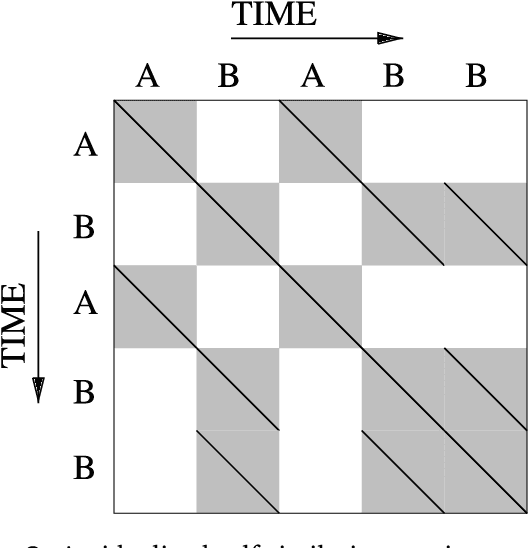

Music Structure Analysis (MSA) is a Music Information Retrieval task consisting of representing a song in a simplified, organized manner by breaking it down into sections typically corresponding to ``chorus'', ``verse'', ``solo'', etc. In this work, we extend an MSA algorithm called the Correlation Block-Matching (CBM) algorithm introduced by (Marmoret et al., 2020, 2022b). The CBM algorithm is a dynamic programming algorithm that segments self-similarity matrices, which are a standard description used in MSA and in numerous other applications. In this work, self-similarity matrices are computed from the feature representation of an audio signal and time is sampled at the bar-scale. This study examines three different standard similarity functions for the computation of self-similarity matrices. Results show that, in optimal conditions, the proposed algorithm achieves a level of performance which is competitive with supervised state-of-the-art methods while only requiring knowledge of bar positions. In addition, the algorithm is made open-source and is highly customizable.
* 19 pages, 13 figures, 11 tables, 1 algorithm, published in Transactions of the International Society for Music Information Retrieval
Polytopic Analysis of Music
Dec 22, 2022
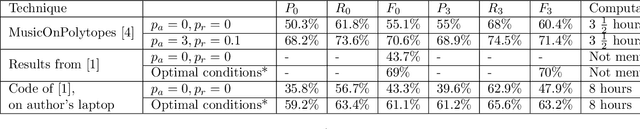

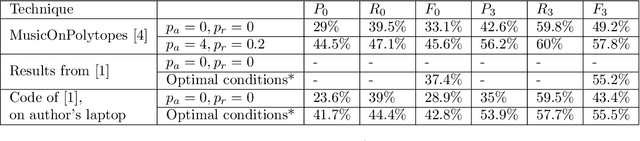
Structural segmentation of music refers to the task of finding a symbolic representation of the organisation of a song, reducing the musical flow to a partition of non-overlapping segments. Under this definition, the musical structure may not be unique, and may even be ambiguous. One way to resolve that ambiguity is to see this task as a compression process, and to consider the musical structure as the optimization of a given compression criteria. In that viewpoint, C. Guichaoua developed a compression-driven model for retrieving the musical structure, based on the "System and Contrast" model, and on polytopes, which are extension of nhypercubes. We present this model, which we call "polytopic analysis of music", along with a new opensource dedicated toolbox called MusicOnPolytopes (in Python). This model is also extended to the use of the Tonnetz as a relation system. Structural segmentation experiments are conducted on the RWC Pop dataset. Results show improvements compared to the previous ones, presented by C. Guichaoua.
Convolutive Block-Matching Segmentation Algorithm with Application to Music Structure Analysis
Oct 27, 2022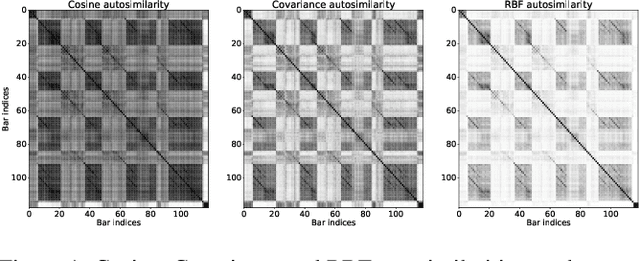
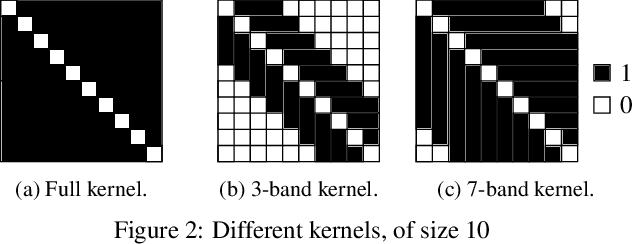
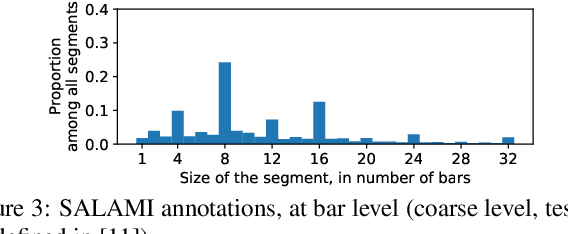
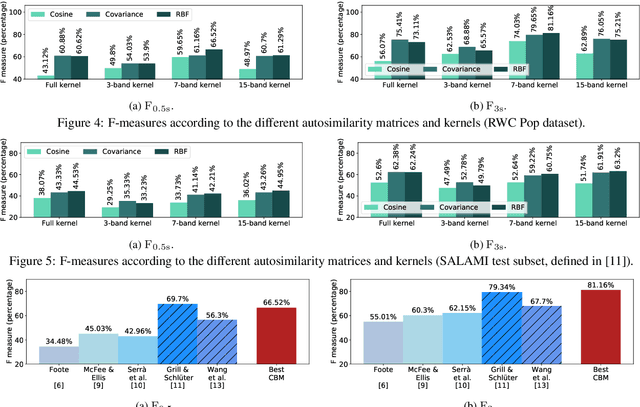
Music Structure Analysis (MSA) consists of representing a song in sections (such as ``chorus'', ``verse'', ``solo'' etc), and can be seen as the retrieval of a simplified organization of the song. This work presents a new algorithm, called Convolutive Block-Matching (CBM) algorithm, devoted to MSA. In particular, the CBM algorithm is a dynamic programming algorithm, applying on autosimilarity matrices, a standard tool in MSA. In this work, autosimilarity matrices are computed from the feature representation of an audio signal, and time is sampled on the barscale. We study three different similarity functions for the computation of autosimilarity matrices. We report that the proposed algorithm achieves a level of performance competitive to that of supervised state-of-the-art methods on 3 among 4 metrics, while being fully unsupervised.
Semi-Supervised Convolutive NMF for Automatic Music Transcription
Feb 10, 2022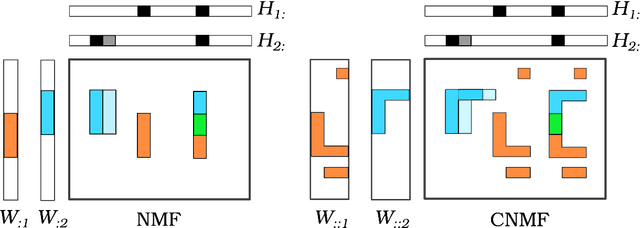
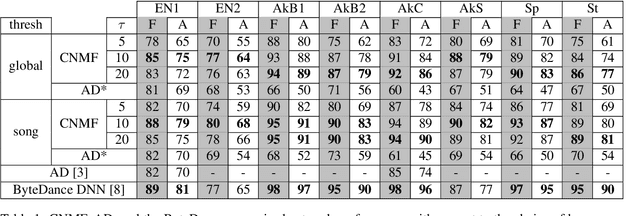
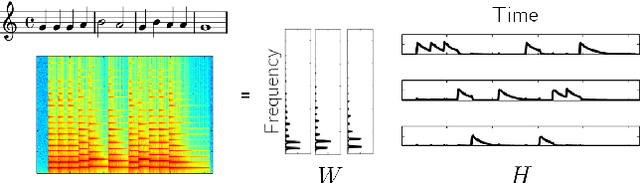
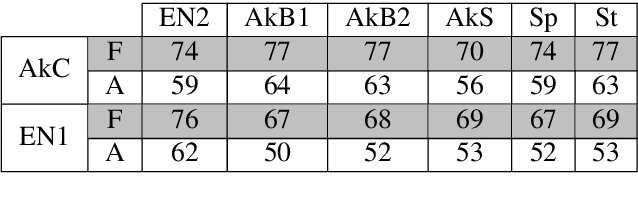
Automatic Music Transcription, which consists in transforming an audio recording of a musical performance into symbolic format, remains a difficult Music Information Retrieval task. In this work, we propose a semi-supervised approach using low-rank matrix factorization techniques, in particular Convolutive Nonnegative Matrix Factorization. In the semi-supervised setting, only a single recording of each individual notes is required. We show on the MAPS dataset that the proposed semi-supervised CNMF method performs better than state-of-the-art low-rank factorization techniques and a little worse than supervised deep learning state-of-the-art methods, while however suffering from generalization issues.
Barwise Compression Schemes for Audio-Based Music Structure Analysis
Feb 10, 2022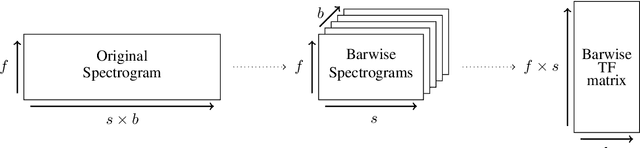
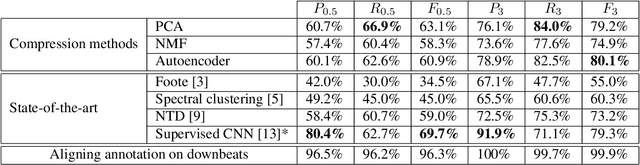
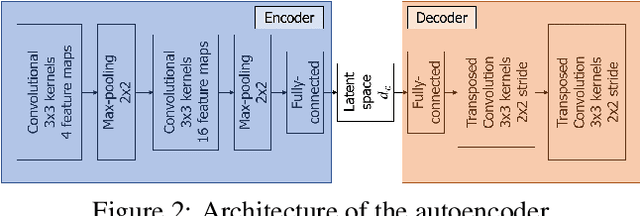
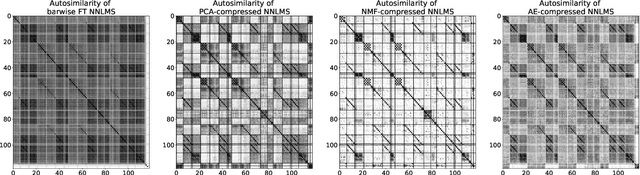
Music Structure Analysis (MSA) consists in segmenting a music piece in several distinct sections. We approach MSA within a compression framework, under the hypothesis that the structure is more easily revealed by a simplified representation of the original content of the song. More specifically, under the hypothesis that MSA is correlated with similarities occurring at the bar scale, linear and non-linear compression schemes can be applied to barwise audio signals. Compressed representations capture the most salient components of the different bars in the song and are then used to infer the song structure using a dynamic programming algorithm. This work explores both low-rank approximation models such as Principal Component Analysis or Nonnegative Matrix Factorization and "piece-specific" Auto-Encoding Neural Networks, with the objective to learn latent representations specific to a given song. Such approaches do not rely on supervision nor annotations, which are well-known to be tedious to collect and possibly ambiguous in MSA description. In our experiments, several unsupervised compression schemes achieve a level of performance comparable to that of state-of-the-art supervised methods (for 3s tolerance) on the RWC-Pop dataset, showcasing the importance of the barwise compression processing for MSA.
Nonnegative Tucker Decomposition with Beta-divergence for Music Structure Analysis of audio signals
Nov 04, 2021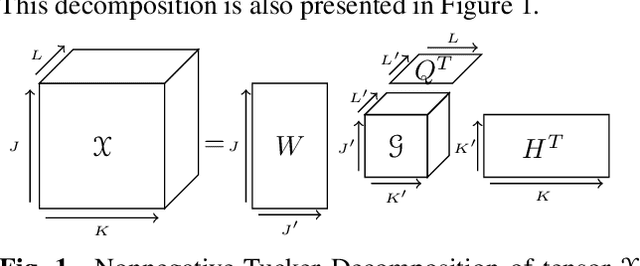
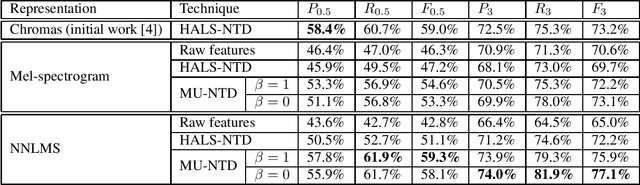
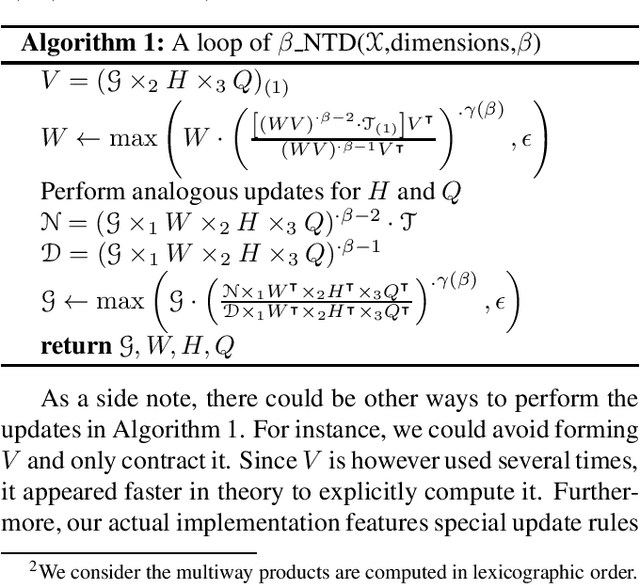
Nonnegative Tucker Decomposition (NTD), a tensor decomposition model, has received increased interest in the recent years because of its ability to blindly extract meaningful patterns in tensor data. Nevertheless, existing algorithms to compute NTD are mostly designed for the Euclidean loss. On the other hand, NTD has recently proven to be a powerful tool in Music Information Retrieval. This work proposes a Multiplicative Updates algorithm to compute NTD with the beta-divergence loss, often considered a better loss for audio processing. We notably show how to implement efficiently the multiplicative rules using tensor algebra, a naive approach being intractable. Finally, we show on a Music Structure Analysis task that unsupervised NTD fitted with beta-divergence loss outperforms earlier results obtained with the Euclidean loss.