 Add to Chrome
 Add to Firefox
 Add to Edge
Paved with True Intents: Intent-Aware Training Improves LLM Safety Classification Across Training Regimes
Jun 25, 2026
We argue that safety classifiers should model user intent as an explicit signal between the prompt and the final label. To study this, we introduce AIMS, a human-annotated dataset of 1,724 difficult safety prompts, each paired with an intent description and harm label. We use AIMS to evaluate intent-aware training across supervised fine-tuning, preference learning, reasoning distillation, and reinforcement learning. Despite its size, AIMS enables competitive safety classifiers across training regimes: DPO from model-generated intent errors improves over SFT, and intent-conditioned distillation outperforms reasoning-only distillation in most teacher-student pairs. Most notably, directly rewarding intent faithfulness with GRPO yields the strongest average performance across five external safety benchmarks, while our intent-aware models form the inference latency-F1 Pareto frontier. These results show that faithful intent modeling is a compact, high-quality supervision signal for more robust safety classifiers.

Nemotron 3 Ultra: Open, Efficient Mixture-of-Experts Hybrid Mamba-Transformer Model for Agentic Reasoning
Jun 12, 2026We introduce Nemotron 3 Ultra, a 550 billion total and 55 billion active parameter Mixture-of-Experts Hybrid Mamba-Attention language model. We pre-trained Nemotron 3 Ultra on 20 trillion text tokens, then extended the context length to 1M tokens, and post-trained using Supervised Fine Tuning (SFT), Reinforcement Learning (RL), and Multi-teacher On-Policy Distillation (MOPD). Nemotron 3 Ultra is our most capable model yet, employing multiple key technologies - LatentMoE, Multi Token Prediction (MTP), NVFP4 pre-training, multi-environment RLVR, MOPD, and reasoning budget control. Nemotron 3 Ultra achieves up to ~6x higher inference throughput as compared to state-of-the-art publicly available LLMs while attaining on-par accuracy. The state-of-the-art accuracy, high inference throughput, and 1M token context length make Nemotron 3 Ultra ideal for long-running autonomous agentic tasks. We open-source the base, post-trained, and quantized checkpoints, along with the training data and recipe on HuggingFace.
Defenses & Enablers For Skill Injection Attacks on Terminal Based Agents
Jun 01, 2026Large language model (LLM) agents increasingly rely on reusable skills i.e. documents describing task-specific procedures. However, this introduces a new attack surface for agents to manage. We study two complementary directions for this threat. First, we evaluate guardian-based defenses: an intermediary LLM agent that acts as a mediator for skill file access (dynamic guardian) or pre-rewrites these files at build time (static guardian). Across three LLM agent families, our guardians cut attack success rate (ASR) by well over half while preserving task utility. Second, we stress test them through attack reframing using four attacks that preserve the malicious instruction but change the phrasing. For non-guardian setup, the reframing pushes the ASR up to 81.4\%, but the dynamic guardian brings it down to 18.6\%, showing that real-time mediation is a robust defense.
"Înţelegi Româneşte?'' A Recipe for Romanian Vision-Language Models
Jun 01, 2026Vision-Language Models (VLMs) largely follow the text-only LLM trajectory, excelling on English benchmarks but sharply degrading on low-resource languages, where neither large-scale image-text corpora nor culturally grounded evaluations exist. We present a systematic study of building a language-specific VLM for Romanian, covering the full pipeline from data construction to architectural choices. We translate established English VLM training and evaluation corpora into Romanian, applying machine translation to textual annotations and to in-image text, preserving visual grounding while adapting the textual content. Using this data, we train and ablate a series of VLMs to isolate the contribution of (i) vision backbones of varying scale and pretraining, (ii) language backbones from multilingual to Romanian-adapted LLMs, and (iii) OCR-style image-text data. We further curate HoraVQA, a culturally native evaluation set grounded in Romanian everyday scenes. Romanian-adapted VLMs consistently outperform their same-sized counterparts and, across all evaluated benchmarks, even surpass models from the next larger size category.
Training a General Purpose Automated Red Teaming Model
Apr 24, 2026Automated methods for red teaming LLMs are an important tool to identify LLM vulnerabilities that may not be covered in static benchmarks, allowing for more thorough probing. They can also adapt to each specific LLM to discover weaknesses unique to it. Most current automated red teaming methods are intended for tackling safety and content moderation. Thus, they make use of content safety models as evaluators and optimize for circumventing them, and as such, have not been tested with other adversarial intents not typically captured by these. We propose a pipeline for training a red teaming model that can generalize to arbitrary adversarial goals, including objectives it has not been directly trained on, and that does not depend on the existence of a pre-existing evaluator available at training time. We demonstrate that finetuning small models, such as Qwen3-8B, using this pipeline results in a substantial improvement in their ability to generate attacks for both in and out of domain adversarial goals.
Nemotron 3 Super: Open, Efficient Mixture-of-Experts Hybrid Mamba-Transformer Model for Agentic Reasoning
Apr 14, 2026We describe the pre-training, post-training, and quantization of Nemotron 3 Super, a 120 billion (active 12 billion) parameter hybrid Mamba-Attention Mixture-of-Experts model. Nemotron 3 Super is the first model in the Nemotron 3 family to 1) be pre-trained in NVFP4, 2) leverage LatentMoE, a new Mixture-of-Experts architecture that optimizes for both accuracy per FLOP and accuracy per parameter, and 3) include MTP layers for inference acceleration through native speculative decoding. We pre-trained Nemotron 3 Super on 25 trillion tokens followed by post-training using supervised fine tuning (SFT) and reinforcement learning (RL). The final model supports up to 1M context length and achieves comparable accuracy on common benchmarks, while also achieving up to 2.2x and 7.5x higher inference throughput compared to GPT-OSS-120B and Qwen3.5-122B, respectively. Nemotron 3 Super datasets, along with the base, post-trained, and quantized checkpoints, are open-sourced on HuggingFace.
Complexity-based code embeddings
Jan 01, 2026This paper presents a generic method for transforming the source code of various algorithms to numerical embeddings, by dynamically analysing the behaviour of computer programs against different inputs and by tailoring multiple generic complexity functions for the analysed metrics. The used algorithms embeddings are based on r-Complexity . Using the proposed code embeddings, we present an implementation of the XGBoost algorithm that achieves an average F1-score on a multi-label dataset with 11 classes, built using real-world code snippets submitted for programming competitions on the Codeforces platform.
Semi-Supervised Learning for Large Language Models Safety and Content Moderation
Dec 24, 2025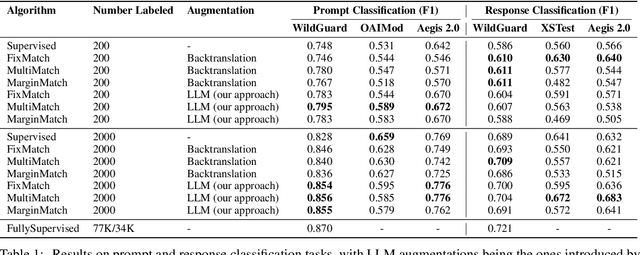
Safety for Large Language Models (LLMs) has been an ongoing research focus since their emergence and is even more relevant nowadays with the increasing capacity of those models. Currently, there are several guardrails in place for all public LLMs and multiple proposed datasets for training safety classifiers. However, training these safety classifiers relies on large quantities of labeled data, which can be problematic to acquire, prone to labeling errors, or often include synthetic data. To address these issues, we suggest a different approach: utilizing semi-supervised learning techniques, which leverage both labeled and unlabeled data, to improve the performance on the safety task. We analyze the improvements that these techniques can offer for both prompts given to Large Language Models and the responses to those requests. Moreover, since augmentation is the central part of semi-supervised algorithms, we demonstrate the importance of using task-specific augmentations, which significantly increase the performance when compared to general-purpose augmentation techniques.
Pluralistic Behavior Suite: Stress-Testing Multi-Turn Adherence to Custom Behavioral Policies
Nov 07, 2025Large language models (LLMs) are typically aligned to a universal set of safety and usage principles intended for broad public acceptability. Yet, real-world applications of LLMs often take place within organizational ecosystems shaped by distinctive corporate policies, regulatory requirements, use cases, brand guidelines, and ethical commitments. This reality highlights the need for rigorous and comprehensive evaluation of LLMs with pluralistic alignment goals, an alignment paradigm that emphasizes adaptability to diverse user values and needs. In this work, we present PLURALISTIC BEHAVIOR SUITE (PBSUITE), a dynamic evaluation suite designed to systematically assess LLMs' capacity to adhere to pluralistic alignment specifications in multi-turn, interactive conversations. PBSUITE consists of (1) a diverse dataset of 300 realistic LLM behavioral policies, grounded in 30 industries; and (2) a dynamic evaluation framework for stress-testing model compliance with custom behavioral specifications under adversarial conditions. Using PBSUITE, We find that leading open- and closed-source LLMs maintain robust adherence to behavioral policies in single-turn settings (less than 4% failure rates), but their compliance weakens substantially in multi-turn adversarial interactions (up to 84% failure rates). These findings highlight that existing model alignment and safety moderation methods fall short in coherently enforcing pluralistic behavioral policies in real-world LLM interactions. Our work contributes both the dataset and analytical framework to support future research toward robust and context-aware pluralistic alignment techniques.
Meta-learning how to Share Credit among Macro-Actions
Jun 16, 2025One proposed mechanism to improve exploration in reinforcement learning is through the use of macro-actions. Paradoxically though, in many scenarios the naive addition of macro-actions does not lead to better exploration, but rather the opposite. It has been argued that this was caused by adding non-useful macros and multiple works have focused on mechanisms to discover effectively environment-specific useful macros. In this work, we take a slightly different perspective. We argue that the difficulty stems from the trade-offs between reducing the average number of decisions per episode versus increasing the size of the action space. Namely, one typically treats each potential macro-action as independent and atomic, hence strictly increasing the search space and making typical exploration strategies inefficient. To address this problem we propose a novel regularization term that exploits the relationship between actions and macro-actions to improve the credit assignment mechanism by reducing the effective dimension of the action space and, therefore, improving exploration. The term relies on a similarity matrix that is meta-learned jointly with learning the desired policy. We empirically validate our strategy looking at macro-actions in Atari games, and the StreetFighter II environment. Our results show significant improvements over the Rainbow-DQN baseline in all environments. Additionally, we show that the macro-action similarity is transferable to related environments. We believe this work is a small but important step towards understanding how the similarity-imposed geometry on the action space can be exploited to improve credit assignment and exploration, therefore making learning more effective.