 Add to Chrome
 Add to Firefox
 Add to Edge
Nemotron 3 Ultra: Open, Efficient Mixture-of-Experts Hybrid Mamba-Transformer Model for Agentic Reasoning
Jun 12, 2026
We introduce Nemotron 3 Ultra, a 550 billion total and 55 billion active parameter Mixture-of-Experts Hybrid Mamba-Attention language model. We pre-trained Nemotron 3 Ultra on 20 trillion text tokens, then extended the context length to 1M tokens, and post-trained using Supervised Fine Tuning (SFT), Reinforcement Learning (RL), and Multi-teacher On-Policy Distillation (MOPD). Nemotron 3 Ultra is our most capable model yet, employing multiple key technologies - LatentMoE, Multi Token Prediction (MTP), NVFP4 pre-training, multi-environment RLVR, MOPD, and reasoning budget control. Nemotron 3 Ultra achieves up to ~6x higher inference throughput as compared to state-of-the-art publicly available LLMs while attaining on-par accuracy. The state-of-the-art accuracy, high inference throughput, and 1M token context length make Nemotron 3 Ultra ideal for long-running autonomous agentic tasks. We open-source the base, post-trained, and quantized checkpoints, along with the training data and recipe on HuggingFace.

Defenses & Enablers For Skill Injection Attacks on Terminal Based Agents
Jun 01, 2026Large language model (LLM) agents increasingly rely on reusable skills i.e. documents describing task-specific procedures. However, this introduces a new attack surface for agents to manage. We study two complementary directions for this threat. First, we evaluate guardian-based defenses: an intermediary LLM agent that acts as a mediator for skill file access (dynamic guardian) or pre-rewrites these files at build time (static guardian). Across three LLM agent families, our guardians cut attack success rate (ASR) by well over half while preserving task utility. Second, we stress test them through attack reframing using four attacks that preserve the malicious instruction but change the phrasing. For non-guardian setup, the reframing pushes the ASR up to 81.4\%, but the dynamic guardian brings it down to 18.6\%, showing that real-time mediation is a robust defense.
Nemotron 3 Super: Open, Efficient Mixture-of-Experts Hybrid Mamba-Transformer Model for Agentic Reasoning
Apr 14, 2026We describe the pre-training, post-training, and quantization of Nemotron 3 Super, a 120 billion (active 12 billion) parameter hybrid Mamba-Attention Mixture-of-Experts model. Nemotron 3 Super is the first model in the Nemotron 3 family to 1) be pre-trained in NVFP4, 2) leverage LatentMoE, a new Mixture-of-Experts architecture that optimizes for both accuracy per FLOP and accuracy per parameter, and 3) include MTP layers for inference acceleration through native speculative decoding. We pre-trained Nemotron 3 Super on 25 trillion tokens followed by post-training using supervised fine tuning (SFT) and reinforcement learning (RL). The final model supports up to 1M context length and achieves comparable accuracy on common benchmarks, while also achieving up to 2.2x and 7.5x higher inference throughput compared to GPT-OSS-120B and Qwen3.5-122B, respectively. Nemotron 3 Super datasets, along with the base, post-trained, and quantized checkpoints, are open-sourced on HuggingFace.
NVIDIA Nemotron 3: Efficient and Open Intelligence
Dec 24, 2025We introduce the Nemotron 3 family of models - Nano, Super, and Ultra. These models deliver strong agentic, reasoning, and conversational capabilities. The Nemotron 3 family uses a Mixture-of-Experts hybrid Mamba-Transformer architecture to provide best-in-class throughput and context lengths of up to 1M tokens. Super and Ultra models are trained with NVFP4 and incorporate LatentMoE, a novel approach that improves model quality. The two larger models also include MTP layers for faster text generation. All Nemotron 3 models are post-trained using multi-environment reinforcement learning enabling reasoning, multi-step tool use, and support granular reasoning budget control. Nano, the smallest model, outperforms comparable models in accuracy while remaining extremely cost-efficient for inference. Super is optimized for collaborative agents and high-volume workloads such as IT ticket automation. Ultra, the largest model, provides state-of-the-art accuracy and reasoning performance. Nano is released together with its technical report and this white paper, while Super and Ultra will follow in the coming months. We will openly release the model weights, pre- and post-training software, recipes, and all data for which we hold redistribution rights.
Nemotron 3 Nano: Open, Efficient Mixture-of-Experts Hybrid Mamba-Transformer Model for Agentic Reasoning
Dec 23, 2025We present Nemotron 3 Nano 30B-A3B, a Mixture-of-Experts hybrid Mamba-Transformer language model. Nemotron 3 Nano was pretrained on 25 trillion text tokens, including more than 3 trillion new unique tokens over Nemotron 2, followed by supervised fine tuning and large-scale RL on diverse environments. Nemotron 3 Nano achieves better accuracy than our previous generation Nemotron 2 Nano while activating less than half of the parameters per forward pass. It achieves up to 3.3x higher inference throughput than similarly-sized open models like GPT-OSS-20B and Qwen3-30B-A3B-Thinking-2507, while also being more accurate on popular benchmarks. Nemotron 3 Nano demonstrates enhanced agentic, reasoning, and chat abilities and supports context lengths up to 1M tokens. We release both our pretrained Nemotron 3 Nano 30B-A3B Base and post-trained Nemotron 3 Nano 30B-A3B checkpoints on Hugging Face.
Pluralistic Behavior Suite: Stress-Testing Multi-Turn Adherence to Custom Behavioral Policies
Nov 07, 2025Large language models (LLMs) are typically aligned to a universal set of safety and usage principles intended for broad public acceptability. Yet, real-world applications of LLMs often take place within organizational ecosystems shaped by distinctive corporate policies, regulatory requirements, use cases, brand guidelines, and ethical commitments. This reality highlights the need for rigorous and comprehensive evaluation of LLMs with pluralistic alignment goals, an alignment paradigm that emphasizes adaptability to diverse user values and needs. In this work, we present PLURALISTIC BEHAVIOR SUITE (PBSUITE), a dynamic evaluation suite designed to systematically assess LLMs' capacity to adhere to pluralistic alignment specifications in multi-turn, interactive conversations. PBSUITE consists of (1) a diverse dataset of 300 realistic LLM behavioral policies, grounded in 30 industries; and (2) a dynamic evaluation framework for stress-testing model compliance with custom behavioral specifications under adversarial conditions. Using PBSUITE, We find that leading open- and closed-source LLMs maintain robust adherence to behavioral policies in single-turn settings (less than 4% failure rates), but their compliance weakens substantially in multi-turn adversarial interactions (up to 84% failure rates). These findings highlight that existing model alignment and safety moderation methods fall short in coherently enforcing pluralistic behavioral policies in real-world LLM interactions. Our work contributes both the dataset and analytical framework to support future research toward robust and context-aware pluralistic alignment techniques.
NVIDIA Nemotron Nano 2: An Accurate and Efficient Hybrid Mamba-Transformer Reasoning Model
Aug 21, 2025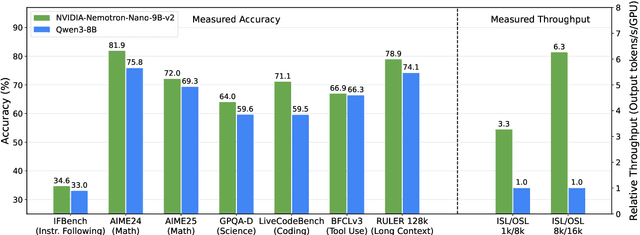

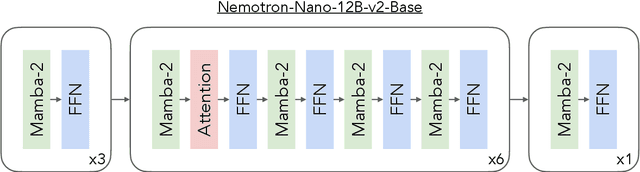
We introduce Nemotron-Nano-9B-v2, a hybrid Mamba-Transformer language model designed to increase throughput for reasoning workloads while achieving state-of-the-art accuracy compared to similarly-sized models. Nemotron-Nano-9B-v2 builds on the Nemotron-H architecture, in which the majority of the self-attention layers in the common Transformer architecture are replaced with Mamba-2 layers, to achieve improved inference speed when generating the long thinking traces needed for reasoning. We create Nemotron-Nano-9B-v2 by first pre-training a 12-billion-parameter model (Nemotron-Nano-12B-v2-Base) on 20 trillion tokens using an FP8 training recipe. After aligning Nemotron-Nano-12B-v2-Base, we employ the Minitron strategy to compress and distill the model with the goal of enabling inference on up to 128k tokens on a single NVIDIA A10G GPU (22GiB of memory, bfloat16 precision). Compared to existing similarly-sized models (e.g., Qwen3-8B), we show that Nemotron-Nano-9B-v2 achieves on-par or better accuracy on reasoning benchmarks while achieving up to 6x higher inference throughput in reasoning settings like 8k input and 16k output tokens. We are releasing Nemotron-Nano-9B-v2, Nemotron-Nano12B-v2-Base, and Nemotron-Nano-9B-v2-Base checkpoints along with the majority of our pre- and post-training datasets on Hugging Face.
Nemotron-H: A Family of Accurate and Efficient Hybrid Mamba-Transformer Models
Apr 10, 2025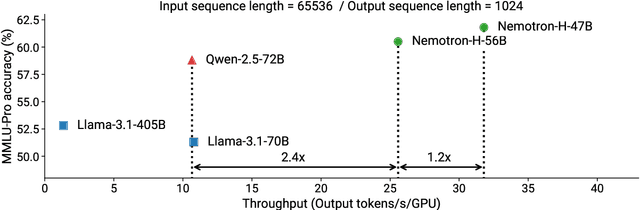

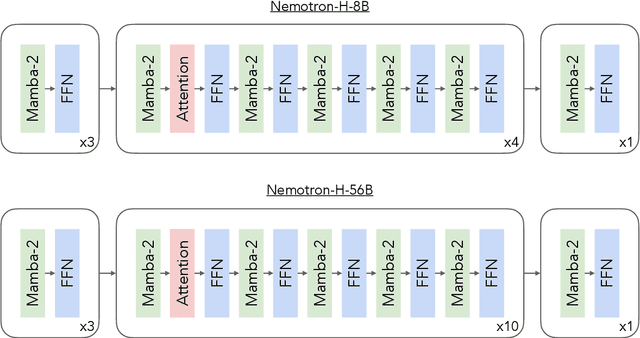
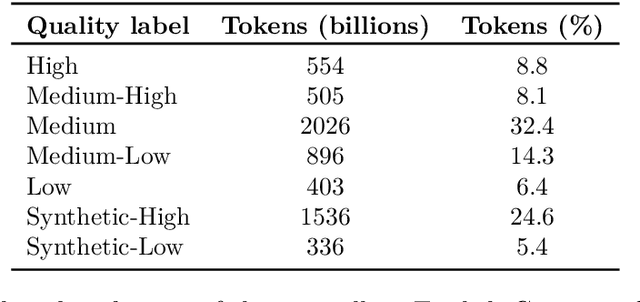
As inference-time scaling becomes critical for enhanced reasoning capabilities, it is increasingly becoming important to build models that are efficient to infer. We introduce Nemotron-H, a family of 8B and 56B/47B hybrid Mamba-Transformer models designed to reduce inference cost for a given accuracy level. To achieve this goal, we replace the majority of self-attention layers in the common Transformer model architecture with Mamba layers that perform constant computation and require constant memory per generated token. We show that Nemotron-H models offer either better or on-par accuracy compared to other similarly-sized state-of-the-art open-sourced Transformer models (e.g., Qwen-2.5-7B/72B and Llama-3.1-8B/70B), while being up to 3$\times$ faster at inference. To further increase inference speed and reduce the memory required at inference time, we created Nemotron-H-47B-Base from the 56B model using a new compression via pruning and distillation technique called MiniPuzzle. Nemotron-H-47B-Base achieves similar accuracy to the 56B model, but is 20% faster to infer. In addition, we introduce an FP8-based training recipe and show that it can achieve on par results with BF16-based training. This recipe is used to train the 56B model. All Nemotron-H models will be released, with support in Hugging Face, NeMo, and Megatron-LM.
Aegis2.0: A Diverse AI Safety Dataset and Risks Taxonomy for Alignment of LLM Guardrails
Jan 15, 2025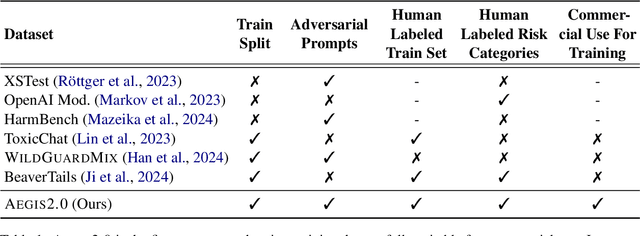

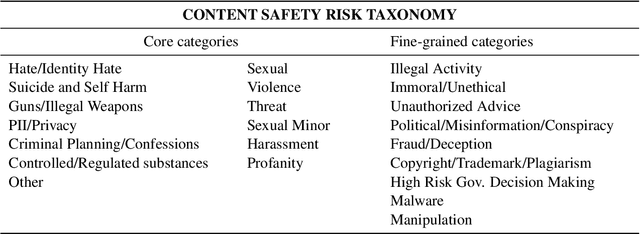

As Large Language Models (LLMs) and generative AI become increasingly widespread, concerns about content safety have grown in parallel. Currently, there is a clear lack of high-quality, human-annotated datasets that address the full spectrum of LLM-related safety risks and are usable for commercial applications. To bridge this gap, we propose a comprehensive and adaptable taxonomy for categorizing safety risks, structured into 12 top-level hazard categories with an extension to 9 fine-grained subcategories. This taxonomy is designed to meet the diverse requirements of downstream users, offering more granular and flexible tools for managing various risk types. Using a hybrid data generation pipeline that combines human annotations with a multi-LLM "jury" system to assess the safety of responses, we obtain Aegis 2.0, a carefully curated collection of 34,248 samples of human-LLM interactions, annotated according to our proposed taxonomy. To validate its effectiveness, we demonstrate that several lightweight models, trained using parameter-efficient techniques on Aegis 2.0, achieve performance competitive with leading safety models fully fine-tuned on much larger, non-commercial datasets. In addition, we introduce a novel training blend that combines safety with topic following data.This approach enhances the adaptability of guard models, enabling them to generalize to new risk categories defined during inference. We plan to open-source Aegis 2.0 data and models to the research community to aid in the safety guardrailing of LLMs.
AEGIS: Online Adaptive AI Content Safety Moderation with Ensemble of LLM Experts
Apr 09, 2024
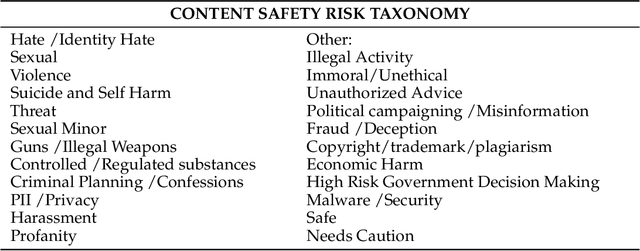

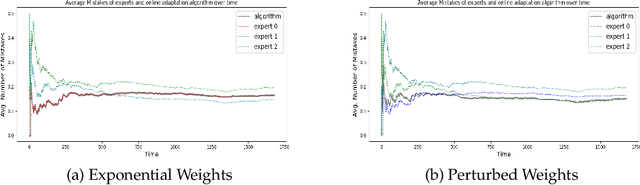
As Large Language Models (LLMs) and generative AI become more widespread, the content safety risks associated with their use also increase. We find a notable deficiency in high-quality content safety datasets and benchmarks that comprehensively cover a wide range of critical safety areas. To address this, we define a broad content safety risk taxonomy, comprising 13 critical risk and 9 sparse risk categories. Additionally, we curate AEGISSAFETYDATASET, a new dataset of approximately 26, 000 human-LLM interaction instances, complete with human annotations adhering to the taxonomy. We plan to release this dataset to the community to further research and to help benchmark LLM models for safety. To demonstrate the effectiveness of the dataset, we instruction-tune multiple LLM-based safety models. We show that our models (named AEGISSAFETYEXPERTS), not only surpass or perform competitively with the state-of-the-art LLM-based safety models and general purpose LLMs, but also exhibit robustness across multiple jail-break attack categories. We also show how using AEGISSAFETYDATASET during the LLM alignment phase does not negatively impact the performance of the aligned models on MT Bench scores. Furthermore, we propose AEGIS, a novel application of a no-regret online adaptation framework with strong theoretical guarantees, to perform content moderation with an ensemble of LLM content safety experts in deployment