 Add to Chrome
 Add to Firefox
 Add to Edge
Semi-Supervised Learning for Large Language Models Safety and Content Moderation
Dec 24, 2025
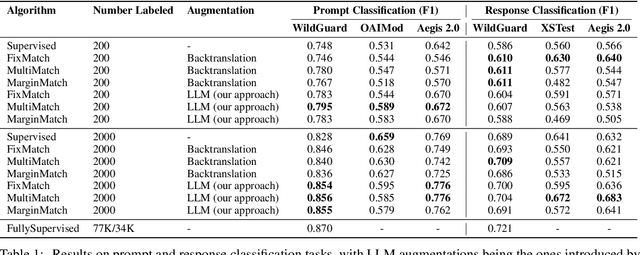
Safety for Large Language Models (LLMs) has been an ongoing research focus since their emergence and is even more relevant nowadays with the increasing capacity of those models. Currently, there are several guardrails in place for all public LLMs and multiple proposed datasets for training safety classifiers. However, training these safety classifiers relies on large quantities of labeled data, which can be problematic to acquire, prone to labeling errors, or often include synthetic data. To address these issues, we suggest a different approach: utilizing semi-supervised learning techniques, which leverage both labeled and unlabeled data, to improve the performance on the safety task. We analyze the improvements that these techniques can offer for both prompts given to Large Language Models and the responses to those requests. Moreover, since augmentation is the central part of semi-supervised algorithms, we demonstrate the importance of using task-specific augmentations, which significantly increase the performance when compared to general-purpose augmentation techniques.

MultiMatch: Multihead Consistency Regularization Matching for Semi-Supervised Text Classification
Jun 09, 2025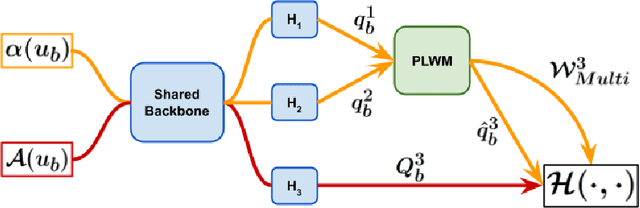
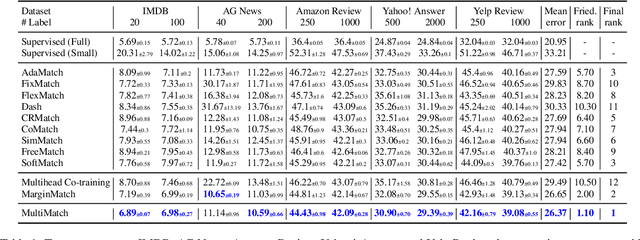
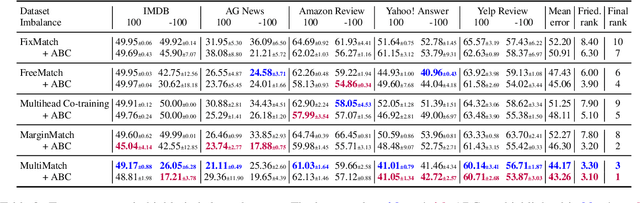
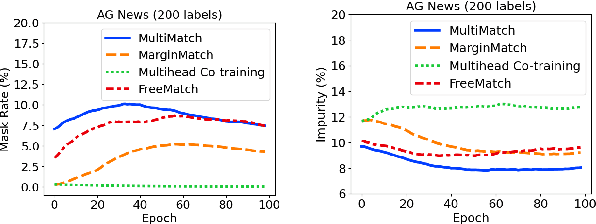
We introduce MultiMatch, a novel semi-supervised learning (SSL) algorithm combining the paradigms of co-training and consistency regularization with pseudo-labeling. At its core, MultiMatch features a three-fold pseudo-label weighting module designed for three key purposes: selecting and filtering pseudo-labels based on head agreement and model confidence, and weighting them according to the perceived classification difficulty. This novel module enhances and unifies three existing techniques -- heads agreement from Multihead Co-training, self-adaptive thresholds from FreeMatch, and Average Pseudo-Margins from MarginMatch -- resulting in a holistic approach that improves robustness and performance in SSL settings. Experimental results on benchmark datasets highlight the superior performance of MultiMatch, achieving state-of-the-art results on 9 out of 10 setups from 5 natural language processing datasets and ranking first according to the Friedman test among 19 methods. Furthermore, MultiMatch demonstrates exceptional robustness in highly imbalanced settings, outperforming the second-best approach by 3.26% -- and data imbalance is a key factor for many text classification tasks.