 Add to Chrome
 Add to Firefox
 Add to Edge
Paved with True Intents: Intent-Aware Training Improves LLM Safety Classification Across Training Regimes
Jun 25, 2026
We argue that safety classifiers should model user intent as an explicit signal between the prompt and the final label. To study this, we introduce AIMS, a human-annotated dataset of 1,724 difficult safety prompts, each paired with an intent description and harm label. We use AIMS to evaluate intent-aware training across supervised fine-tuning, preference learning, reasoning distillation, and reinforcement learning. Despite its size, AIMS enables competitive safety classifiers across training regimes: DPO from model-generated intent errors improves over SFT, and intent-conditioned distillation outperforms reasoning-only distillation in most teacher-student pairs. Most notably, directly rewarding intent faithfulness with GRPO yields the strongest average performance across five external safety benchmarks, while our intent-aware models form the inference latency-F1 Pareto frontier. These results show that faithful intent modeling is a compact, high-quality supervision signal for more robust safety classifiers.

GIT-CXR: End-to-End Transformer for Chest X-Ray Report Generation
Jan 05, 2025
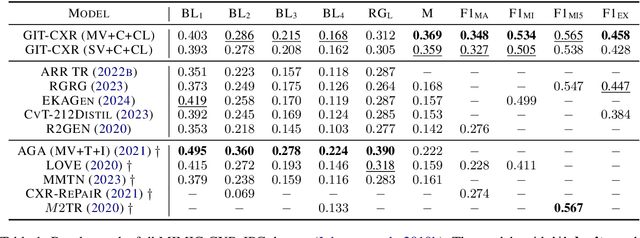
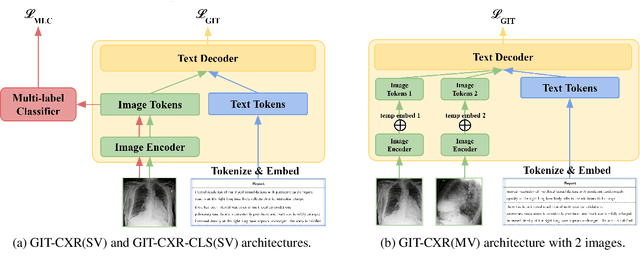
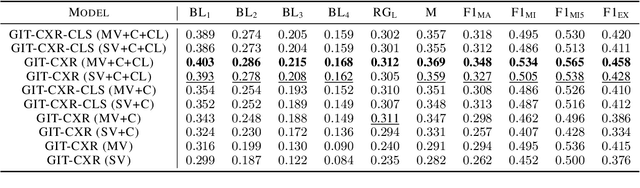
Medical imaging is crucial for diagnosing, monitoring, and treating medical conditions. The medical reports of radiology images are the primary medium through which medical professionals attest their findings, but their writing is time consuming and requires specialized clinical expertise. The automated generation of radiography reports has thus the potential to improve and standardize patient care and significantly reduce clinicians workload. Through our work, we have designed and evaluated an end-to-end transformer-based method to generate accurate and factually complete radiology reports for X-ray images. Additionally, we are the first to introduce curriculum learning for end-to-end transformers in medical imaging and demonstrate its impact in obtaining improved performance. The experiments have been conducted using the MIMIC-CXR-JPG database, the largest available chest X-ray dataset. The results obtained are comparable with the current state-of-the-art on the natural language generation (NLG) metrics BLEU and ROUGE-L, while setting new state-of-the-art results on F1 examples-averaged, F1-macro and F1-micro metrics for clinical accuracy and on the METEOR metric widely used for NLG.