 Add to Chrome
 Add to Firefox
 Add to Edge
Nemotron 3 Ultra: Open, Efficient Mixture-of-Experts Hybrid Mamba-Transformer Model for Agentic Reasoning
Jun 12, 2026
We introduce Nemotron 3 Ultra, a 550 billion total and 55 billion active parameter Mixture-of-Experts Hybrid Mamba-Attention language model. We pre-trained Nemotron 3 Ultra on 20 trillion text tokens, then extended the context length to 1M tokens, and post-trained using Supervised Fine Tuning (SFT), Reinforcement Learning (RL), and Multi-teacher On-Policy Distillation (MOPD). Nemotron 3 Ultra is our most capable model yet, employing multiple key technologies - LatentMoE, Multi Token Prediction (MTP), NVFP4 pre-training, multi-environment RLVR, MOPD, and reasoning budget control. Nemotron 3 Ultra achieves up to ~6x higher inference throughput as compared to state-of-the-art publicly available LLMs while attaining on-par accuracy. The state-of-the-art accuracy, high inference throughput, and 1M token context length make Nemotron 3 Ultra ideal for long-running autonomous agentic tasks. We open-source the base, post-trained, and quantized checkpoints, along with the training data and recipe on HuggingFace.

PhysGraph: A Physics-aware 3D Scene Graph for Perception and Reasoning
Jun 07, 2026To perform a wide range of daily tasks, robots need to construct a 3D representation that is semantically rich, physically grounded, and structured enough to support task planning and affordance prediction. However, existing approaches primarily focus on semantic retrieval, often overlooking physical and kinematic factors. Methods that attempt to model physical properties typically rely on narrow training sets or single-object modeling, limiting scalability and generalization across diverse object types. To address these challenges, we present PhysGraph, a framework that unifies symbolic reasoning with structured 3D geometry to model kinematic and physical properties in cluttered scenes. Given RGB-D observations, PhysGraph reconstructs object-centric 3D geometry and associates object instances across views. It then decomposes objects into functional parts and infers materials and articulations through visual reasoning. Evaluated on both synthetic and real-world datasets, PhysGraph achieves state-of-the-art results in semantic segmentation, multi-object mass estimation, and articulation prediction. With its simple yet effective design, PhysGraph produces physically consistent and semantically structured scene graphs, serving as a structured 3D representation for downstream tasks such as constraint-aware 3D affordance prediction and real-to-sim transfer, both of which are demonstrated in our experiments.
Same Graph, Different Likelihoods: Calibration of Autoregressive Graph Generators via Permutation-Equivalent Encodings
Apr 07, 2026Autoregressive graph generators define likelihoods via a sequential construction process, but these likelihoods are only meaningful if they are consistent across all linearizations of the same graph. Segmented Eulerian Neighborhood Trails (SENT), a recent linearization method, converts graphs into sequences that can be perfectly decoded and efficiently processed by language models, but admit multiple equivalent linearizations of the same graph. We quantify violations in assigned negative log-likelihood (NLL) using the coefficient of variation across equivalent linearizations, which we call Linearization Uncertainty (LU). Training transformers under four linearization strategies on two datasets, we show that biased orderings achieve lower NLL on their native order but exhibit expected calibration error (ECE) two orders of magnitude higher under random permutation, indicating that these models have learned their training linearization rather than the underlying graph. On the molecular graph benchmark QM9, NLL for generated graphs is negatively correlated with molecular stability (AUC $=0.43$), while LU achieves AUC $=0.85$, suggesting that permutation-based evaluation provides a more reliable quality check for generated molecules. Code is available at https://github.com/lauritsf/linearization-uncertainty
Refining Salience-Aware Sparse Fine-Tuning Strategies for Language Models
Dec 18, 2024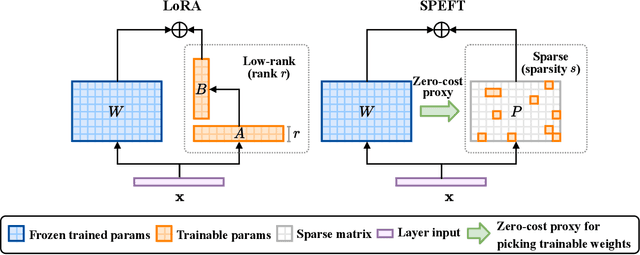
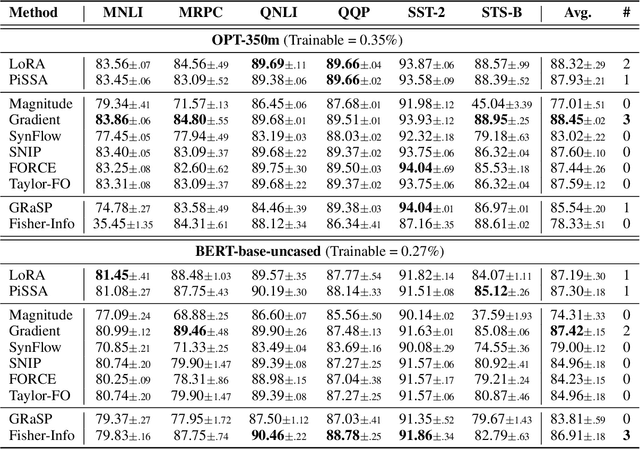
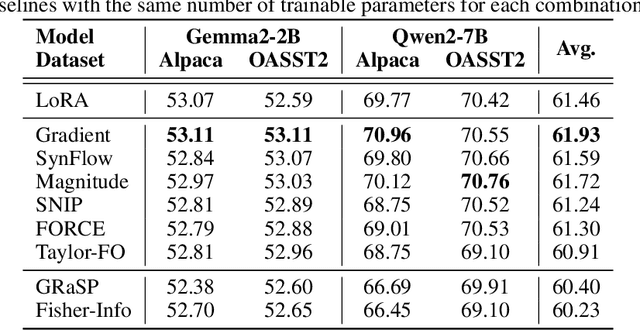

Parameter-Efficient Fine-Tuning (PEFT) has gained prominence through low-rank adaptation methods like LoRA. In this paper, we focus on sparsity-based PEFT (SPEFT), which introduces trainable sparse adaptations to the weight matrices in the model, offering greater flexibility in selecting fine-tuned parameters compared to low-rank methods. We conduct the first systematic evaluation of salience metrics for SPEFT, inspired by zero-cost NAS proxies, and identify simple gradient-based metrics is reliable, and results are on par with the best alternatives, offering both computational efficiency and robust performance. Additionally, we compare static and dynamic masking strategies, finding that static masking, which predetermines non-zero entries before training, delivers efficiency without sacrificing performance, while dynamic masking offers no substantial benefits. Across NLP tasks, a simple gradient-based, static SPEFT consistently outperforms other fine-tuning methods for LLMs, providing a simple yet effective baseline for SPEFT. Our work challenges the notion that complexity is necessary for effective PEFT. Our work is open source and available to the community at [https://github.com/0-ml/speft].