 Add to Chrome
 Add to Firefox
 Add to Edge
OPTune: Efficient Online Preference Tuning
Jun 11, 2024
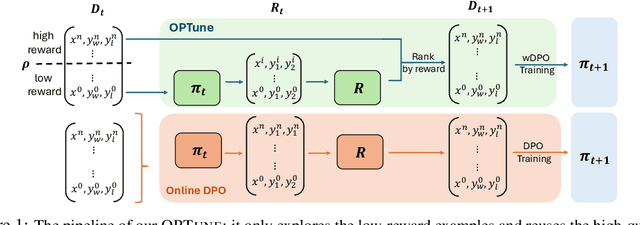
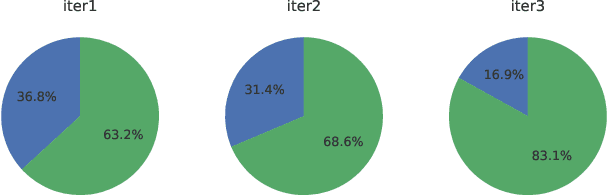

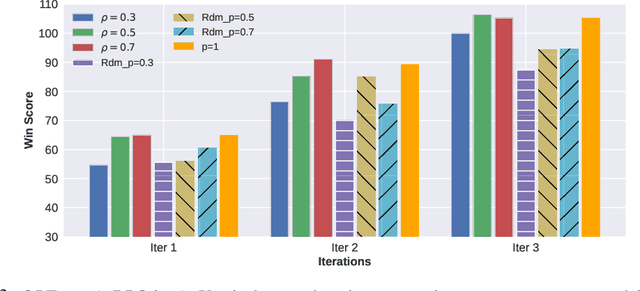
Reinforcement learning with human feedback~(RLHF) is critical for aligning Large Language Models (LLMs) with human preference. Compared to the widely studied offline version of RLHF, \emph{e.g.} direct preference optimization (DPO), recent works have shown that the online variants achieve even better alignment. However, online alignment requires on-the-fly generation of new training data, which is costly, hard to parallelize, and suffers from varying quality and utility. In this paper, we propose a more efficient data exploration strategy for online preference tuning (OPTune), which does not rely on human-curated or pre-collected teacher responses but dynamically samples informative responses for on-policy preference alignment. During data generation, OPTune only selects prompts whose (re)generated responses can potentially provide more informative and higher-quality training signals than the existing responses. In the training objective, OPTune reweights each generated response (pair) by its utility in improving the alignment so that learning can be focused on the most helpful samples. Throughout our evaluations, OPTune'd LLMs maintain the instruction-following benefits provided by standard preference tuning whilst enjoying 1.27-1.56x faster training speed due to the efficient data exploration strategy.

The CLRS-Text Algorithmic Reasoning Language Benchmark
Jun 06, 2024
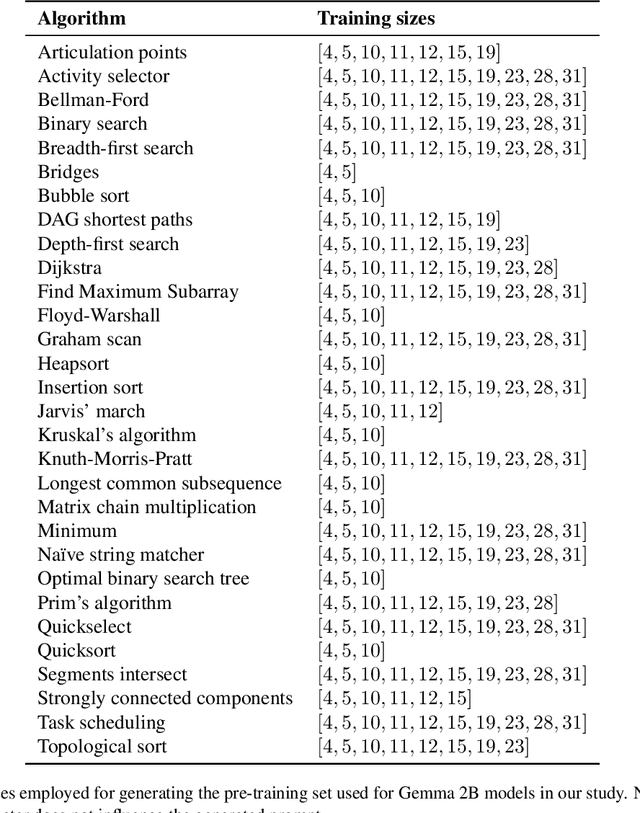
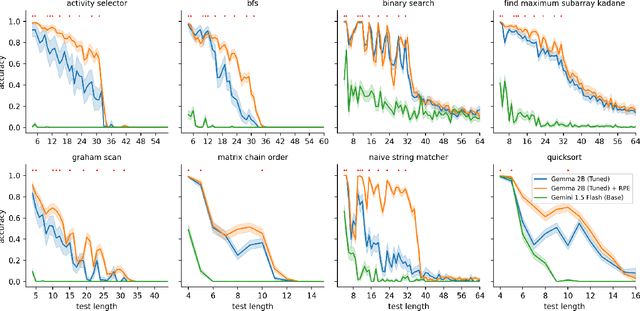
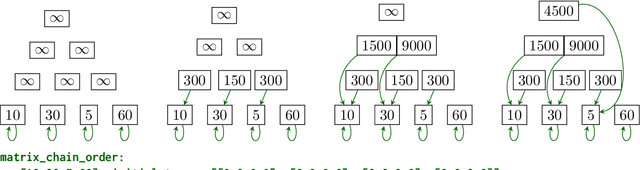
Eliciting reasoning capabilities from language models (LMs) is a critical direction on the path towards building intelligent systems. Most recent studies dedicated to reasoning focus on out-of-distribution performance on procedurally-generated synthetic benchmarks, bespoke-built to evaluate specific skills only. This trend makes results hard to transfer across publications, slowing down progress. Three years ago, a similar issue was identified and rectified in the field of neural algorithmic reasoning, with the advent of the CLRS benchmark. CLRS is a dataset generator comprising graph execution traces of classical algorithms from the Introduction to Algorithms textbook. Inspired by this, we propose CLRS-Text -- a textual version of these algorithmic traces. Out of the box, CLRS-Text is capable of procedurally generating trace data for thirty diverse, challenging algorithmic tasks across any desirable input distribution, while offering a standard pipeline in which any additional algorithmic tasks may be created in the benchmark. We fine-tune and evaluate various LMs as generalist executors on this benchmark, validating prior work and revealing a novel, interesting challenge for the LM reasoning community. Our code is available at https://github.com/google-deepmind/clrs/tree/master/clrs/_src/clrs_text.
Enhancing Visual-Language Modality Alignment in Large Vision Language Models via Self-Improvement
May 29, 2024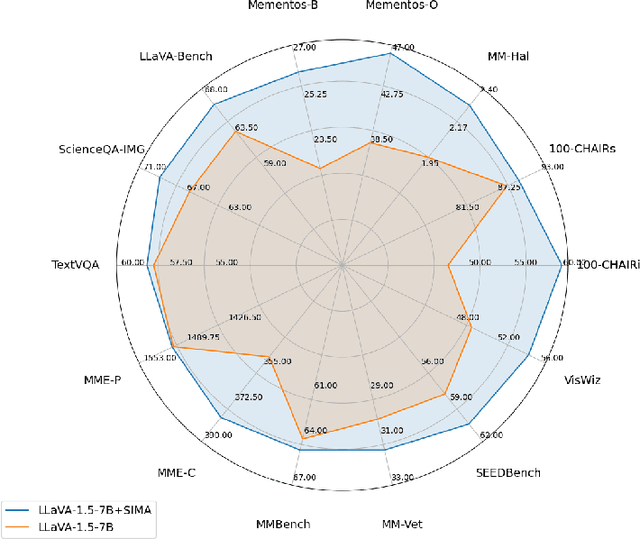


Large vision-language models (LVLMs) have achieved impressive results in various visual question-answering and reasoning tasks through vision instruction tuning on specific datasets. However, there is still significant room for improvement in the alignment between visual and language modalities. Previous methods to enhance this alignment typically require external models or data, heavily depending on their capabilities and quality, which inevitably sets an upper bound on performance. In this paper, we propose SIMA, a framework that enhances visual and language modality alignment through self-improvement, eliminating the needs for external models or data. SIMA leverages prompts from existing vision instruction tuning datasets to self-generate responses and employs an in-context self-critic mechanism to select response pairs for preference tuning. The key innovation is the introduction of three vision metrics during the in-context self-critic process, which can guide the LVLM in selecting responses that enhance image comprehension. Through experiments across 14 hallucination and comprehensive benchmarks, we demonstrate that SIMA not only improves model performance across all benchmarks but also achieves superior modality alignment, outperforming previous approaches.
Transformers Can Do Arithmetic with the Right Embeddings
May 27, 2024


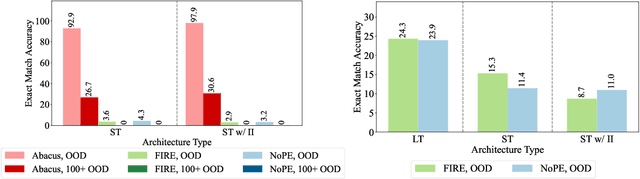
The poor performance of transformers on arithmetic tasks seems to stem in large part from their inability to keep track of the exact position of each digit inside of a large span of digits. We mend this problem by adding an embedding to each digit that encodes its position relative to the start of the number. In addition to the boost these embeddings provide on their own, we show that this fix enables architectural modifications such as input injection and recurrent layers to improve performance even further. With positions resolved, we can study the logical extrapolation ability of transformers. Can they solve arithmetic problems that are larger and more complex than those in their training data? We find that training on only 20 digit numbers with a single GPU for one day, we can reach state-of-the-art performance, achieving up to 99% accuracy on 100 digit addition problems. Finally, we show that these gains in numeracy also unlock improvements on other multi-step reasoning tasks including sorting and multiplication.
CinePile: A Long Video Question Answering Dataset and Benchmark
May 14, 2024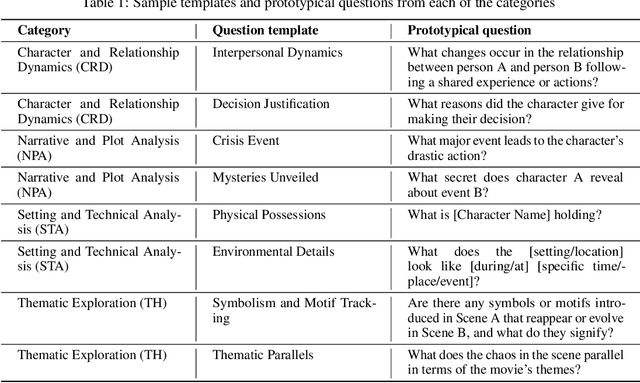
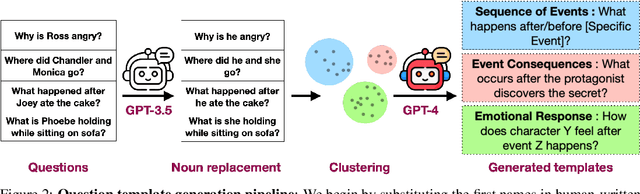
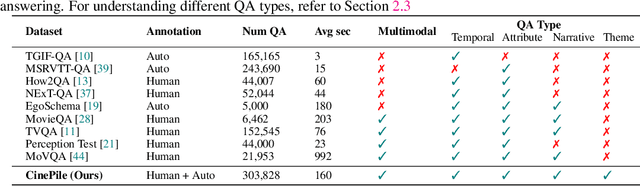
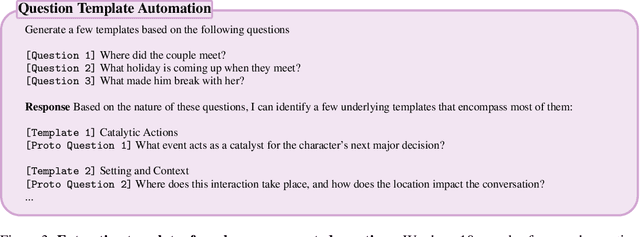
Current datasets for long-form video understanding often fall short of providing genuine long-form comprehension challenges, as many tasks derived from these datasets can be successfully tackled by analyzing just one or a few random frames from a video. To address this issue, we present a novel dataset and benchmark, CinePile, specifically designed for authentic long-form video understanding. This paper details our innovative approach for creating a question-answer dataset, utilizing advanced LLMs with human-in-the-loop and building upon human-generated raw data. Our comprehensive dataset comprises 305,000 multiple-choice questions (MCQs), covering various visual and multimodal aspects, including temporal comprehension, understanding human-object interactions, and reasoning about events or actions within a scene. Additionally, we evaluate recent video-centric LLMs, both open-source and proprietary, on the test split of our dataset. The findings reveal that even state-of-the-art video-centric LLMs significantly lag behind human performance in these tasks, highlighting the complexity and challenge inherent in video understanding. The dataset is available at https://hf.co/datasets/tomg-group-umd/cinepile
LMD3: Language Model Data Density Dependence
May 10, 2024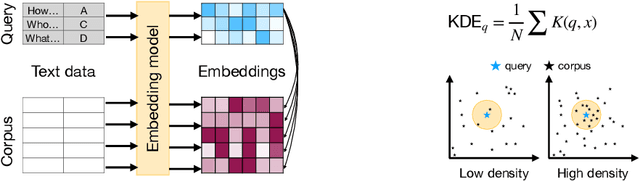
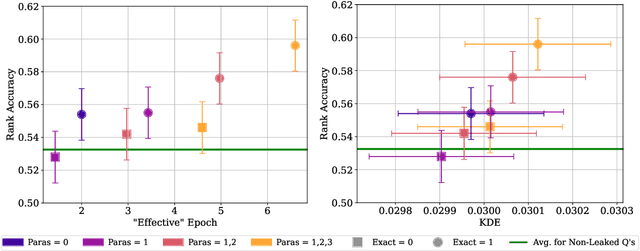
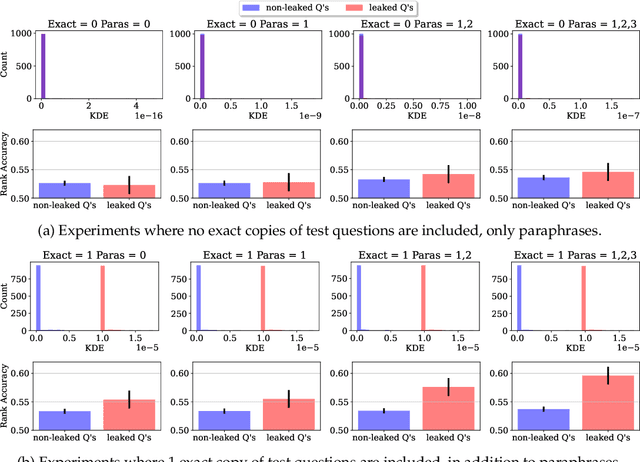
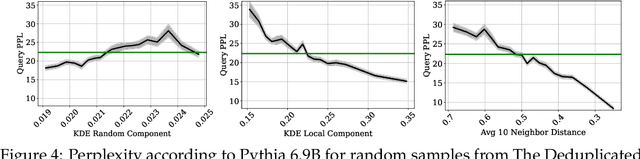
We develop a methodology for analyzing language model task performance at the individual example level based on training data density estimation. Experiments with paraphrasing as a controlled intervention on finetuning data demonstrate that increasing the support in the training distribution for specific test queries results in a measurable increase in density, which is also a significant predictor of the performance increase caused by the intervention. Experiments with pretraining data demonstrate that we can explain a significant fraction of the variance in model perplexity via density measurements. We conclude that our framework can provide statistical evidence of the dependence of a target model's predictions on subsets of its training data, and can more generally be used to characterize the support (or lack thereof) in the training data for a given test task.
Benchmarking ChatGPT on Algorithmic Reasoning
Apr 04, 2024


We evaluate ChatGPT's ability to solve algorithm problems from the CLRS benchmark suite that is designed for GNNs. The benchmark requires the use of a specified classical algorithm to solve a given problem. We find that ChatGPT outperforms specialist GNN models, using Python to successfully solve these problems. This raises new points in the discussion about learning algorithms with neural networks.
Measuring Style Similarity in Diffusion Models
Apr 01, 2024

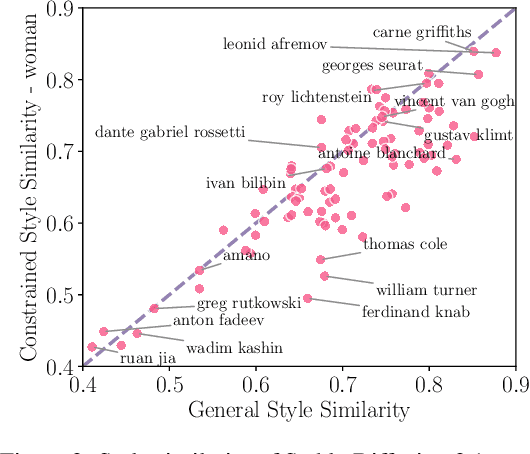

Generative models are now widely used by graphic designers and artists. Prior works have shown that these models remember and often replicate content from their training data during generation. Hence as their proliferation increases, it has become important to perform a database search to determine whether the properties of the image are attributable to specific training data, every time before a generated image is used for professional purposes. Existing tools for this purpose focus on retrieving images of similar semantic content. Meanwhile, many artists are concerned with style replication in text-to-image models. We present a framework for understanding and extracting style descriptors from images. Our framework comprises a new dataset curated using the insight that style is a subjective property of an image that captures complex yet meaningful interactions of factors including but not limited to colors, textures, shapes, etc. We also propose a method to extract style descriptors that can be used to attribute style of a generated image to the images used in the training dataset of a text-to-image model. We showcase promising results in various style retrieval tasks. We also quantitatively and qualitatively analyze style attribution and matching in the Stable Diffusion model. Code and artifacts are available at https://github.com/learn2phoenix/CSD.
Privacy Backdoors: Enhancing Membership Inference through Poisoning Pre-trained Models
Apr 01, 2024It is commonplace to produce application-specific models by fine-tuning large pre-trained models using a small bespoke dataset. The widespread availability of foundation model checkpoints on the web poses considerable risks, including the vulnerability to backdoor attacks. In this paper, we unveil a new vulnerability: the privacy backdoor attack. This black-box privacy attack aims to amplify the privacy leakage that arises when fine-tuning a model: when a victim fine-tunes a backdoored model, their training data will be leaked at a significantly higher rate than if they had fine-tuned a typical model. We conduct extensive experiments on various datasets and models, including both vision-language models (CLIP) and large language models, demonstrating the broad applicability and effectiveness of such an attack. Additionally, we carry out multiple ablation studies with different fine-tuning methods and inference strategies to thoroughly analyze this new threat. Our findings highlight a critical privacy concern within the machine learning community and call for a reevaluation of safety protocols in the use of open-source pre-trained models.
Generating Potent Poisons and Backdoors from Scratch with Guided Diffusion
Mar 25, 2024

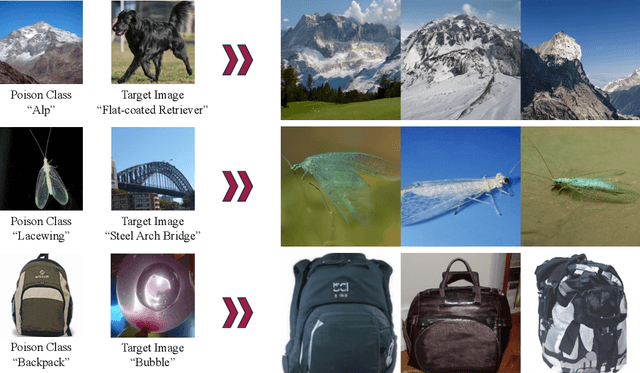

Modern neural networks are often trained on massive datasets that are web scraped with minimal human inspection. As a result of this insecure curation pipeline, an adversary can poison or backdoor the resulting model by uploading malicious data to the internet and waiting for a victim to scrape and train on it. Existing approaches for creating poisons and backdoors start with randomly sampled clean data, called base samples, and then modify those samples to craft poisons. However, some base samples may be significantly more amenable to poisoning than others. As a result, we may be able to craft more potent poisons by carefully choosing the base samples. In this work, we use guided diffusion to synthesize base samples from scratch that lead to significantly more potent poisons and backdoors than previous state-of-the-art attacks. Our Guided Diffusion Poisoning (GDP) base samples can be combined with any downstream poisoning or backdoor attack to boost its effectiveness. Our implementation code is publicly available at: https://github.com/hsouri/GDP .