 Add to Chrome
 Add to Firefox
 Add to Edge
RMMI: Enhanced Obstacle Avoidance for Reactive Mobile Manipulation using an Implicit Neural Map
Aug 29, 2024
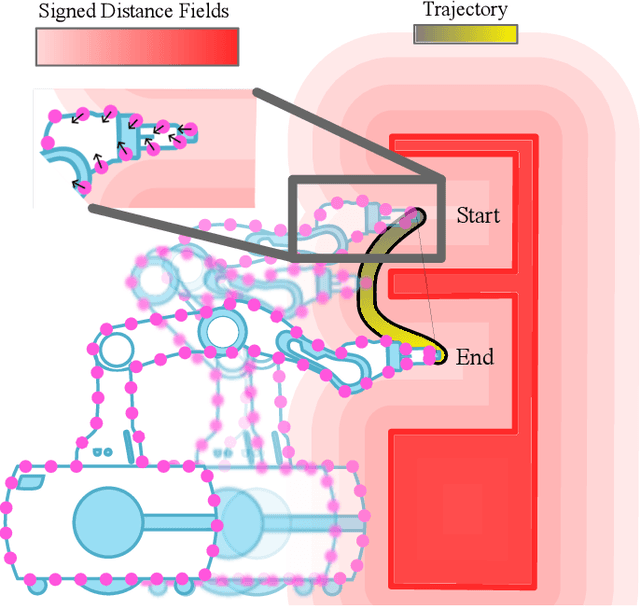
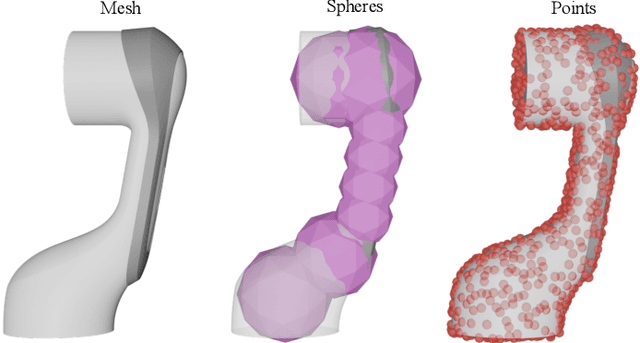
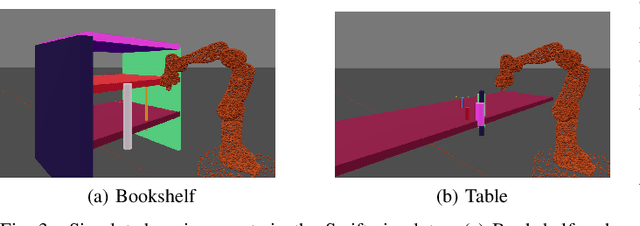
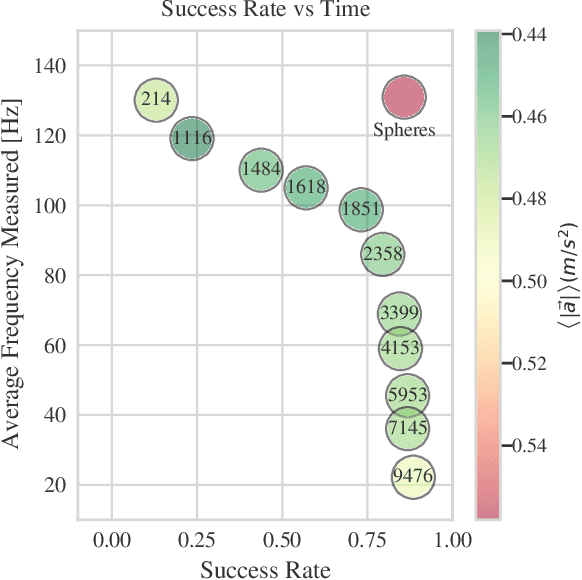
We introduce RMMI, a novel reactive control framework for mobile manipulators operating in complex, static environments. Our approach leverages a neural Signed Distance Field (SDF) to model intricate environment details and incorporates this representation as inequality constraints within a Quadratic Program (QP) to coordinate robot joint and base motion. A key contribution is the introduction of an active collision avoidance cost term that maximises the total robot distance to obstacles during the motion. We first evaluate our approach in a simulated reaching task, outperforming previous methods that rely on representing both the robot and the scene as a set of primitive geometries. Compared with the baseline, we improved the task success rate by 25% in total, which includes increases of 10% by using the active collision cost. We also demonstrate our approach on a real-world platform, showing its effectiveness in reaching target poses in cluttered and confined spaces using environment models built directly from sensor data. For additional details and experiment videos, visit https://rmmi.github.io/.

MICDrop: Masking Image and Depth Features via Complementary Dropout for Domain-Adaptive Semantic Segmentation
Aug 29, 2024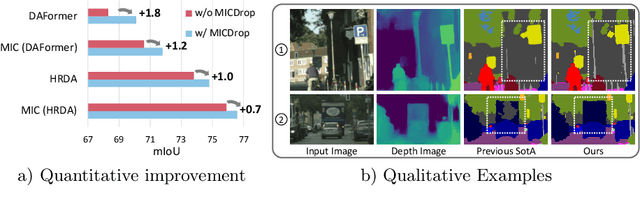
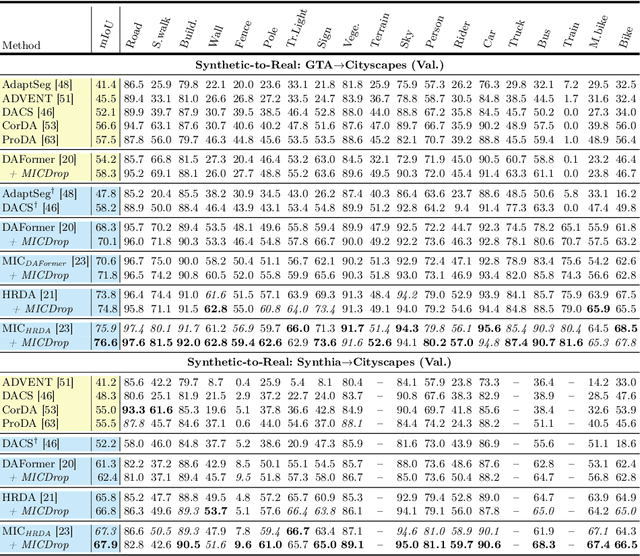
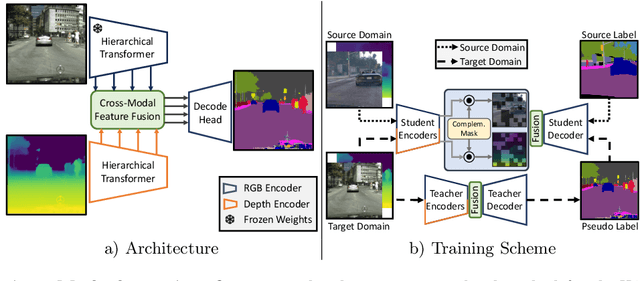

Unsupervised Domain Adaptation (UDA) is the task of bridging the domain gap between a labeled source domain, e.g., synthetic data, and an unlabeled target domain. We observe that current UDA methods show inferior results on fine structures and tend to oversegment objects with ambiguous appearance. To address these shortcomings, we propose to leverage geometric information, i.e., depth predictions, as depth discontinuities often coincide with segmentation boundaries. We show that naively incorporating depth into current UDA methods does not fully exploit the potential of this complementary information. To this end, we present MICDrop, which learns a joint feature representation by masking image encoder features while inversely masking depth encoder features. With this simple yet effective complementary masking strategy, we enforce the use of both modalities when learning the joint feature representation. To aid this process, we propose a feature fusion module to improve both global as well as local information sharing while being robust to errors in the depth predictions. We show that our method can be plugged into various recent UDA methods and consistently improve results across standard UDA benchmarks, obtaining new state-of-the-art performances.
A compact neuromorphic system for ultra energy-efficient, on-device robot localization
Aug 29, 2024


Neuromorphic computing offers a transformative pathway to overcome the computational and energy challenges faced in deploying robotic localization and navigation systems at the edge. Visual place recognition, a critical component for navigation, is often hampered by the high resource demands of conventional systems, making them unsuitable for small-scale robotic platforms which still require to perform complex, long-range tasks. Although neuromorphic approaches offer potential for greater efficiency, real-time edge deployment remains constrained by the complexity and limited scalability of bio-realistic networks. Here, we demonstrate a neuromorphic localization system that performs accurate place recognition in up to 8km of traversal using models as small as 180 KB with 44k parameters, while consuming less than 1% of the energy required by conventional methods. Our Locational Encoding with Neuromorphic Systems (LENS) integrates spiking neural networks, an event-based dynamic vision sensor, and a neuromorphic processor within a single SPECK(TM) chip, enabling real-time, energy-efficient localization on a hexapod robot. LENS represents the first fully neuromorphic localization system capable of large-scale, on-device deployment, setting a new benchmark for energy efficient robotic place recognition.
FUSELOC: Fusing Global and Local Descriptors to Disambiguate 2D-3D Matching in Visual Localization
Aug 21, 2024Hierarchical methods represent state-of-the-art visual localization, optimizing search efficiency by using global descriptors to focus on relevant map regions. However, this state-of-the-art performance comes at the cost of substantial memory requirements, as all database images must be stored for feature matching. In contrast, direct 2D-3D matching algorithms require significantly less memory but suffer from lower accuracy due to the larger and more ambiguous search space. We address this ambiguity by fusing local and global descriptors using a weighted average operator within a 2D-3D search framework. This fusion rearranges the local descriptor space such that geographically nearby local descriptors are closer in the feature space according to the global descriptors. Therefore, the number of irrelevant competing descriptors decreases, specifically if they are geographically distant, thereby increasing the likelihood of correctly matching a query descriptor. We consistently improve the accuracy over local-only systems and achieve performance close to hierarchical methods while halving memory requirements. Extensive experiments using various state-of-the-art local and global descriptors across four different datasets demonstrate the effectiveness of our approach. For the first time, our approach enables direct matching algorithms to benefit from global descriptors while maintaining memory efficiency. The code for this paper will be published at \href{https://github.com/sontung/descriptor-disambiguation}{github.com/sontung/descriptor-disambiguation}.
Dynamic 3D Gaussian Fields for Urban Areas
Jun 05, 2024
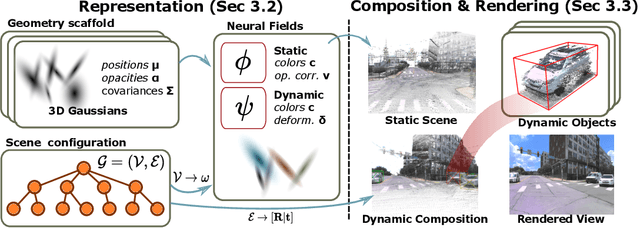
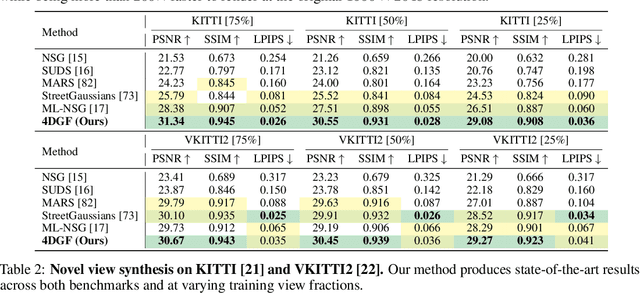
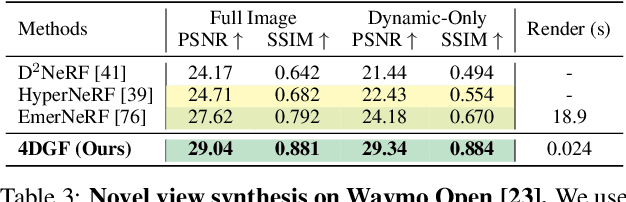
We present an efficient neural 3D scene representation for novel-view synthesis (NVS) in large-scale, dynamic urban areas. Existing works are not well suited for applications like mixed-reality or closed-loop simulation due to their limited visual quality and non-interactive rendering speeds. Recently, rasterization-based approaches have achieved high-quality NVS at impressive speeds. However, these methods are limited to small-scale, homogeneous data, i.e. they cannot handle severe appearance and geometry variations due to weather, season, and lighting and do not scale to larger, dynamic areas with thousands of images. We propose 4DGF, a neural scene representation that scales to large-scale dynamic urban areas, handles heterogeneous input data, and substantially improves rendering speeds. We use 3D Gaussians as an efficient geometry scaffold while relying on neural fields as a compact and flexible appearance model. We integrate scene dynamics via a scene graph at global scale while modeling articulated motions on a local level via deformations. This decomposed approach enables flexible scene composition suitable for real-world applications. In experiments, we surpass the state-of-the-art by over 3 dB in PSNR and more than 200 times in rendering speed.
Human-in-the-Loop Segmentation of Multi-species Coral Imagery
Apr 16, 2024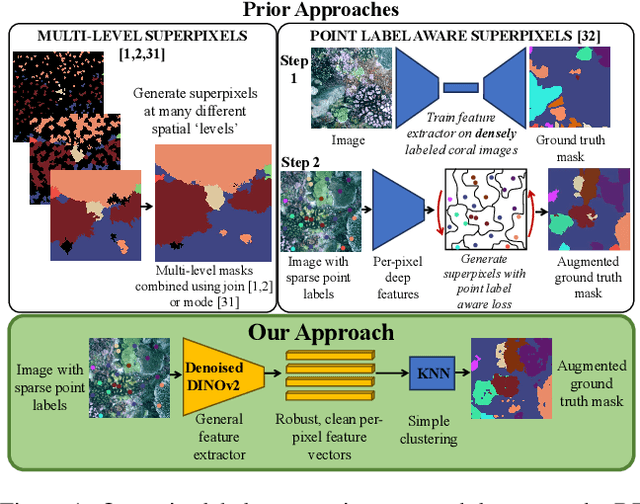
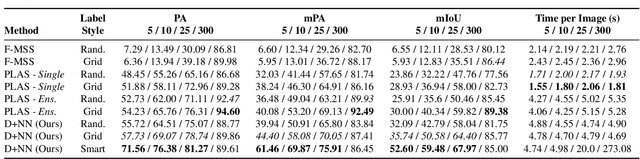
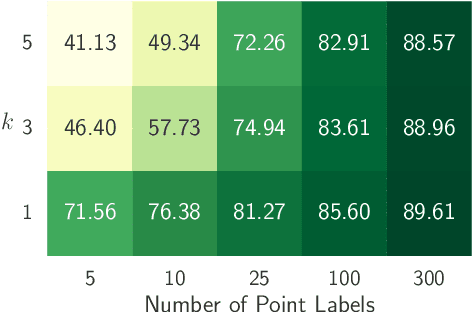

Broad-scale marine surveys performed by underwater vehicles significantly increase the availability of coral reef imagery, however it is costly and time-consuming for domain experts to label images. Point label propagation is an approach used to leverage existing image data labeled with sparse point labels. The resulting augmented ground truth generated is then used to train a semantic segmentation model. Here, we first demonstrate that recent advances in foundation models enable generation of multi-species coral augmented ground truth masks using denoised DINOv2 features and K-Nearest Neighbors (KNN), without the need for any pre-training or custom-designed algorithms. For extremely sparsely labeled images, we propose a labeling regime based on human-in-the-loop principles, resulting in significant improvement in annotation efficiency: If only 5 point labels per image are available, our proposed human-in-the-loop approach improves on the state-of-the-art by 17.3% for pixel accuracy and 22.6% for mIoU; and by 10.6% and 19.1% when 10 point labels per image are available. Even if the human-in-the-loop labeling regime is not used, the denoised DINOv2 features with a KNN outperforms the prior state-of-the-art by 3.5% for pixel accuracy and 5.7% for mIoU (5 grid points). We also provide a detailed analysis of how point labeling style and the quantity of points per image affects the point label propagation quality and provide general recommendations on maximizing point label efficiency.
Know Your Neighbors: Improving Single-View Reconstruction via Spatial Vision-Language Reasoning
Apr 04, 2024Recovering the 3D scene geometry from a single view is a fundamental yet ill-posed problem in computer vision. While classical depth estimation methods infer only a 2.5D scene representation limited to the image plane, recent approaches based on radiance fields reconstruct a full 3D representation. However, these methods still struggle with occluded regions since inferring geometry without visual observation requires (i) semantic knowledge of the surroundings, and (ii) reasoning about spatial context. We propose KYN, a novel method for single-view scene reconstruction that reasons about semantic and spatial context to predict each point's density. We introduce a vision-language modulation module to enrich point features with fine-grained semantic information. We aggregate point representations across the scene through a language-guided spatial attention mechanism to yield per-point density predictions aware of the 3D semantic context. We show that KYN improves 3D shape recovery compared to predicting density for each 3D point in isolation. We achieve state-of-the-art results in scene and object reconstruction on KITTI-360, and show improved zero-shot generalization compared to prior work. Project page: https://ruili3.github.io/kyn.
Multi-Level Neural Scene Graphs for Dynamic Urban Environments
Mar 29, 2024We estimate the radiance field of large-scale dynamic areas from multiple vehicle captures under varying environmental conditions. Previous works in this domain are either restricted to static environments, do not scale to more than a single short video, or struggle to separately represent dynamic object instances. To this end, we present a novel, decomposable radiance field approach for dynamic urban environments. We propose a multi-level neural scene graph representation that scales to thousands of images from dozens of sequences with hundreds of fast-moving objects. To enable efficient training and rendering of our representation, we develop a fast composite ray sampling and rendering scheme. To test our approach in urban driving scenarios, we introduce a new, novel view synthesis benchmark. We show that our approach outperforms prior art by a significant margin on both established and our proposed benchmark while being faster in training and rendering.
Enhancing Visual Place Recognition via Fast and Slow Adaptive Biasing in Event Cameras
Mar 25, 2024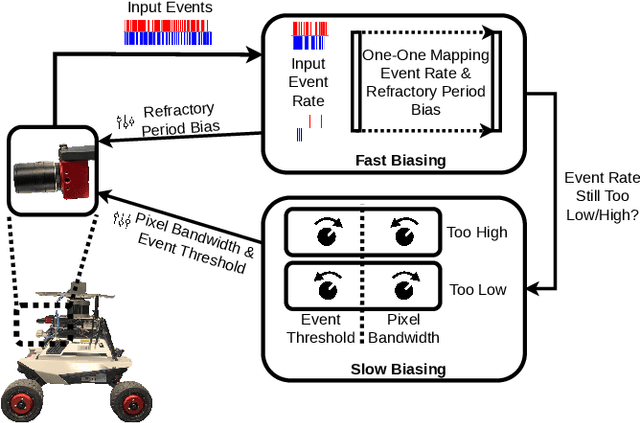
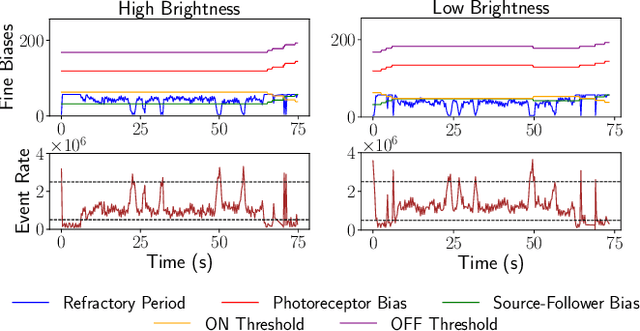
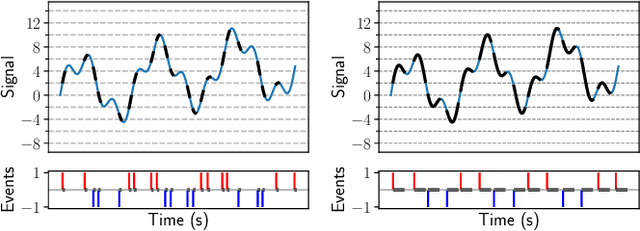
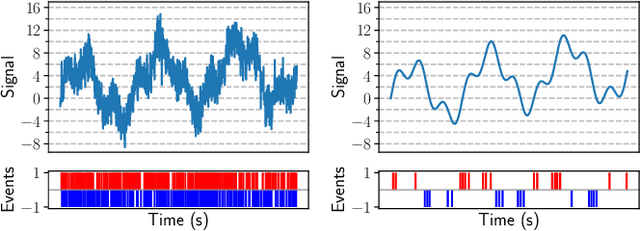
Event cameras are increasingly popular in robotics due to their beneficial features, such as low latency, energy efficiency, and high dynamic range. Nevertheless, their downstream task performance is greatly influenced by the optimization of bias parameters. These parameters, for instance, regulate the necessary change in light intensity to trigger an event, which in turn depends on factors such as the environment lighting and camera motion. This paper introduces feedback control algorithms that automatically tune the bias parameters through two interacting methods: 1) An immediate, on-the-fly fast adaptation of the refractory period, which sets the minimum interval between consecutive events, and 2) if the event rate exceeds the specified bounds even after changing the refractory period repeatedly, the controller adapts the pixel bandwidth and event thresholds, which stabilizes after a short period of noise events across all pixels (slow adaptation). Our evaluation focuses on the visual place recognition task, where incoming query images are compared to a given reference database. We conducted comprehensive evaluations of our algorithms' adaptive feedback control in real-time. To do so, we collected the QCR-Fast-and-Slow dataset that contains DAVIS346 event camera streams from 366 repeated traversals of a Scout Mini robot navigating through a 100 meter long indoor lab setting (totaling over 35km distance traveled) in varying brightness conditions with ground truth location information. Our proposed feedback controllers result in superior performance when compared to the standard bias settings and prior feedback control methods. Our findings also detail the impact of bias adjustments on task performance and feature ablation studies on the fast and slow adaptation mechanisms.
CR3DT: Camera-RADAR Fusion for 3D Detection and Tracking
Mar 22, 2024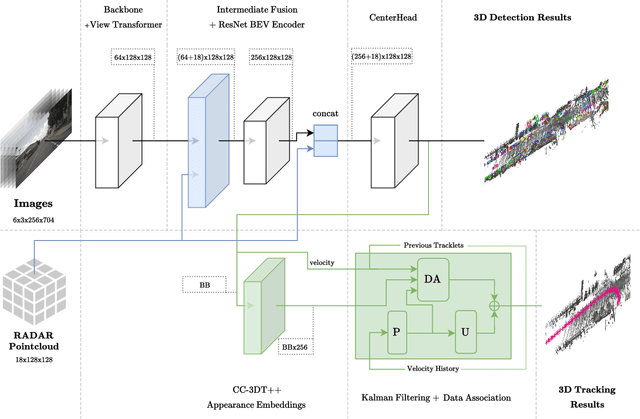
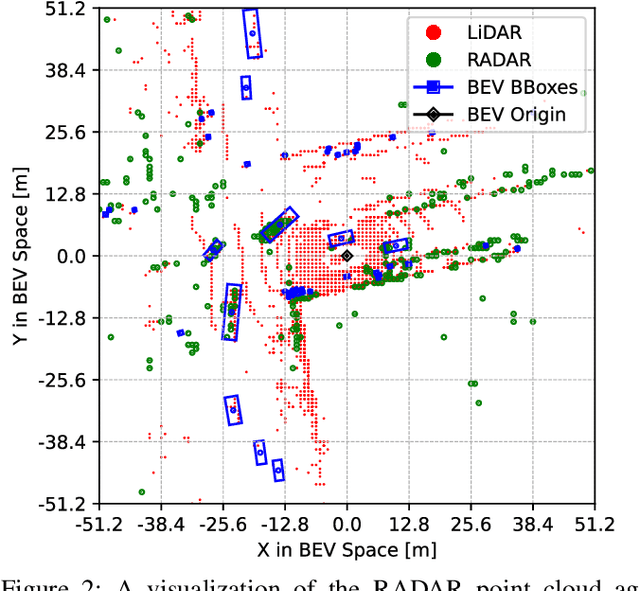
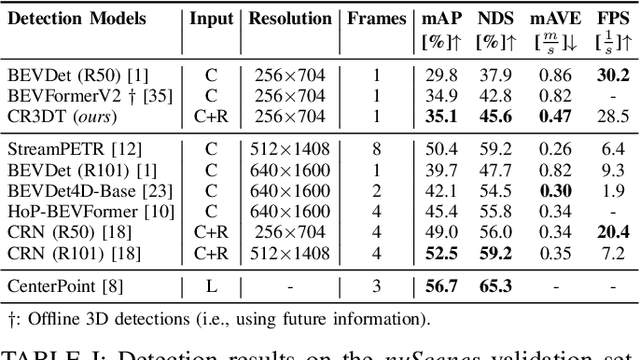
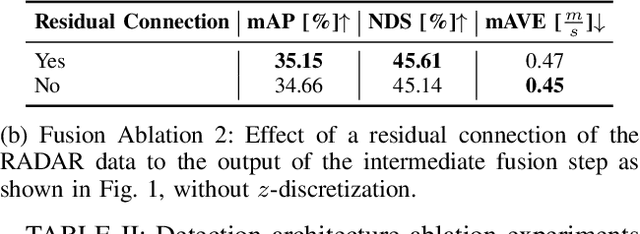
Accurate detection and tracking of surrounding objects is essential to enable self-driving vehicles. While Light Detection and Ranging (LiDAR) sensors have set the benchmark for high performance, the appeal of camera-only solutions lies in their cost-effectiveness. Notably, despite the prevalent use of Radio Detection and Ranging (RADAR) sensors in automotive systems, their potential in 3D detection and tracking has been largely disregarded due to data sparsity and measurement noise. As a recent development, the combination of RADARs and cameras is emerging as a promising solution. This paper presents Camera-RADAR 3D Detection and Tracking (CR3DT), a camera-RADAR fusion model for 3D object detection, and Multi-Object Tracking (MOT). Building upon the foundations of the State-of-the-Art (SotA) camera-only BEVDet architecture, CR3DT demonstrates substantial improvements in both detection and tracking capabilities, by incorporating the spatial and velocity information of the RADAR sensor. Experimental results demonstrate an absolute improvement in detection performance of 5.3% in mean Average Precision (mAP) and a 14.9% increase in Average Multi-Object Tracking Accuracy (AMOTA) on the nuScenes dataset when leveraging both modalities. CR3DT bridges the gap between high-performance and cost-effective perception systems in autonomous driving, by capitalizing on the ubiquitous presence of RADAR in automotive applications.