 Add to Chrome
 Add to Firefox
 Add to Edge
Bio-SFT: Asymmetric Cortical Guidance and Retinal Adaptation for Robust HDR Reconstruction
Jul 20, 2026
Recovering high dynamic range (HDR) radiance from a single standard dynamic range (SDR) image is highly ill-posed. Extreme luminance variation and severe quantization in dark regions make accurate reconstruction challenging, often leading to visual artifacts and color distortions. To address this problem, we propose Bio-SFT, a bio-inspired spiking frequency transformer for single-image HDR reconstruction. Bio-SFT incorporates three biologically motivated components. First, a learnable Naka--Rushton retinal adaptation frontend stabilizes the input under complex lighting conditions. Second, an explicit Parvo--Magno split introduces asymmetric Parvo-to-Magno guidance, allowing high-frequency structural cues to modulate low-frequency reconstruction. Third, an event-driven SNN hard gating module applies all-or-none spiking to suppress dark-region noise while preserving structural details. The module is trained with a sparsity prior to encourage efficient feature utilization. Built for end-to-end training within a transformer backbone, these lightweight components provide strong parameter efficiency. Experiments on HDRTV1K show that Bio-SFT achieves competitive perceptual quality and consistently improves HDR-VDP-3 and $ΔE_{ITP}$ while reducing artifact propagation in symmetric guidance pipelines.

3D Printing of Passively Actuated Self-Folding Robots with Integrated Functional Modules
May 06, 2026We introduce an elastic-driven self-folding approach that fabricates robots directly from flat 3D-printed conductive PLA nets. Elastic bands routed through printed hooks store energy that folds the sheet into programmed 3D geometries, while the flat state allows accurate placement of electronics and magnets before deployment. The same substrate doubles as electrodes for capacitive touch and supports a reusable platform I/O palette with Hall sensors and eccentric rotating mass (ERM) motors for docking detection and vibration actuation. We also derive a closed-form folding model that balances hinge stiffness with elastic band moment to predict equilibrium fold angles; experiments validate the model and yield a design map linking hinge thickness, band size, and hook spacing to target angles. Using this workflow we realize multiple polyhedral modules and demonstrate three applications: a cube that highlights the potential of self-folding for scalable modular robot collectives, a deployable gripper, and a tendon-driven finger. The method is low cost, stimulus-free, and integrates actuation and sensing.
Deco: Extending Personal Physical Objects into Pervasive AI Companion through a Dual-Embodiment Framework
May 05, 2026Individuals frequently form deep attachments to physical objects (e.g., plush toys) that usually cannot sense or respond to their emotions. While AI companions offer responsiveness and personalization, they exist independently of these physical objects and lack an ongoing connection to them. To bridge this gap, we conducted a formative study (N=9) to explore how digital agents could inherit and extend the emotional bond, deriving four design principles (Faithful Identity, Calibrated Agency, Ambient Presence, and Reciprocal Memory). We then present the Dual-Embodiment Companion Framework, instantiated as Deco, a mobile system integrating multimodal Large Language Models (LLMs) and Augmented Reality to create synchronized digital embodiments of users' physical companions. A within-subjects study (N=25) showed Deco significantly outperformed a personalized LLM-empowered digital companion baseline on perceived companionship, emotional bond, and design-principle scales (all p<0.01). A seven-day field deployment (N=17) showed sustained engagement, subjective well-being improvement (p=.040), and three key relational patterns: digital activities retroactively vitalized physical objects, bond deepening was driven by emotional engagement depth rather than interaction frequency, and users sustained bonds while actively navigating digital companions' AI nature. This work highlights a promising alternative for designing digital companions: moving from creating new relationships to dual embodiment, where digital agents seamlessly extend the emotional history of physical objects.
Zero Shot Deformation Reconstruction for Soft Robots Using a Flexible Sensor Array and Cage Based 3D Gaussian Modeling
Mar 20, 2026We present a zero-shot deformation reconstruction framework for soft robots that operates without any visual supervision at inference time. In this work, zero-shot deformation reconstruction is defined as the ability to infer object-wide deformations on previously unseen soft robots without collecting object-specific deformation data or performing any retraining during deployment. Our method assumes access to a static geometric proxy of the undeformed object, which can be obtained from a STL model. During operation, the system relies exclusively on tactile sensing, enabling camera-free deformation inference. The proposed framework integrates a flexible piezoresistive sensor array with a geometry-aware, cage-based 3D Gaussian deformation model. Local tactile measurements are mapped to low-dimensional cage control signals and propagated to dense Gaussian primitives to generate globally consistent shape deformations. A graph attention network regresses cage displacements from tactile input, enforcing spatial smoothness and structural continuity via boundary-aware propagation. Given only a nominal geometric proxy and real-time tactile signals, the system performs zero-shot deformation reconstruction of unseen soft robots in bending and twisting motions, while rendering photorealistic RGB in real time. It achieves 0.67 IoU, 0.65 SSIM, and 3.48 mm Chamfer distance, demonstrating strong zero-shot generalization through explicit coupling of tactile sensing and structured geometric deformation.
Towards Autonomous Sustainability Assessment via Multimodal AI Agents
Jul 22, 2025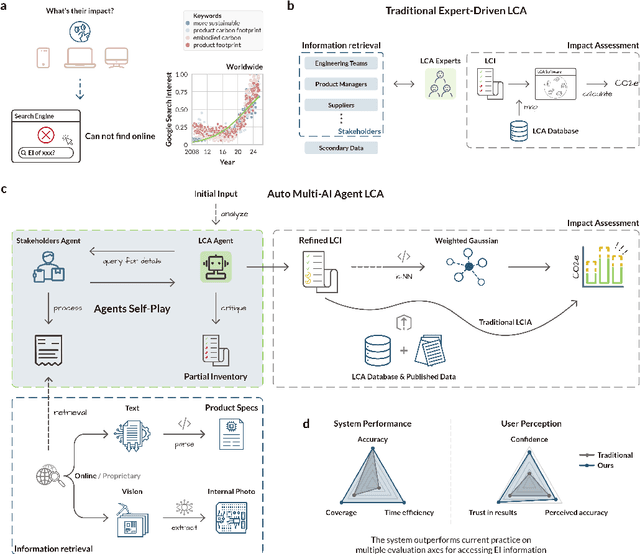
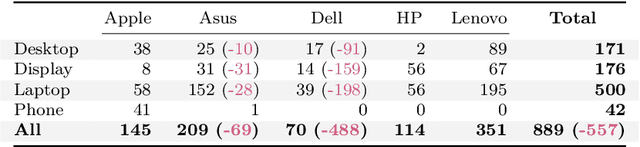
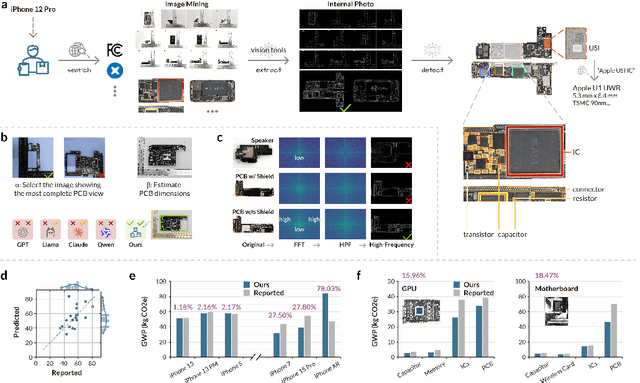

Interest in sustainability information has surged in recent years. However, the data required for a life cycle assessment (LCA) that maps the materials and processes from product manufacturing to disposal into environmental impacts (EI) are often unavailable. Here we reimagine conventional LCA by introducing multimodal AI agents that emulate interactions between LCA experts and stakeholders like product managers and engineers to calculate the cradle-to-gate (production) carbon emissions of electronic devices. The AI agents iteratively generate a detailed life-cycle inventory leveraging a custom data abstraction and software tools that extract information from online text and images from repair communities and government certifications. This approach reduces weeks or months of expert time to under one minute and closes data availability gaps while yielding carbon footprint estimates within 19% of expert LCAs with zero proprietary data. Additionally, we develop a method to directly estimate EI by comparing an input to a cluster of products with similar descriptions and known carbon footprints. This runs in 3 ms on a laptop with a MAPE of 12.28% on electronic products. Further, we develop a data-driven method to generate emission factors. We use the properties of an unknown material to represent it as a weighted sum of emission factors for similar materials. Compared to human experts picking the closest LCA database entry, this improves MAPE by 120.26%. We analyze the data and compute scaling of this approach and discuss its implications for future LCA workflows.