 Add to Chrome
 Add to Firefox
 Add to Edge
Scaling Human and G2P Supervision for Robust Phonetic Transcription
Jun 14, 2026
Expert phonetic annotation is costly, especially for non-standard dialects and atypical speech. A common alternative is using Grapheme-to-Phoneme (G2P) models to auto-generate phonetic labels from text transcripts at scale. We study how automatic phonetic transcription performance scales with human and G2P supervision in English. Using a curated 80-hour benchmark spanning native, non-native and post-stroke speech, we identify a supervision quality threshold: G2P supervision helps only when fewer than 20-30 hours of human annotation are available. Beyond this threshold, it provides no significant benefit and can reduce cross-dialect robustness. What is effective after this threshold is ASR pretraining which we use to achieve a 2.3x reduction in weighted phone feature error rate over prior systems, with strong gains on non-native and aphasic speech. These results suggest that quantity-driven G2P scaling may yield diminishing returns for robust generalization.

Towards Autonomous Sustainability Assessment via Multimodal AI Agents
Jul 22, 2025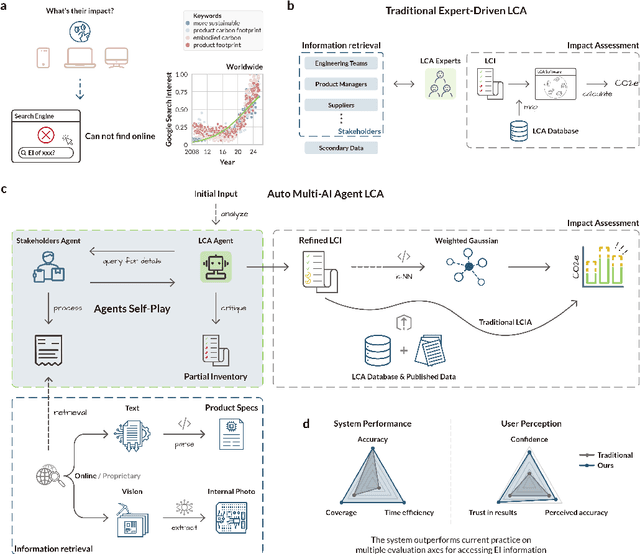
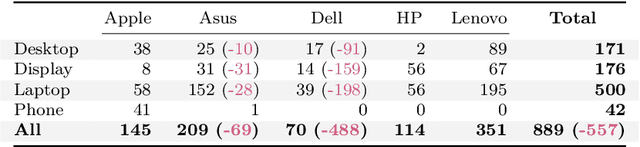
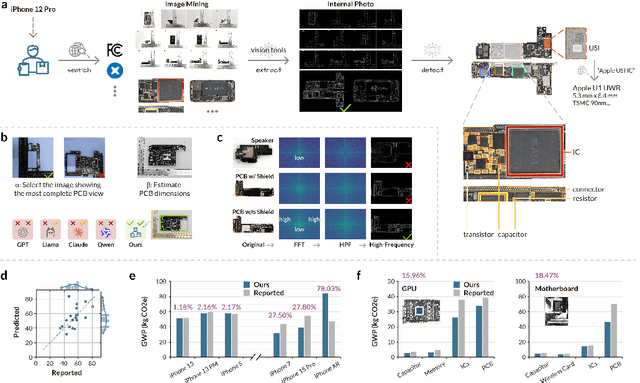

Interest in sustainability information has surged in recent years. However, the data required for a life cycle assessment (LCA) that maps the materials and processes from product manufacturing to disposal into environmental impacts (EI) are often unavailable. Here we reimagine conventional LCA by introducing multimodal AI agents that emulate interactions between LCA experts and stakeholders like product managers and engineers to calculate the cradle-to-gate (production) carbon emissions of electronic devices. The AI agents iteratively generate a detailed life-cycle inventory leveraging a custom data abstraction and software tools that extract information from online text and images from repair communities and government certifications. This approach reduces weeks or months of expert time to under one minute and closes data availability gaps while yielding carbon footprint estimates within 19% of expert LCAs with zero proprietary data. Additionally, we develop a method to directly estimate EI by comparing an input to a cluster of products with similar descriptions and known carbon footprints. This runs in 3 ms on a laptop with a MAPE of 12.28% on electronic products. Further, we develop a data-driven method to generate emission factors. We use the properties of an unknown material to represent it as a weighted sum of emission factors for similar materials. Compared to human experts picking the closest LCA database entry, this improves MAPE by 120.26%. We analyze the data and compute scaling of this approach and discuss its implications for future LCA workflows.