 Add to Chrome
 Add to Firefox
 Add to Edge
Unwarping the Lens: A Physics-Grounded Approach to Video Glasses Removal
Aug 20, 2026
High-fidelity removal of eyeglasses from video is a major challenge in facial attribute editing, as the underlying facial geometry is often obscured by complex refractive distortions and view-dependent specular reflections. While large-scale generative priors have shown promise in eye-glasses removal via static image inpainting, they often lack the structural constraints necessary to maintain identity, expression, and pose, leading to visible "identity drift" in both static images and dynamic sequences. In this paper, we propose a novel transfer framework that addresses the stochastic nature of generative priors. Our pipeline first extracts high-fidelity synthetic face images from a commercial-grade generative model (Nano Banana, Gemini 3 Pro Image), regularizes them via a three-stage structural filtering process to preserve identity, expression, and pose, and finally applies physically-based simulation of lens optics during training to provide diverse, paired data. This process transfers Nano Banana's photo-realistic, multi-view knowledge into a specialized restoration architecture, JFSnet (Joint Feature-Spatial network). JFSnet integrates DINOv2-based semantic features with a convolutional decoder for spatial reconstruction, leveraging translation equivariance constraints to improve temporal consistency and high-frequency detail preservation. Evaluations on the curated Flickr-Faces-HQ (FFHQ) subset (12,163 images) show that our approach achieves high fidelity and structural accuracy, while maintaining inference speed of 27.68 FPS. In perceptual studies on CelebV-Text video sequences, our results are consistently preferred over diffusion and GAN-based baselines for ocular consistency, temporal stability, and overall restoration quality.

3D Facial Expressions through Analysis-by-Neural-Synthesis
Apr 05, 2024While existing methods for 3D face reconstruction from in-the-wild images excel at recovering the overall face shape, they commonly miss subtle, extreme, asymmetric, or rarely observed expressions. We improve upon these methods with SMIRK (Spatial Modeling for Image-based Reconstruction of Kinesics), which faithfully reconstructs expressive 3D faces from images. We identify two key limitations in existing methods: shortcomings in their self-supervised training formulation, and a lack of expression diversity in the training images. For training, most methods employ differentiable rendering to compare a predicted face mesh with the input image, along with a plethora of additional loss functions. This differentiable rendering loss not only has to provide supervision to optimize for 3D face geometry, camera, albedo, and lighting, which is an ill-posed optimization problem, but the domain gap between rendering and input image further hinders the learning process. Instead, SMIRK replaces the differentiable rendering with a neural rendering module that, given the rendered predicted mesh geometry, and sparsely sampled pixels of the input image, generates a face image. As the neural rendering gets color information from sampled image pixels, supervising with neural rendering-based reconstruction loss can focus solely on the geometry. Further, it enables us to generate images of the input identity with varying expressions while training. These are then utilized as input to the reconstruction model and used as supervision with ground truth geometry. This effectively augments the training data and enhances the generalization for diverse expressions. Our qualitative, quantitative and particularly our perceptual evaluations demonstrate that SMIRK achieves the new state-of-the art performance on accurate expression reconstruction. Project webpage: https://georgeretsi.github.io/smirk/.
EMOCA: Emotion Driven Monocular Face Capture and Animation
Apr 24, 2022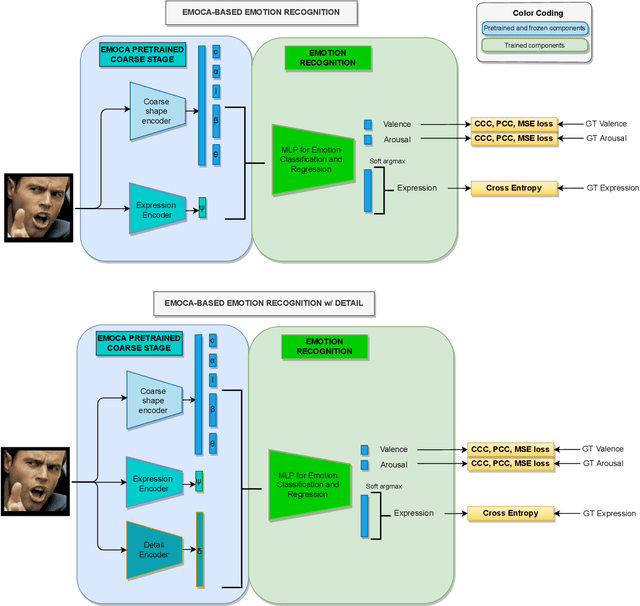
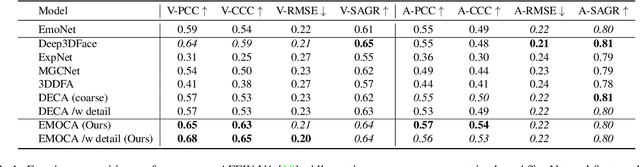
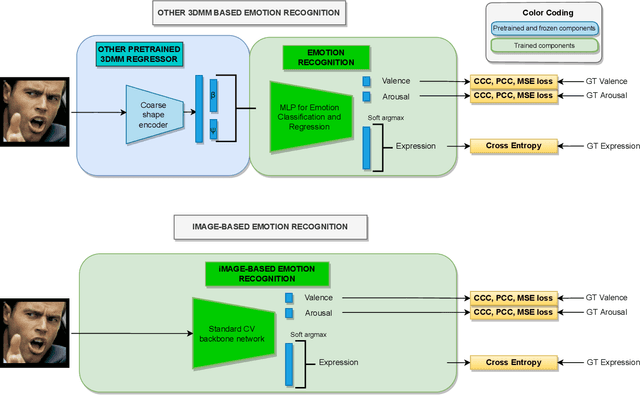
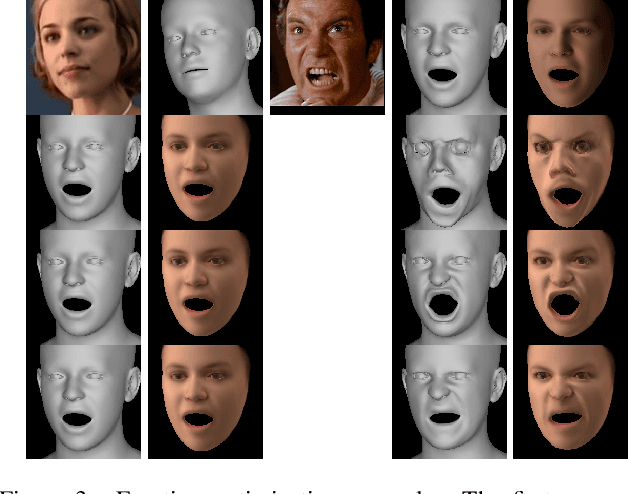
As 3D facial avatars become more widely used for communication, it is critical that they faithfully convey emotion. Unfortunately, the best recent methods that regress parametric 3D face models from monocular images are unable to capture the full spectrum of facial expression, such as subtle or extreme emotions. We find the standard reconstruction metrics used for training (landmark reprojection error, photometric error, and face recognition loss) are insufficient to capture high-fidelity expressions. The result is facial geometries that do not match the emotional content of the input image. We address this with EMOCA (EMOtion Capture and Animation), by introducing a novel deep perceptual emotion consistency loss during training, which helps ensure that the reconstructed 3D expression matches the expression depicted in the input image. While EMOCA achieves 3D reconstruction errors that are on par with the current best methods, it significantly outperforms them in terms of the quality of the reconstructed expression and the perceived emotional content. We also directly regress levels of valence and arousal and classify basic expressions from the estimated 3D face parameters. On the task of in-the-wild emotion recognition, our purely geometric approach is on par with the best image-based methods, highlighting the value of 3D geometry in analyzing human behavior. The model and code are publicly available at https://emoca.is.tue.mpg.de.