 Add to Chrome
 Add to Firefox
 Add to Edge
Decentralized Federated Learning for Heterogeneous Multi-Task Semantic Communication
Aug 15, 2026
Collaborative training in distributed semantic communication (DSC) networks typically relies on decentralized federated learning (DFL). However, pushing topology-agnostic aggregation into heterogeneous, multi-task environments creates a fundamental bottleneck: it drives negative transfer and overconsensus bias (OCB). This paper introduces a personalized DSC framework that cuts off this cross-task interference. At the node level, a policy-driven multi-path routing mechanism separates task-specific features from shared representations to preserve local fidelity. Across the network, we deploy a "communicationwhile- aggregation" protocol. It calibrates a column-stochastic consensus matrix using task affinities. This limits the system to absorbing complementary knowledge while actively blocking mismatched parameter updates. To bound the convergence, we derive a unified Lyapunov drift analysis. We reveal a strict Ushaped trade-off: deeper topological mixing reduces variance but amplifies structural OCB. Resolving this tension yields a closed-form expression for the optimal aggregation depth. We evaluate the proposed framework on NYU-v2, where the results reveal a clear trade-off between insufficient aggregation and excessive topological mixing. At the analytically derived optimal aggregation depth, our method achieves a 4.77% global relative improvement over the no-aggregation baseline and outperforms decentralized FedAvg, FedAMP, and heuristic max aggregation. We further evaluate the framework on Taskonomy and imperfect wireless links to examine the effects of network-size variation and wireless-link reliability.

Prior-Aided Iterative Channel Reconstruction with Optimized Frame Structure for DSE Mitigation in CP-OTFS-Based LEO Satellite Systems
Aug 04, 2026Orthogonal time frequency space (OTFS) modulation has emerged as a promising solution to mitigate the severe Doppler shift in low Earth orbit (LEO) satellite communications. However, the frequency-dependent Doppler shift induced by the high mobility of LEO satellites leads to the Doppler squint effect (DSE). This effect compromises the channel sparsity in the delay-Doppler (DD) domain, rendering existing channel estimation methods ineffective. To overcome this challenge, this paper proposes a DSE-resilient transmission scheme for cyclic prefix OTFS (CP-OTFS)-based LEO satellite systems. Specifically, we analyze the input-output relationship of the CPOTFS- based LEO satellite communication system and derive a DSE-aware representation of the satellite-terrestrial channel in the DD domain. To efficiently capture DSE-aware channel characteristics, we propose a novel OTFS frame structure that allows the energy distribution of the received signal to serve as prior information for channel estimation. Meanwhile, this frame structure strategically allocates pilot symbols to achieve uniform energy distribution and reduce the peak-to-average power ratio (PAPR), while imposing a time-domain waveform continuity constraint to suppress out-of-band emission (OOBE) caused by rectangular pulses. Based on the frame structure, we propose a prior-aided iterative channel reconstruction (PAICR) algorithm to mitigate the severe power leakage induced by DSE. The proposed algorithm iteratively extracts and removes dominant channel components using Doppler-domain received signal energy observations, with a convergence criterion ensuring reliable termination. Furthermore, a Cramer-Rao lower bound is derived to provide a theoretical benchmark for evaluating the algorithm's performance.
Adaptive Dual-Path Framework for Covert Semantic Communication
May 05, 2026This paper proposes a novel adaptive dual-path framework for covert semantic communication (SemCom), which integrates covert information transmission with task-oriented semantic coding. Unlike conventional covert communication methods that embed hidden messages through power-domain signal superposition, our framework embeds covert data within task-specific features via semantic-level intrinsic encoding. This new architecture introduces dual encoding paths with adaptive block selection: an Explicit path for public task execution and a Stego path that jointly encodes both public and covert information through contrastive representation alignment. A Gumbel-Softmax enabled adaptive path selection mechanism dynamically activates network blocks based on task require- ments. We formulate a multi-objective optimization framework that simultaneously ensures accurate semantic understanding and reliable covert transmission. We rigorously evaluate our framework's security against a powerful, independently trained attacker. Experimental results on the Cityscapes dataset demon- strate a state-of-the-art level of covertness: our method suppresses the attacker's detection accuracy to a near-random guessing level of 56.12%. This robust security is achieved while simultaneously maintaining superior performance on the primary semantic tasks compared to the baselines.
Joint Routing and Model Pruning for Decentralized Federated Learning in Bandwidth-Constrained Multi-Hop Wireless Networks
Mar 16, 2026Decentralized federated learning (D-FL) enables privacy-preserving training without a central server, but multi-hop model exchanges and aggregation are often bottlenecked by communication resource constraints. To address this issue, we propose a joint routing-and-pruning framework that optimizes routing paths and pruning rates to maintain communication latency within prescribed limits. We analyze how the sum of model biases across all clients affects the convergence bound of D-FL and formulate an optimization problem that maximizes the model retention rate to minimize these biases under communication constraints. Further analysis reveals that each client's model retention rate is path-dependent, which reduces the original problem to a routing optimization. Leveraging this insight, we develop a routing algorithm that selects latency-efficient transmission paths, allowing more parameters to be delivered within the time budget and thereby improving D-FL convergence. Simulations demonstrate that, compared with unpruned systems, the proposed framework reduces average transmission latency by 27.8% and improves testing accuracy by approximately 12%. Furthermore, relative to standard benchmark routing algorithms, the proposed routing method improves accuracy by roughly 8%.
A Harmony Composition-Inspired Tensor Modalization Method for Near-Field IRS Channel Estimation
Mar 11, 2026Intelligent reflecting surfaces (IRSs) are poised to revolutionize next-generation wireless communication systems by enhancing channel quality and spectrum efficiency through advanced wave manipulation. However, extremely large-scale IRS {(XL-IRS)} deployments face significant challenges in channel estimation due to multiplicative path loss and near-field (NF) effects, where spherical wavefronts couple distance and angle parameters. Existing polar-domain codebook-based compressive sensing methods for NF channel estimation suffer from low accuracy and high complexity, caused by the need for high-resolution grids of both distance and angle parameters. To address this, we propose a harmonic processing-inspired channel estimation framework for NF {XL-IRS} systems by leveraging tensor modalization to decouple channel parameters. Drawing an analogy to musical harmonic analysis, our approach decomposes the high-dimensional NF channel tensor into independent factor matrices, modeled as ``chords," representing distance and angle parameters. Through harmonic analysis-inspired distance parameter decoupling, we design a compact, distance-dependent codebook that enables high-resolution NF channel parameter estimation. This approach significantly reduces the codebook size compared to polar-domain methods. {Then, we} derive the Cramér-Rao lower bound (CRLB) to evaluate the estimators. Finally, simulation results show an 8.5 dB improvement in normalized mean square error (NMSE) compared to conventional methods, underscoring its low complexity and high accuracy.
Efficient Off-Grid Near-Field Cascade Channel Estimation for XL-IRS Systems via Tucker Decomposition
Feb 15, 2026Accurate cascaded channel state information is pivotal for extremely large-scale intelligent reflecting surfaces (XL-IRS) in next-generation wireless networks. However, the large XL-IRS aperture induces spherical wavefront propagation due to near-field (NF) effects, complicating cascaded channel estimation. Conventional dictionary-based methods suffer from cumulative quantization errors and high complexity, especially in uniform planar array (UPA) systems. To address these issues, we first propose a tensor modelization method for NF cascaded channels by exploiting the tensor product among the horizontal and vertical response vectors of the UPA-structured base station (BS) and the incident-reflective array response vector of the IRS. This structure leverages spatial characteristics, enabling independent estimation of factor matrices to improve efficiency. Meanwhile, to avoid quantization errors, we propose an off-grid cascaded channel estimation framework based on sparse Tucker decomposition. Specifically, we model the received signal as a Tucker tensor, where the sparse core tensor captures path gain-delay terms and three factor matrices are spanned by BS and NF IRS array responses. We then formulate a sparse core tensor minimization problem with tri-modal log-sum sparsity constraints to tackle the NP-hard challenge. Finally, the method is accelerated via higher-order singular value decomposition preprocessing, combined with majorization-minimization and a tailored tensor over-relaxation fast iterative shrinkage-thresholding technique. We derive the Cramér-Rao lower bound and conduct convergence analysis. Simulations show the proposed scheme achieves a 13.6 dB improvement in normalized mean square error over benchmarks with significantly reduced runtime.
ARIS-RSMA Enhanced ISAC System: Joint Rate Splitting and Beamforming Design
Feb 06, 2026This letter proposes an active reconfigurable intelligent surface (ARIS) assisted rate-splitting multiple access (RSMA) integrated sensing and communication (ISAC) system to overcome the fairness bottleneck in multi-target sensing under obstructed line-of-sight environments. Beamforming at the transceiver and ARIS, along with rate splitting, are optimized to maximize the minimum multi-target echo signal-to-interference-plus-noise ratio under multi-user rate and power constraints. The intricate non-convex problem is decoupled into three subproblems and solved iteratively by majorization-minimization (MM) and sequential rank-one constraint relaxation (SROCR) algorithms. Simulations show our scheme outperforms nonorthogonal multiple access, space-division multiple access, and passive RIS baselines, approaching sensing-only upper bounds.
Stacked Intelligent Metasurfaces-Based Electromagnetic Wave Domain Interference-Free Precoding
Jan 27, 2026This paper introduces an interference-free multi-stream transmission architecture leveraging stacked intelligent metasurfaces (SIMs), from a new perspective of interference exploitation. Unlike traditional interference exploitation precoding (IEP) which relies on computational hardware circuitry, we perform the precoding operations within the analog wave domain provided by SIMs. However, the benefits of SIM-enabled IEP are limited by the nonlinear distortion (NLD) caused by power amplifiers. A hardware-efficient interference-free transmitter architecture is developed to exploit SIM's high and flexible degree of freedom (DoF), where the NLD on modulated symbols can be directly compensated in the wave domain. Moreover, we design a frame-level SIM configuration scheme and formulate a maxmin problem on the safety margin function. With respect to the optimization of SIM phase shifts, we propose a recursive oblique manifold (ROM) algorithm to tackle the complex coupling among phase shifts across multiple layers. A flexible DoF-driven antenna selection (AS) scheme is explored in the SIM-enabled IEP system. Using an ROM-based alternating optimization (ROM-AO) framework, our approach jointly optimizes transmit AS, SIM phase shift design, and power allocation (PA), and develops a greedy safety margin-based AS algorithm. Simulations show that the proposed SIM-enabled frame-level IEP scheme significantly outperforms benchmarks. Specifically, the strategy with AS and PA can achieve a 20 dB performance gain compared to the case without any strategy under the 12 dB signal-to-noise ratio, which confirms the superiority of the NLD-aware IEP scheme and the effectiveness of the proposed algorithm.
Free Privacy Protection for Wireless Federated Learning: Enjoy It or Suffer from It?
Jun 15, 2025Inherent communication noises have the potential to preserve privacy for wireless federated learning (WFL) but have been overlooked in digital communication systems predominantly using floating-point number standards, e.g., IEEE 754, for data storage and transmission. This is due to the potentially catastrophic consequences of bit errors in floating-point numbers, e.g., on the sign or exponent bits. This paper presents a novel channel-native bit-flipping differential privacy (DP) mechanism tailored for WFL, where transmit bits are randomly flipped and communication noises are leveraged, to collectively preserve the privacy of WFL in digital communication systems. The key idea is to interpret the bit perturbation at the transmitter and bit errors caused by communication noises as a bit-flipping DP process. This is achieved by designing a new floating-point-to-fixed-point conversion method that only transmits the bits in the fraction part of model parameters, hence eliminating the need for transmitting the sign and exponent bits and preventing the catastrophic consequence of bit errors. We analyze a new metric to measure the bit-level distance of the model parameters and prove that the proposed mechanism satisfies (\lambda,\epsilon)-R\'enyi DP and does not violate the WFL convergence. Experiments validate privacy and convergence analysis of the proposed mechanism and demonstrate its superiority to the state-of-the-art Gaussian mechanisms that are channel-agnostic and add Gaussian noise for privacy protection.
Multi-Task Semantic Communication With Graph Attention-Based Feature Correlation Extraction
Jan 02, 2025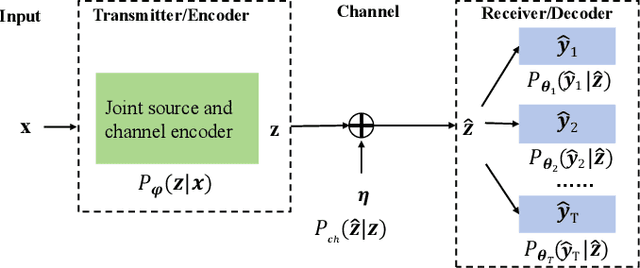


Multi-task semantic communication can serve multiple learning tasks using a shared encoder model. Existing models have overlooked the intricate relationships between features extracted during an encoding process of tasks. This paper presents a new graph attention inter-block (GAI) module to the encoder/transmitter of a multi-task semantic communication system, which enriches the features for multiple tasks by embedding the intermediate outputs of encoding in the features, compared to the existing techniques. The key idea is that we interpret the outputs of the intermediate feature extraction blocks of the encoder as the nodes of a graph to capture the correlations of the intermediate features. Another important aspect is that we refine the node representation using a graph attention mechanism to extract the correlations and a multi-layer perceptron network to associate the node representations with different tasks. Consequently, the intermediate features are weighted and embedded into the features transmitted for executing multiple tasks at the receiver. Experiments demonstrate that the proposed model surpasses the most competitive and publicly available models by 11.4% on the CityScapes 2Task dataset and outperforms the established state-of-the-art by 3.97% on the NYU V2 3Task dataset, respectively, when the bandwidth ratio of the communication channel (i.e., compression level for transmission over the channel) is as constrained as 1 12 .