 Add to Chrome
 Add to Firefox
 Add to Edge
A Harmony Composition-Inspired Tensor Modalization Method for Near-Field IRS Channel Estimation
Mar 11, 2026
Intelligent reflecting surfaces (IRSs) are poised to revolutionize next-generation wireless communication systems by enhancing channel quality and spectrum efficiency through advanced wave manipulation. However, extremely large-scale IRS {(XL-IRS)} deployments face significant challenges in channel estimation due to multiplicative path loss and near-field (NF) effects, where spherical wavefronts couple distance and angle parameters. Existing polar-domain codebook-based compressive sensing methods for NF channel estimation suffer from low accuracy and high complexity, caused by the need for high-resolution grids of both distance and angle parameters. To address this, we propose a harmonic processing-inspired channel estimation framework for NF {XL-IRS} systems by leveraging tensor modalization to decouple channel parameters. Drawing an analogy to musical harmonic analysis, our approach decomposes the high-dimensional NF channel tensor into independent factor matrices, modeled as ``chords," representing distance and angle parameters. Through harmonic analysis-inspired distance parameter decoupling, we design a compact, distance-dependent codebook that enables high-resolution NF channel parameter estimation. This approach significantly reduces the codebook size compared to polar-domain methods. {Then, we} derive the Cramér-Rao lower bound (CRLB) to evaluate the estimators. Finally, simulation results show an 8.5 dB improvement in normalized mean square error (NMSE) compared to conventional methods, underscoring its low complexity and high accuracy.

Efficient Off-Grid Near-Field Cascade Channel Estimation for XL-IRS Systems via Tucker Decomposition
Feb 15, 2026Accurate cascaded channel state information is pivotal for extremely large-scale intelligent reflecting surfaces (XL-IRS) in next-generation wireless networks. However, the large XL-IRS aperture induces spherical wavefront propagation due to near-field (NF) effects, complicating cascaded channel estimation. Conventional dictionary-based methods suffer from cumulative quantization errors and high complexity, especially in uniform planar array (UPA) systems. To address these issues, we first propose a tensor modelization method for NF cascaded channels by exploiting the tensor product among the horizontal and vertical response vectors of the UPA-structured base station (BS) and the incident-reflective array response vector of the IRS. This structure leverages spatial characteristics, enabling independent estimation of factor matrices to improve efficiency. Meanwhile, to avoid quantization errors, we propose an off-grid cascaded channel estimation framework based on sparse Tucker decomposition. Specifically, we model the received signal as a Tucker tensor, where the sparse core tensor captures path gain-delay terms and three factor matrices are spanned by BS and NF IRS array responses. We then formulate a sparse core tensor minimization problem with tri-modal log-sum sparsity constraints to tackle the NP-hard challenge. Finally, the method is accelerated via higher-order singular value decomposition preprocessing, combined with majorization-minimization and a tailored tensor over-relaxation fast iterative shrinkage-thresholding technique. We derive the Cramér-Rao lower bound and conduct convergence analysis. Simulations show the proposed scheme achieves a 13.6 dB improvement in normalized mean square error over benchmarks with significantly reduced runtime.
ARIS-RSMA Enhanced ISAC System: Joint Rate Splitting and Beamforming Design
Feb 06, 2026This letter proposes an active reconfigurable intelligent surface (ARIS) assisted rate-splitting multiple access (RSMA) integrated sensing and communication (ISAC) system to overcome the fairness bottleneck in multi-target sensing under obstructed line-of-sight environments. Beamforming at the transceiver and ARIS, along with rate splitting, are optimized to maximize the minimum multi-target echo signal-to-interference-plus-noise ratio under multi-user rate and power constraints. The intricate non-convex problem is decoupled into three subproblems and solved iteratively by majorization-minimization (MM) and sequential rank-one constraint relaxation (SROCR) algorithms. Simulations show our scheme outperforms nonorthogonal multiple access, space-division multiple access, and passive RIS baselines, approaching sensing-only upper bounds.
Stacked Intelligent Metasurfaces-Based Electromagnetic Wave Domain Interference-Free Precoding
Jan 27, 2026This paper introduces an interference-free multi-stream transmission architecture leveraging stacked intelligent metasurfaces (SIMs), from a new perspective of interference exploitation. Unlike traditional interference exploitation precoding (IEP) which relies on computational hardware circuitry, we perform the precoding operations within the analog wave domain provided by SIMs. However, the benefits of SIM-enabled IEP are limited by the nonlinear distortion (NLD) caused by power amplifiers. A hardware-efficient interference-free transmitter architecture is developed to exploit SIM's high and flexible degree of freedom (DoF), where the NLD on modulated symbols can be directly compensated in the wave domain. Moreover, we design a frame-level SIM configuration scheme and formulate a maxmin problem on the safety margin function. With respect to the optimization of SIM phase shifts, we propose a recursive oblique manifold (ROM) algorithm to tackle the complex coupling among phase shifts across multiple layers. A flexible DoF-driven antenna selection (AS) scheme is explored in the SIM-enabled IEP system. Using an ROM-based alternating optimization (ROM-AO) framework, our approach jointly optimizes transmit AS, SIM phase shift design, and power allocation (PA), and develops a greedy safety margin-based AS algorithm. Simulations show that the proposed SIM-enabled frame-level IEP scheme significantly outperforms benchmarks. Specifically, the strategy with AS and PA can achieve a 20 dB performance gain compared to the case without any strategy under the 12 dB signal-to-noise ratio, which confirms the superiority of the NLD-aware IEP scheme and the effectiveness of the proposed algorithm.
Beamforming-Codebook-Aware Channel Knowledge Map Construction for Multi-Antenna Systems
May 22, 2025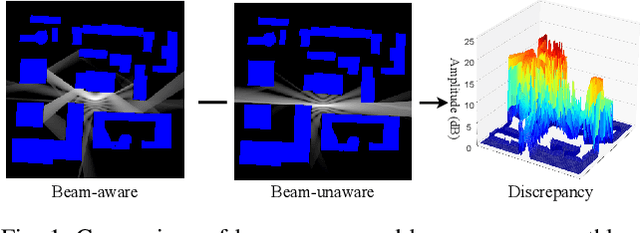
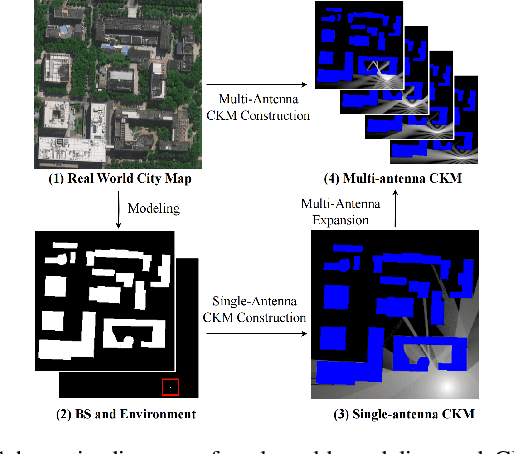
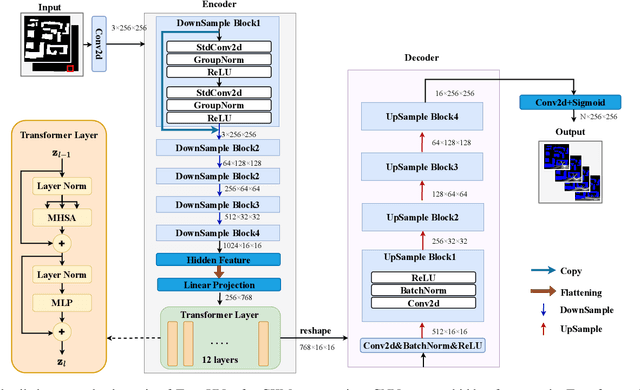
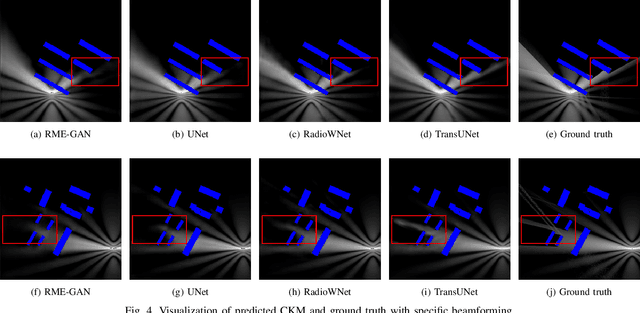
Channel knowledge map (CKM) has emerged as a crucial technology for next-generation communication, enabling the construction of high-fidelity mappings between spatial environments and channel parameters via electromagnetic information analysis. Traditional CKM construction methods like ray tracing are computationally intensive. Recent studies utilizing neural networks (NNs) have achieved efficient CKM generation with reduced computational complexity and real-time processing capabilities. Nevertheless, existing research predominantly focuses on single-antenna systems, failing to address the beamforming requirements inherent to MIMO configurations. Given that appropriate precoding vector selection in MIMO systems can substantially enhance user communication rates, this paper presents a TransUNet-based framework for constructing CKM, which effectively incorporates discrete Fourier transform (DFT) precoding vectors. The proposed architecture combines a UNet backbone for multiscale feature extraction with a Transformer module to capture global dependencies among encoded linear vectors. Experimental results demonstrate that the proposed method outperforms state-of-the-art (SOTA) deep learning (DL) approaches, yielding a 17\% improvement in RMSE compared to RadioWNet. The code is publicly accessible at https://github.com/github-whh/TransUNet.
Lightweight and Self-Evolving Channel Twinning: An Ensemble DMD-Assisted Approach
Apr 23, 2025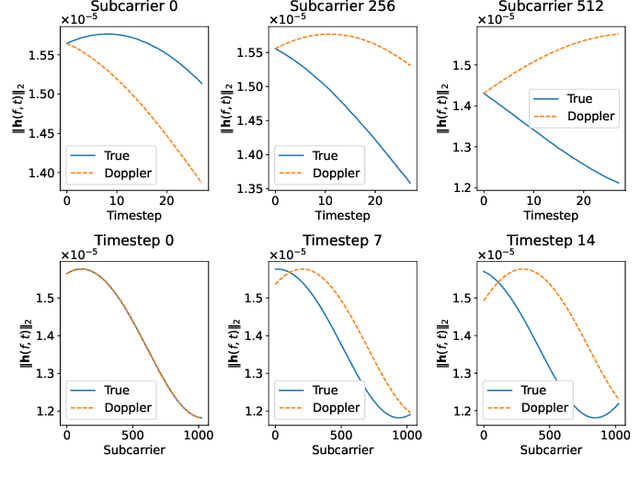
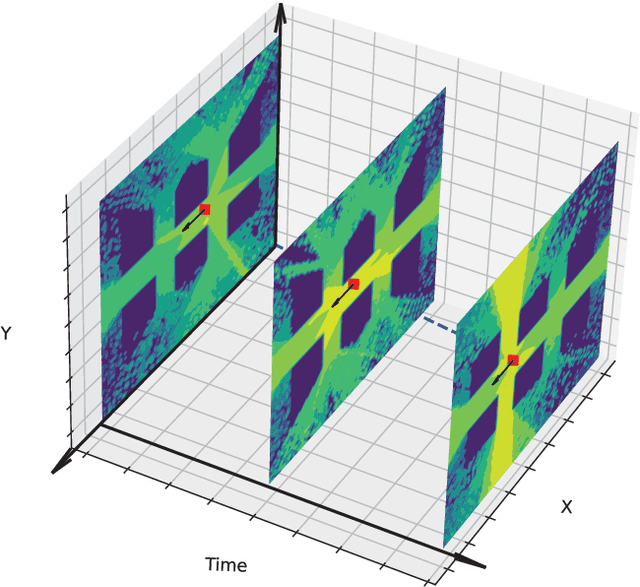
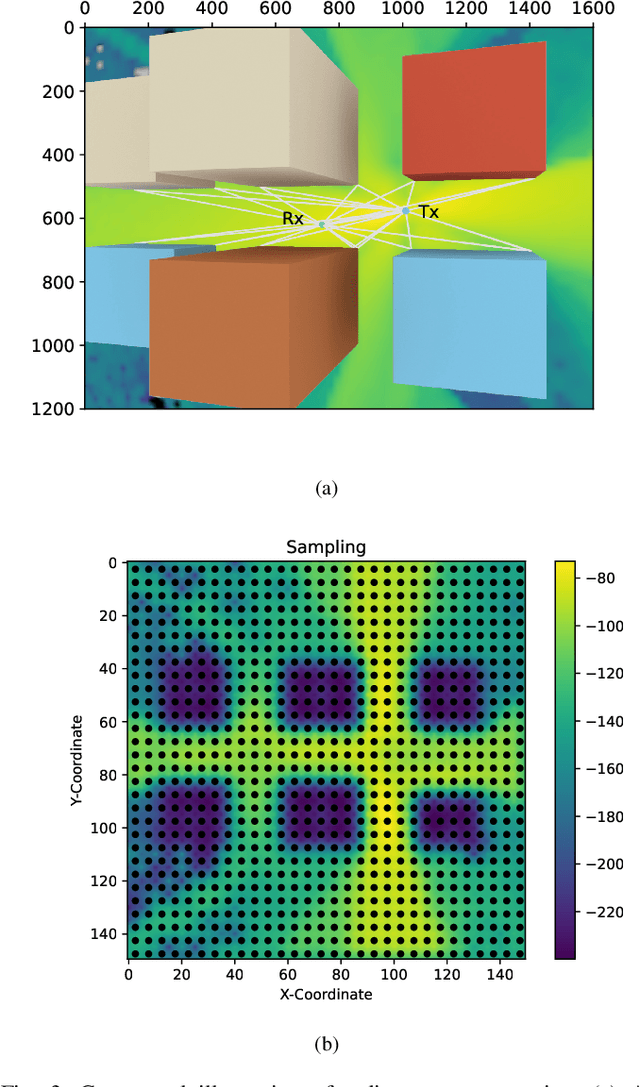
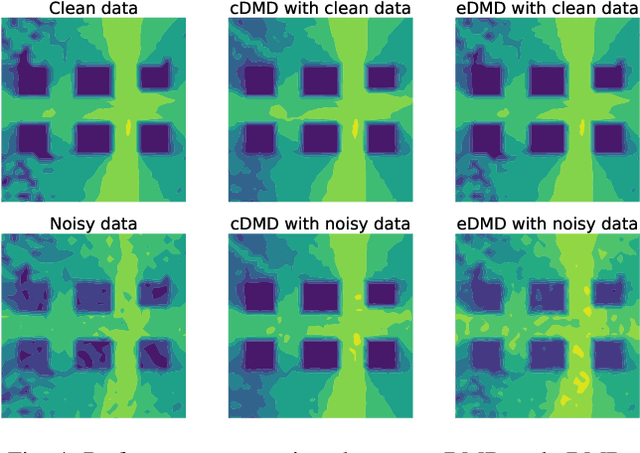
Traditional channel acquisition faces significant limitations due to ideal model assumptions and scalability challenges. A novel environment-aware paradigm, known as channel twinning, tackles these issues by constructing radio propagation environment semantics using a data-driven approach. In the spotlight of channel twinning technology, a radio map is recognized as an effective region-specific model for learning the spatial distribution of channel information. However, most studies focus on static channel map construction, with only a few collecting numerous channel samples and using deep learning for radio map prediction. In this paper, we develop a novel dynamic radio map twinning framework with a substantially small dataset. Specifically, we present an innovative approach that employs dynamic mode decomposition (DMD) to model the evolution of the dynamic channel gain map as a dynamical system. We first interpret dynamic channel gain maps as spatio-temporal video stream data. The coarse-grained and fine-grained evolving modes are extracted from the stream data using a new ensemble DMD (Ens-DMD) algorithm. To mitigate the impact of noisy data, we design a median-based threshold mask technique to filter the noise artifacts of the twin maps. With the proposed DMD-based radio map twinning framework, numerical results are provided to demonstrate the low-complexity reproduction and evolution of the channel gain maps. Furthermore, we consider four radio map twin performance metrics to confirm the superiority of our framework compared to the baselines.
Channel Twinning: An Enabler for Next-Generation Ubiquitous Wireless Connectivity
Jun 18, 2024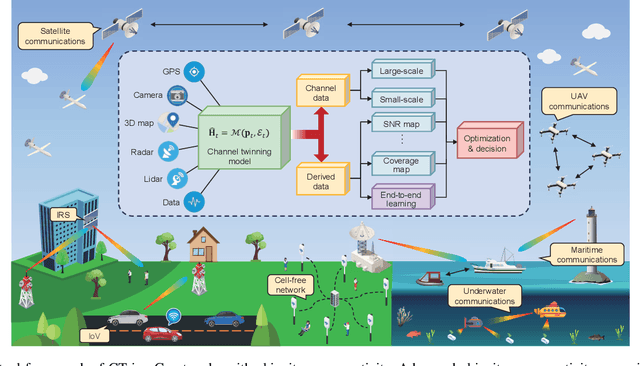
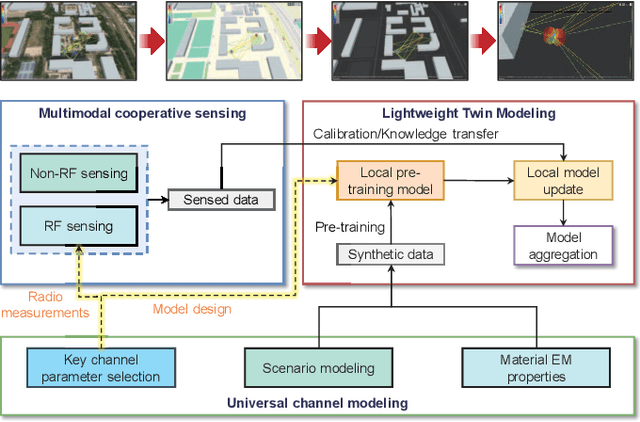
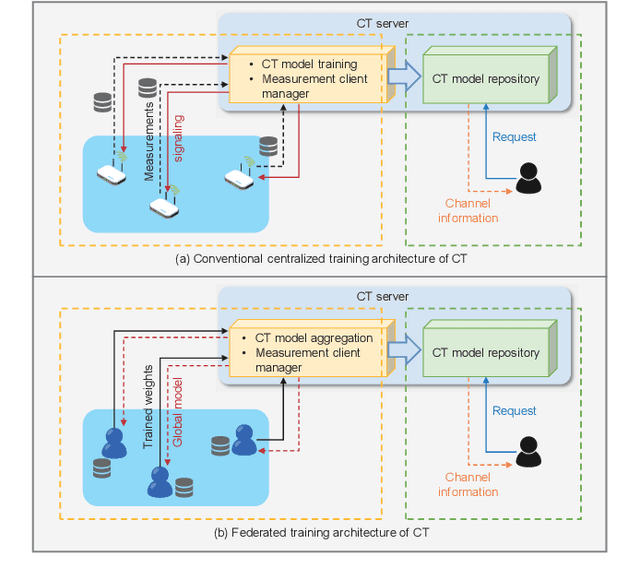
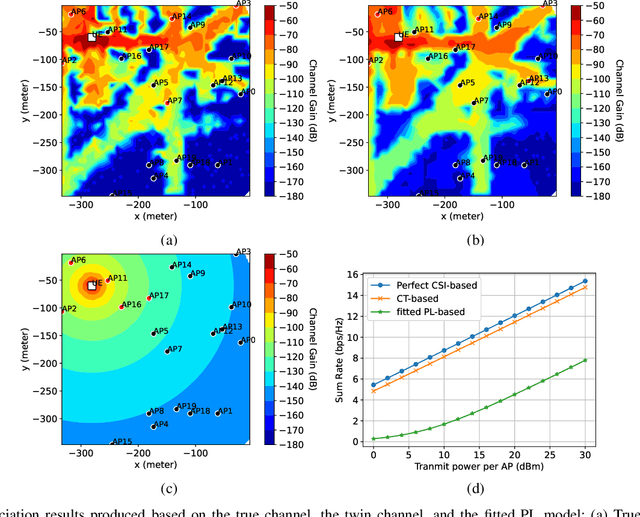
The emerging concept of channel twinning (CT) has great potential to become a key enabler of ubiquitous connectivity in next-generation (xG) wireless systems. By fusing multimodal sensor data, CT advocates a high-fidelity and low-overhead channel acquisition paradigm, which is promising to provide accurate channel prediction in cross-domain and high-mobility scenarios of ubiquitous xG networks. However, the current literature lacks a universal CT architecture to address the challenges of heterogeneous scenarios, data, and resources in xG networks, which hinders the widespread deployment and applications of CT. This article discusses a new modularized CT architecture to bridge the barriers to scene recognition, cooperative sensing, and decentralized training. Based on the modularized design of CT, universal channel modeling, multimodal cooperative sensing, and lightweight twin modeling are described. Moreover, this article provides a concise definition, technical features, and case studies of CT, followed by potential applications of CT-empowered ubiquitous connectivity and some issues requiring future investigations.
Multi-Objective Optimization-Based Waveform Design for Multi-User and Multi-Target MIMO-ISAC Systems
May 22, 2024Integrated sensing and communication (ISAC) opens up new service possibilities for sixth-generation (6G) systems, where both communication and sensing (C&S) functionalities co-exist by sharing the same hardware platform and radio resource. In this paper, we investigate the waveform design problem in a downlink multi-user and multi-target ISAC system under different C&S performance preferences. The multi-user interference (MUI) may critically degrade the communication performance. To eliminate the MUI, we employ the constructive interference mechanism into the ISAC system, which saves the power budget for communication. However, due to the conflict between C&S metrics, it is intractable for the ISAC system to achieve the optimal performance of C&S objective simultaneously. Therefore, it is important to strike a tradeoff between C&S objectives. By virtue of the multi-objective optimization theory, we propose a weighted Tchebycheff-based transformation method to re-frame the C&S trade-off problem as a Pareto-optimal problem, thus effectively tackling the constraints in ISAC systems. Finally, simulation results reveal the trade-off relation between C&S performances, which provides insights for the flexible waveform design under different C&S performance preferences in MIMO-ISAC systems.
Intelligent Reflecting Surfaces and Next Generation Wireless Systems
Feb 27, 2024Intelligent reflecting surface (IRS) is a potential candidate for massive multiple-input multiple-output (MIMO) 2.0 technology due to its low cost, ease of deployment, energy efficiency and extended coverage. This chapter investigates the slot-by-slot IRS reflection pattern design and two-timescale reflection pattern design schemes, respectively. For the slot-by-slot reflection optimization, we propose exploiting an IRS to improve the propagation channel rank in mmWave massive MIMO systems without need to increase the transmit power budget. Then, we analyze the impact of the distributed IRS on the channel rank. To further reduce the heavy overhead of channel training, channel state information (CSI) estimation, and feedback in time-varying MIMO channels, we present a two-timescale reflection optimization scheme, where the IRS is configured relatively infrequently based on statistical CSI (S-CSI) and the active beamformers and power allocation are updated based on quickly outdated instantaneous CSI (I-CSI) per slot. The achievable average sum-rate (AASR) of the system is maximized without excessive overhead of cascaded channel estimation. A recursive sampling particle swarm optimization (PSO) algorithm is developed to optimize the large-timescale IRS reflection pattern efficiently with reduced samplings of channel samples.
Multi-Carrier NOMA-Empowered Wireless Federated Learning with Optimal Power and Bandwidth Allocation
Feb 13, 2023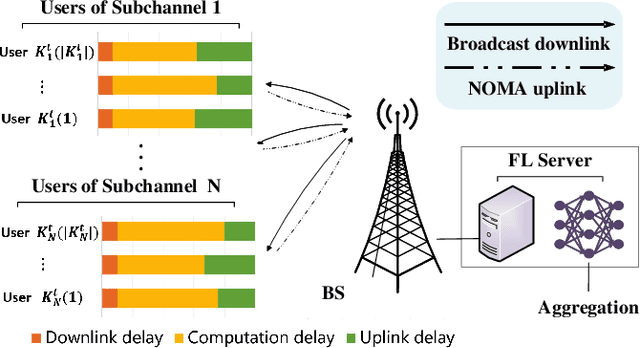
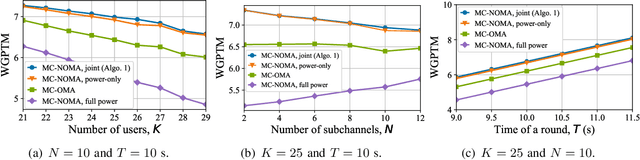
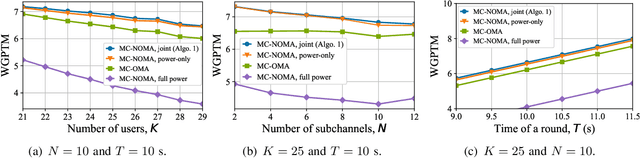

Wireless federated learning (WFL) undergoes a communication bottleneck in uplink, limiting the number of users that can upload their local models in each global aggregation round. This paper presents a new multi-carrier non-orthogonal multiple-access (MC-NOMA)-empowered WFL system under an adaptive learning setting of Flexible Aggregation. Since a WFL round accommodates both local model training and uploading for each user, the use of Flexible Aggregation allows the users to train different numbers of iterations per round, adapting to their channel conditions and computing resources. The key idea is to use MC-NOMA to concurrently upload the local models of the users, thereby extending the local model training times of the users and increasing participating users. A new metric, namely, Weighted Global Proportion of Trained Mini-batches (WGPTM), is analytically established to measure the convergence of the new system. Another important aspect is that we maximize the WGPTM to harness the convergence of the new system by jointly optimizing the transmit powers and subchannel bandwidths. This nonconvex problem is converted equivalently to a tractable convex problem and solved efficiently using variable substitution and Cauchy's inequality. As corroborated experimentally using a convolutional neural network and an 18-layer residential network, the proposed MC-NOMA WFL can efficiently reduce communication delay, increase local model training times, and accelerate the convergence by over 40%, compared to its existing alternative.