 Add to Chrome
 Add to Firefox
 Add to Edge
Occluding the Solution Space: Planner-Agnostic Adversarial Attacks on Tolerance-Aware Manipulation
Jul 04, 2026
Adversarial attacks on motion planning are crucial for evaluating and quantifying the intrinsic robustness of robotic manipulation. However, existing approaches are typically limited by restrictive exact-pose objectives and their reliance on planner-in-the-loop queries. To address these limitations, we propose a planner-agnostic attack framework for tolerance-aware manipulation. Our approach shifts the evaluation paradigm to task-level feasibility over goal regions, efficiently inserting adversarial obstacles without requiring oracle access to the victim system. Offline, we characterize the robot's intrinsic workspace capabilities via a kinematic occupancy heatmap, which encodes the density of feasible trajectories and robustness priors without invoking a specific planner. Online, we formulate the attack as a budgeted maximum-coverage optimization, strategically deploying obstacles subject to explicit geometric constraints to occlude the solution space. Extensive experiments across simulation and real-world scenarios demonstrate that our method reliably induces planning failures, significantly outperforming planner-in-the-loop baselines in both computational efficiency and attack efficacy.

In-context Region-based Drag: Drag Any Region to Any Shape
Jun 24, 2026Diffusion models have shown promise in drag-style editing. Previous works mainly focus on point-based drag, which is inherently ambiguous. This paper focuses on region-based drag and introduces a novel In-Context Region-based Drag (ICRDrag) method. Under the in-context learning framework, ICRDrag consumes a source image, a source region mask, and a target region mask, producing the target dragged image. Built upon the basic in-context learning model, we introduce two novel attention regularization: 1) image-mask attention consistency to ensure that a target region attends to similar source regions for image and mask modalities; 2) source-target attention correspondence to ensure the mutual correspondence between source and target regions. To facilitate region-based drag, we also construct Paired Region Dataset (PRD), a large-scale dataset with paired masks and images. Extensive experiments show that ICRDrag significantly outperforms existing methods in both quantitative metrics and user studies, achieving superior editing accuracy and visual fidelity. The dataset, code, and model are available at https://github.com/bcmi/ICRDrag-Region-Drag-Editing.
Partially Observable Adversarial Patch Attacks on Vision-Language-Action Models in Robotics
Jun 02, 2026Vision-language-action (VLA) models are gaining attention in robotics, yet their robustness to adversarial attacks remains largely unexplored. Existing work shows that adversarial patches can mislead VLA-based robots but assumes full access to the entire execution trajectory, an unrealistic requirement in practice. We address this limitation by formulating a partially observable threat model, where the adversary can exploit only a short prefix of the trajectory to generate a fixed patch applied to all subsequent frames. Under this setting, we propose a two-phase framework. First, we localize the patch using the model's attention maps to identify visually critical regions that correspond to the full instruction. Then, we optimize the patch to disrupt the semantic grounding of target objects and increase the curvature of action trajectories, thereby compounding failures in both perception and control. Extensive experiments in simulation and real-world robotic environments show that our method sustains adversarial effects under partial observability, inducing long-horizon disruptions and significantly reducing task success rates.
Adaptive Contextual Embedding for Robust Far-View Borehole Detection
May 08, 2025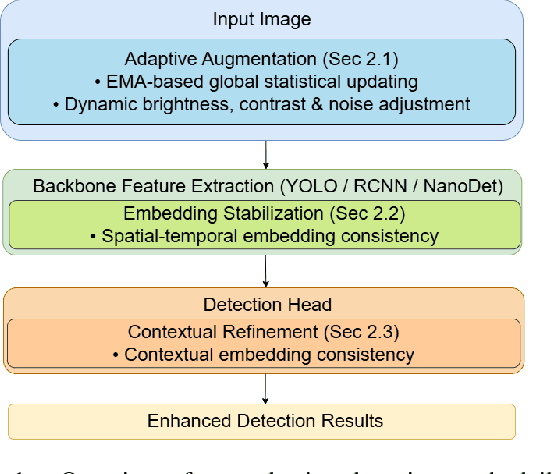
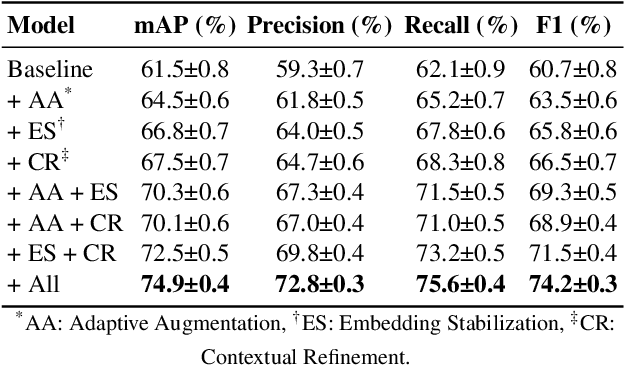
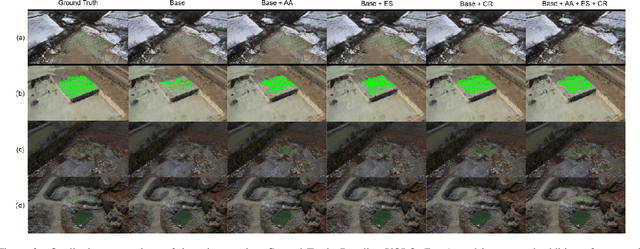
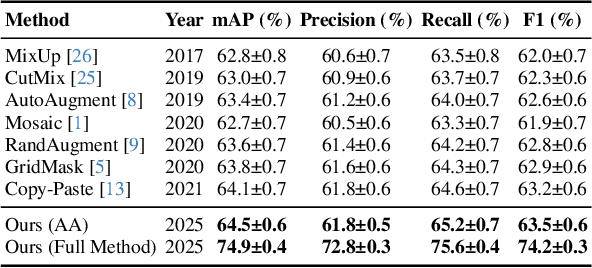
In controlled blasting operations, accurately detecting densely distributed tiny boreholes from far-view imagery is critical for operational safety and efficiency. However, existing detection methods often struggle due to small object scales, highly dense arrangements, and limited distinctive visual features of boreholes. To address these challenges, we propose an adaptive detection approach that builds upon existing architectures (e.g., YOLO) by explicitly leveraging consistent embedding representations derived through exponential moving average (EMA)-based statistical updates. Our method introduces three synergistic components: (1) adaptive augmentation utilizing dynamically updated image statistics to robustly handle illumination and texture variations; (2) embedding stabilization to ensure consistent and reliable feature extraction; and (3) contextual refinement leveraging spatial context for improved detection accuracy. The pervasive use of EMA in our method is particularly advantageous given the limited visual complexity and small scale of boreholes, allowing stable and robust representation learning even under challenging visual conditions. Experiments on a challenging proprietary quarry-site dataset demonstrate substantial improvements over baseline YOLO-based architectures, highlighting our method's effectiveness in realistic and complex industrial scenarios.