 Add to Chrome
 Add to Firefox
 Add to Edge
Partially Observable Adversarial Patch Attacks on Vision-Language-Action Models in Robotics
Jun 02, 2026
Vision-language-action (VLA) models are gaining attention in robotics, yet their robustness to adversarial attacks remains largely unexplored. Existing work shows that adversarial patches can mislead VLA-based robots but assumes full access to the entire execution trajectory, an unrealistic requirement in practice. We address this limitation by formulating a partially observable threat model, where the adversary can exploit only a short prefix of the trajectory to generate a fixed patch applied to all subsequent frames. Under this setting, we propose a two-phase framework. First, we localize the patch using the model's attention maps to identify visually critical regions that correspond to the full instruction. Then, we optimize the patch to disrupt the semantic grounding of target objects and increase the curvature of action trajectories, thereby compounding failures in both perception and control. Extensive experiments in simulation and real-world robotic environments show that our method sustains adversarial effects under partial observability, inducing long-horizon disruptions and significantly reducing task success rates.

Neuronal Stochastic Attention Circuit (NSAC) for Probabilistic Representation Learning
May 25, 2026Reliable quantification of uncertainty estimates in continuous-time (CT) representation learning remains nascent, particularly within CT attention architectures. We introduce the Neuronal Stochastic Attention Circuit (NSAC), a novel biologically-inspired CT attention architecture that reformulates attention logit computation as the solution of an Ornstein-Uhlenbeck stochastic differential equation modulated by input-dependent, nonlinear interlinked gates derived from repurposed C.elegans Neuronal Circuit Policies (NCPs) wiring mechanism. It induces Gaussian distribution over logits that propagates principled stochasticity through logistic-normal distribution over attention weights to yield probabilistic output. A two-term objective function combining Gaussian negative log-likelihood with an epistemic-separation regularizer enforces higher predictive variance and enables joint quantification of aleatoric and epistemic uncertainty. Empirically, we implement NSAC in a diverse set of learning tasks including: (i) irregular CT function approximation; (ii) multivariate regression; (iii) long-range forecasting; (iv) Industry 4.0; and (v) the lane-keeping of autonomous vehicles. We observe that the NSAC remains competitive against several baselines in terms of accuracy and produces reasonably well-calibrated uncertainty estimates while being interpretable at the neuronal cell level.
FLUID: Continuous-Time Hyperconnected Sparse Transformer for Sink-Free Learning
May 06, 2026Continuous-time (CT) Transformers improve irregular and long-range modeling over CT-RNNs by exploiting inputs or outputs embeddings with continuous dynamics. However, the core scaled-dot-product-attention (SDPA) mechanism remains inherently discrete. We propose FLUID (Flexible Unified Information Dynamics), a CT Transformer that incorporates continuous dynamics directly into the attention computation by replacing it with Liquid Attention Network (LAN). LAN reinterprets attention logits as continuous dynamical system and reformulates them as the solution to a linear ODE modulated by input-dependent nonlinear recurrent gates. Theoretically, we establish stability guarantees for LAN dynamics and show that it serves as an interpolating middle ground between SDPA and CT-RNNs, recovering each as special case under well-defined parameterization of its gating functions. LAN also introduces an explicit attention-sink gate to eliminate disproportionate attention mass on uninformative nodes. FLUID replaces standard residual connections with input-dependent Liquid Hyper-Connections to adaptively regulate interlayer information flow. Empirically, we evaluate FLUID on a broad set of learning tasks, including (i) irregular time-series, (ii) long-range modeling, (iii) lane-keeping control of autonomous vehicles, and (iv) learning physical dynamics under a scarce data regime. Across all the tasks, FLUID consistently matches or outperforms CT baselines, achieving improvements of up to 47% in certain scenarios and enhancing generalization under distributional shifts. Additionally, FLUID demonstrates superior noise robustness and a self-correcting inductive bias in autonomous vehicle control. We also provide a detailed analysis of key hyperparameters to guide tuning and show that FLUID occupies an intermediate position among competing approaches in terms of runtime and memory efficiency.
DA-SPS: A Dual-stage Network based on Singular Spectrum Analysis, Patching-strategy and Spearman-correlation for Multivariate Time-series Prediction
Jan 29, 2026Multivariate time-series forecasting, as a typical problem in the field of time series prediction, has a wide range of applications in weather forecasting, traffic flow prediction, and other scenarios. However, existing works do not effectively consider the impact of extraneous variables on the prediction of the target variable. On the other hand, they fail to fully extract complex sequence information based on various time patterns of the sequences. To address these drawbacks, we propose a DA-SPS model, which adopts different modules for feature extraction based on the information characteristics of different variables. DA-SPS mainly consists of two stages: the target variable processing stage (TVPS) and the extraneous variables processing stage (EVPS). In TVPS, the model first uses Singular Spectrum Analysis (SSA) to process the target variable sequence and then uses Long Short-Term Memory (LSTM) and P-Conv-LSTM which deploys a patching strategy to extract features from trend and seasonality components, respectively. In EVPS, the model filters extraneous variables that have a strong correlation with the target variate by using Spearman correlation analysis and further analyses them using the L-Attention module which consists of LSTM and attention mechanism. Finally, the results obtained by TVPS and EVPS are combined through weighted summation and linear mapping to produce the final prediction. The results on four public datasets demonstrate that the DA-SPS model outperforms existing state-of-the-art methods. Additionally, its performance in real-world scenarios is further validated using a private dataset collected by ourselves, which contains the test items' information on laptop motherboards.
Developing Distance-Aware, and Evident Uncertainty Quantification in Dynamic Physics-Constrained Neural Networks for Robust Bearing Degradation Estimation
Dec 18, 2025Accurate and uncertainty-aware degradation estimation is essential for predictive maintenance in safety-critical systems like rotating machinery with rolling-element bearings. Many existing uncertainty methods lack confidence calibration, are costly to run, are not distance-aware, and fail to generalize under out-of-distribution data. We introduce two distance-aware uncertainty methods for deterministic physics-guided neural networks: PG-SNGP, based on Spectral Normalization Gaussian Process, and PG-SNER, based on Deep Evidential Regression. We apply spectral normalization to the hidden layers so the network preserves distances from input to latent space. PG-SNGP replaces the final dense layer with a Gaussian Process layer for distance-sensitive uncertainty, while PG-SNER outputs Normal Inverse Gamma parameters to model uncertainty in a coherent probabilistic form. We assess performance using standard accuracy metrics and a new distance-aware metric based on the Pearson Correlation Coefficient, which measures how well predicted uncertainty tracks the distance between test and training samples. We also design a dynamic weighting scheme in the loss to balance data fidelity and physical consistency. We test our methods on rolling-element bearing degradation using the PRONOSTIA, XJTU-SY and HUST datasets and compare them with Monte Carlo and Deep Ensemble PGNNs. Results show that PG-SNGP and PG-SNER improve prediction accuracy, generalize reliably under OOD conditions, and remain robust to adversarial attacks and noise.
Neuronal Attention Circuit (NAC) for Representation Learning
Dec 12, 2025Attention improves representation learning over RNNs, but its discrete nature limits continuous-time (CT) modeling. We introduce Neuronal Attention Circuit (NAC), a novel, biologically plausible CT-Attention mechanism that reformulates attention logits computation as the solution to a linear first-order ODE with nonlinear interlinked gates derived from repurposing \textit{C. elegans} Neuronal Circuit Policies (NCPs) wiring mechanism. NAC replaces dense projections with sparse sensory gates for key-query projections and a sparse backbone network with two heads for computing \textit{content-target} and \textit{learnable time-constant} gates, enabling efficient adaptive dynamics. NAC supports three attention logit computation modes: (i) explicit Euler integration, (ii) exact closed-form solution, and (iii) steady-state approximation. To improve memory intensity, we implemented a sparse Top-\emph{K} pairwise concatenation scheme that selectively curates key-query interactions. We provide rigorous theoretical guarantees, including state stability, bounded approximation errors, and universal approximation. Empirically, we implemented NAC in diverse domains, including irregular time-series classification, lane-keeping for autonomous vehicles, and industrial prognostics. We observed that NAC matches or outperforms competing baselines in accuracy and occupies an intermediate position in runtime and memory efficiency compared with several CT baselines.
IBN: An Interpretable Bidirectional-Modeling Network for Multivariate Time Series Forecasting with Variable Missing
Sep 09, 2025Multivariate time series forecasting (MTSF) often faces challenges from missing variables, which hinder conventional spatial-temporal graph neural networks in modeling inter-variable correlations. While GinAR addresses variable missing using attention-based imputation and adaptive graph learning for the first time, it lacks interpretability and fails to capture more latent temporal patterns due to its simple recursive units (RUs). To overcome these limitations, we propose the Interpretable Bidirectional-modeling Network (IBN), integrating Uncertainty-Aware Interpolation (UAI) and Gaussian kernel-based Graph Convolution (GGCN). IBN estimates the uncertainty of reconstructed values using MC Dropout and applies an uncertainty-weighted strategy to mitigate high-risk reconstructions. GGCN explicitly models spatial correlations among variables, while a bidirectional RU enhances temporal dependency modeling. Extensive experiments show that IBN achieves state-of-the-art forecasting performance under various missing-rate scenarios, providing a more reliable and interpretable framework for MTSF with missing variables. Code is available at: https://github.com/zhangth1211/NICLab-IBN.
C3RL: Rethinking the Combination of Channel-independence and Channel-mixing from Representation Learning
Jul 23, 2025Multivariate time series forecasting has drawn increasing attention due to its practical importance. Existing approaches typically adopt either channel-mixing (CM) or channel-independence (CI) strategies. CM strategy can capture inter-variable dependencies but fails to discern variable-specific temporal patterns. CI strategy improves this aspect but fails to fully exploit cross-variable dependencies like CM. Hybrid strategies based on feature fusion offer limited generalization and interpretability. To address these issues, we propose C3RL, a novel representation learning framework that jointly models both CM and CI strategies. Motivated by contrastive learning in computer vision, C3RL treats the inputs of the two strategies as transposed views and builds a siamese network architecture: one strategy serves as the backbone, while the other complements it. By jointly optimizing contrastive and prediction losses with adaptive weighting, C3RL balances representation and forecasting performance. Extensive experiments on seven models show that C3RL boosts the best-case performance rate to 81.4\% for models based on CI strategy and to 76.3\% for models based on CM strategy, demonstrating strong generalization and effectiveness. The code will be available once the paper is accepted.
FMamba: Mamba based on Fast-attention for Multivariate Time-series Forecasting
Jul 20, 2024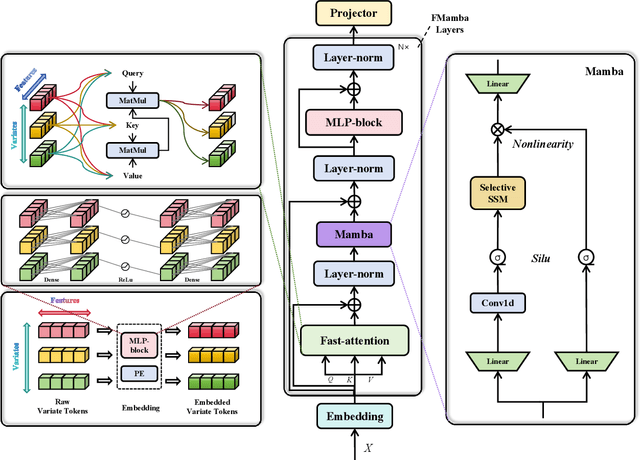
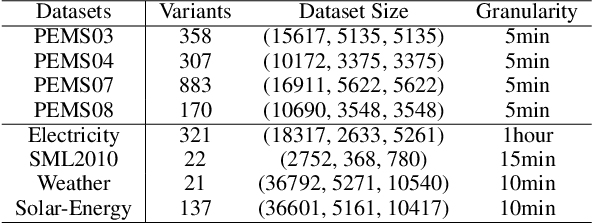
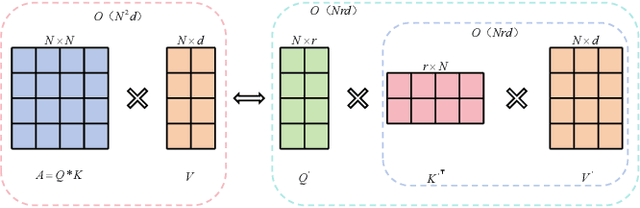
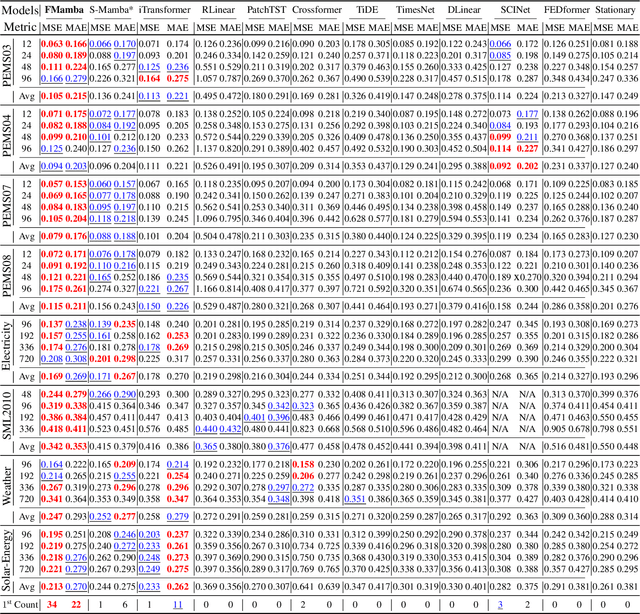
In multivariate time-series forecasting (MTSF), extracting the temporal correlations of the input sequences is crucial. While popular Transformer-based predictive models can perform well, their quadratic computational complexity results in inefficiency and high overhead. The recently emerged Mamba, a selective state space model, has shown promising results in many fields due to its strong temporal feature extraction capabilities and linear computational complexity. However, due to the unilateral nature of Mamba, channel-independent predictive models based on Mamba cannot attend to the relationships among all variables in the manner of Transformer-based models. To address this issue, we combine fast-attention with Mamba to introduce a novel framework named FMamba for MTSF. Technically, we first extract the temporal features of the input variables through an embedding layer, then compute the dependencies among input variables via the fast-attention module. Subsequently, we use Mamba to selectively deal with the input features and further extract the temporal dependencies of the variables through the multi-layer perceptron block (MLP-block). Finally, FMamba obtains the predictive results through the projector, a linear layer. Experimental results on eight public datasets demonstrate that FMamba can achieve state-of-the-art performance while maintaining low computational overhead.