 Add to Chrome
 Add to Firefox
 Add to Edge
FinGPT: Large Generative Models for a Small Language
Nov 03, 2023

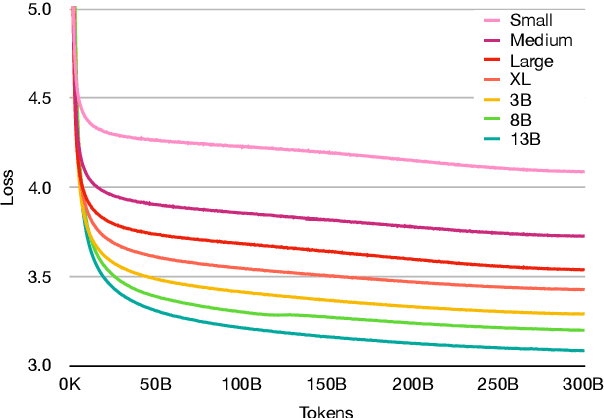


Large language models (LLMs) excel in many tasks in NLP and beyond, but most open models have very limited coverage of smaller languages and LLM work tends to focus on languages where nearly unlimited data is available for pretraining. In this work, we study the challenges of creating LLMs for Finnish, a language spoken by less than 0.1% of the world population. We compile an extensive dataset of Finnish combining web crawls, news, social media and eBooks. We pursue two approaches to pretrain models: 1) we train seven monolingual models from scratch (186M to 13B parameters) dubbed FinGPT, 2) we continue the pretraining of the multilingual BLOOM model on a mix of its original training data and Finnish, resulting in a 176 billion parameter model we call BLUUMI. For model evaluation, we introduce FIN-bench, a version of BIG-bench with Finnish tasks. We also assess other model qualities such as toxicity and bias. Our models and tools are openly available at https://turkunlp.org/gpt3-finnish.

Zephyr: Direct Distillation of LM Alignment
Oct 25, 2023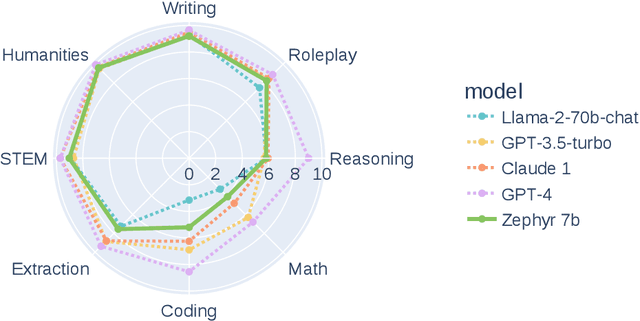
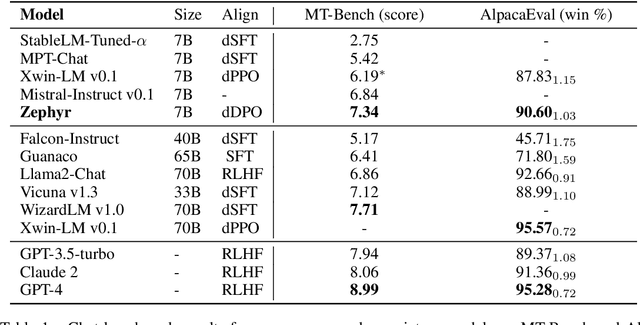
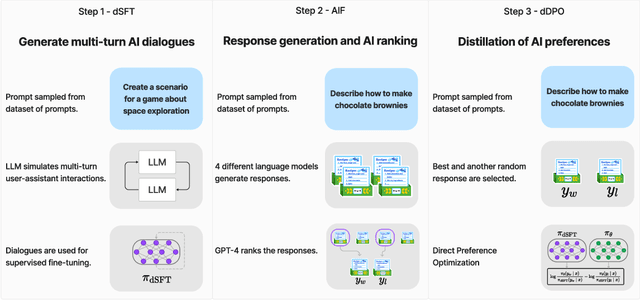
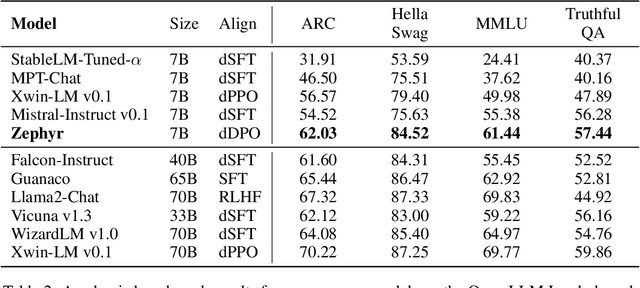
We aim to produce a smaller language model that is aligned to user intent. Previous research has shown that applying distilled supervised fine-tuning (dSFT) on larger models significantly improves task accuracy; however, these models are unaligned, i.e. they do not respond well to natural prompts. To distill this property, we experiment with the use of preference data from AI Feedback (AIF). Starting from a dataset of outputs ranked by a teacher model, we apply distilled direct preference optimization (dDPO) to learn a chat model with significantly improved intent alignment. The approach requires only a few hours of training without any additional sampling during fine-tuning. The final result, Zephyr-7B, sets the state-of-the-art on chat benchmarks for 7B parameter models, and requires no human annotation. In particular, results on MT-Bench show that Zephyr-7B surpasses Llama2-Chat-70B, the best open-access RLHF-based model. Code, models, data, and tutorials for the system are available at https://github.com/huggingface/alignment-handbook.
Scaling Data-Constrained Language Models
May 25, 2023The current trend of scaling language models involves increasing both parameter count and training dataset size. Extrapolating this trend suggests that training dataset size may soon be limited by the amount of text data available on the internet. Motivated by this limit, we investigate scaling language models in data-constrained regimes. Specifically, we run a large set of experiments varying the extent of data repetition and compute budget, ranging up to 900 billion training tokens and 9 billion parameter models. We find that with constrained data for a fixed compute budget, training with up to 4 epochs of repeated data yields negligible changes to loss compared to having unique data. However, with more repetition, the value of adding compute eventually decays to zero. We propose and empirically validate a scaling law for compute optimality that accounts for the decreasing value of repeated tokens and excess parameters. Finally, we experiment with approaches mitigating data scarcity, including augmenting the training dataset with code data or removing commonly used filters. Models and datasets from our 400 training runs are publicly available at https://github.com/huggingface/datablations.
StarCoder: may the source be with you!
May 09, 2023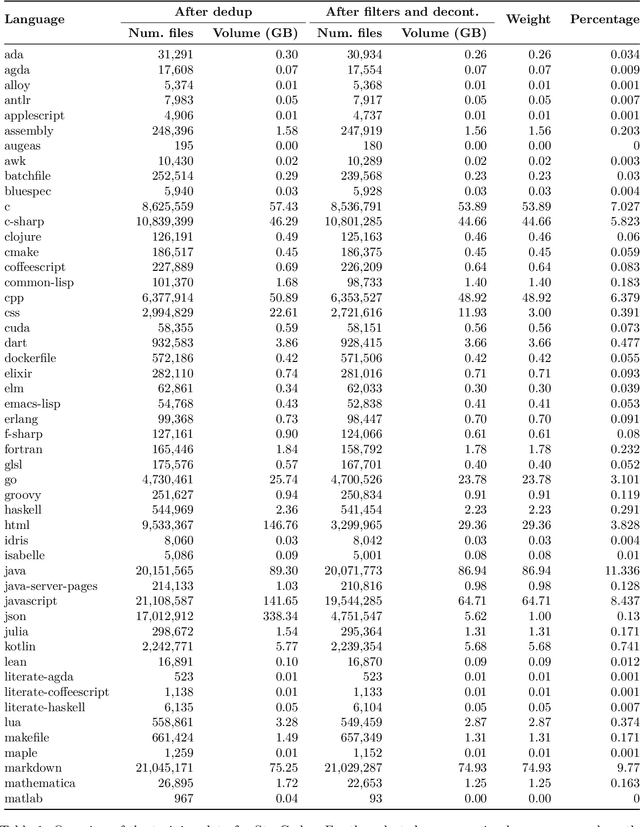
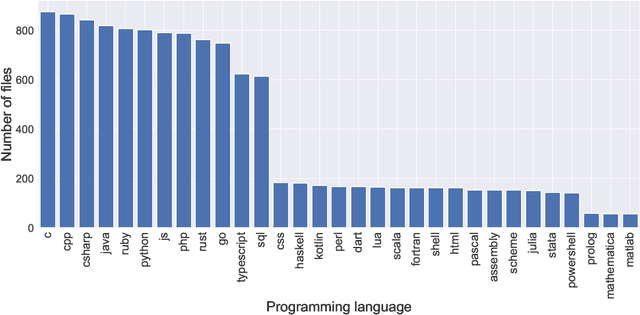
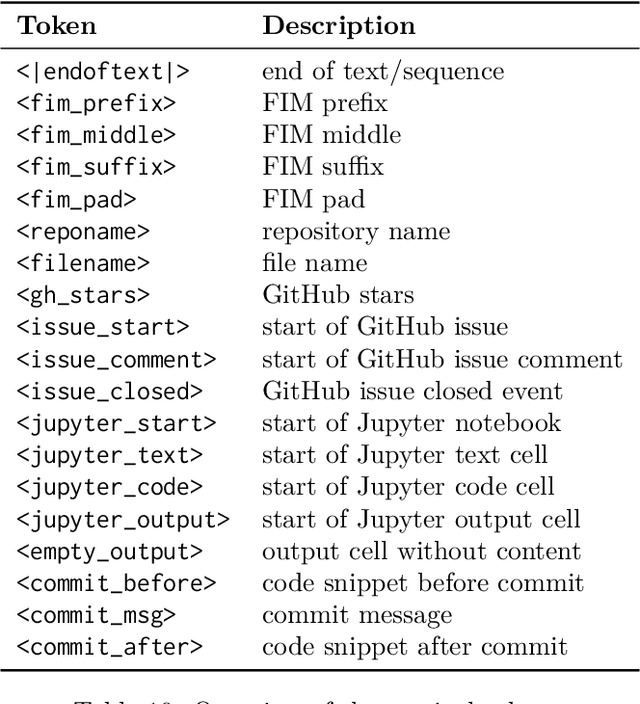
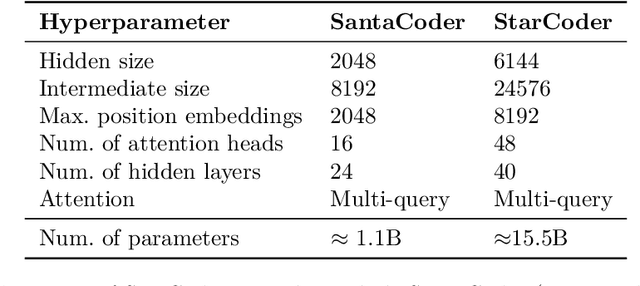
The BigCode community, an open-scientific collaboration working on the responsible development of Large Language Models for Code (Code LLMs), introduces StarCoder and StarCoderBase: 15.5B parameter models with 8K context length, infilling capabilities and fast large-batch inference enabled by multi-query attention. StarCoderBase is trained on 1 trillion tokens sourced from The Stack, a large collection of permissively licensed GitHub repositories with inspection tools and an opt-out process. We fine-tuned StarCoderBase on 35B Python tokens, resulting in the creation of StarCoder. We perform the most comprehensive evaluation of Code LLMs to date and show that StarCoderBase outperforms every open Code LLM that supports multiple programming languages and matches or outperforms the OpenAI code-cushman-001 model. Furthermore, StarCoder outperforms every model that is fine-tuned on Python, can be prompted to achieve 40\% pass@1 on HumanEval, and still retains its performance on other programming languages. We take several important steps towards a safe open-access model release, including an improved PII redaction pipeline and a novel attribution tracing tool, and make the StarCoder models publicly available under a more commercially viable version of the Open Responsible AI Model license.
Grounding Large Language Models in Interactive Environments with Online Reinforcement Learning
Feb 06, 2023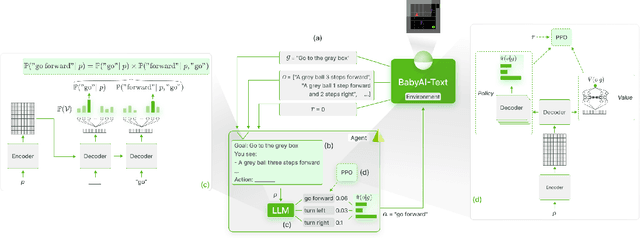

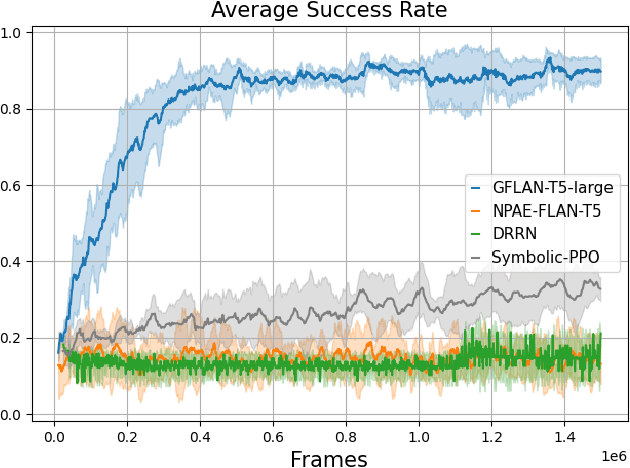
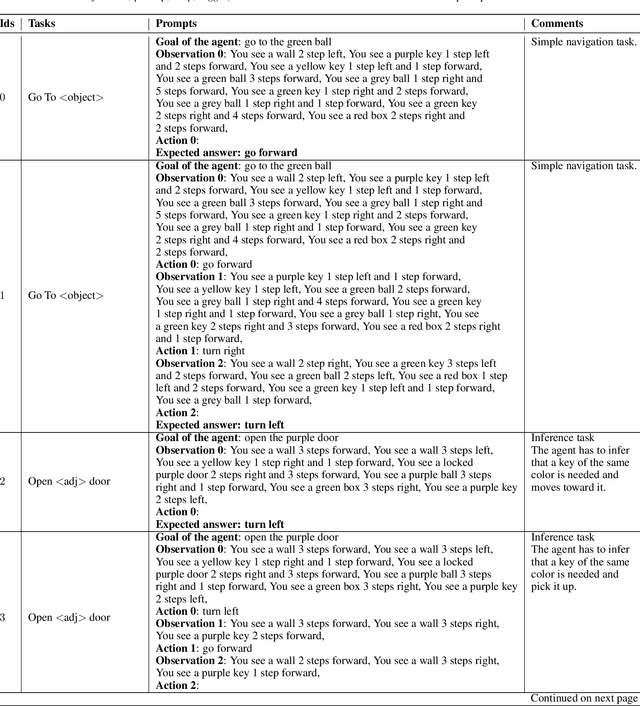
Recent works successfully leveraged Large Language Models' (LLM) abilities to capture abstract knowledge about world's physics to solve decision-making problems. Yet, the alignment between LLMs' knowledge and the environment can be wrong and limit functional competence due to lack of grounding. In this paper, we study an approach to achieve this alignment through functional grounding: we consider an agent using an LLM as a policy that is progressively updated as the agent interacts with the environment, leveraging online Reinforcement Learning to improve its performance to solve goals. Using an interactive textual environment designed to study higher-level forms of functional grounding, and a set of spatial and navigation tasks, we study several scientific questions: 1) Can LLMs boost sample efficiency for online learning of various RL tasks? 2) How can it boost different forms of generalization? 3) What is the impact of online learning? We study these questions by functionally grounding several variants (size, architecture) of FLAN-T5.
The Stack: 3 TB of permissively licensed source code
Nov 20, 2022

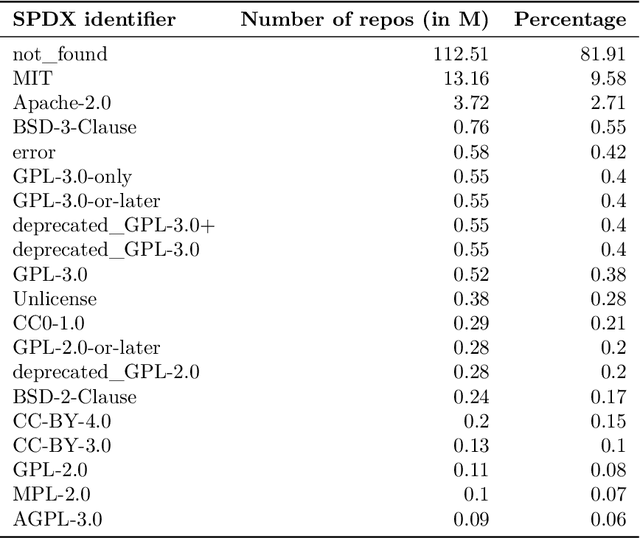

Large Language Models (LLMs) play an ever-increasing role in the field of Artificial Intelligence (AI)--not only for natural language processing but also for code understanding and generation. To stimulate open and responsible research on LLMs for code, we introduce The Stack, a 3.1 TB dataset consisting of permissively licensed source code in 30 programming languages. We describe how we collect the full dataset, construct a permissively licensed subset, present a data governance plan, discuss limitations, and show promising results on text2code benchmarks by training 350M-parameter decoders on different Python subsets. We find that (1) near-deduplicating the data significantly boosts performance across all experiments, and (2) it is possible to match previously reported HumanEval and MBPP performance using only permissively licensed data. We make the dataset available at https://hf.co/BigCode, provide a tool called "Am I in The Stack" (https://hf.co/spaces/bigcode/in-the-stack) for developers to search The Stack for copies of their code, and provide a process for code to be removed from the dataset by following the instructions at https://www.bigcode-project.org/docs/about/the-stack/.
BLOOM: A 176B-Parameter Open-Access Multilingual Language Model
Nov 09, 2022Large language models (LLMs) have been shown to be able to perform new tasks based on a few demonstrations or natural language instructions. While these capabilities have led to widespread adoption, most LLMs are developed by resource-rich organizations and are frequently kept from the public. As a step towards democratizing this powerful technology, we present BLOOM, a 176B-parameter open-access language model designed and built thanks to a collaboration of hundreds of researchers. BLOOM is a decoder-only Transformer language model that was trained on the ROOTS corpus, a dataset comprising hundreds of sources in 46 natural and 13 programming languages (59 in total). We find that BLOOM achieves competitive performance on a wide variety of benchmarks, with stronger results after undergoing multitask prompted finetuning. To facilitate future research and applications using LLMs, we publicly release our models and code under the Responsible AI License.
Evaluate & Evaluation on the Hub: Better Best Practices for Data and Model Measurements
Oct 06, 2022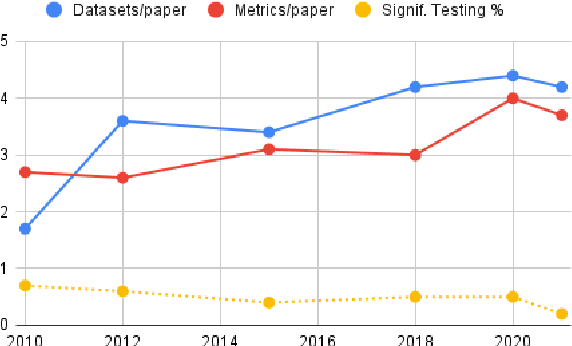
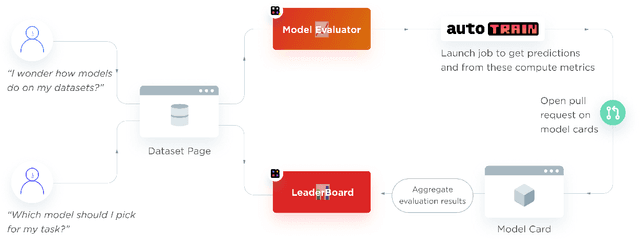
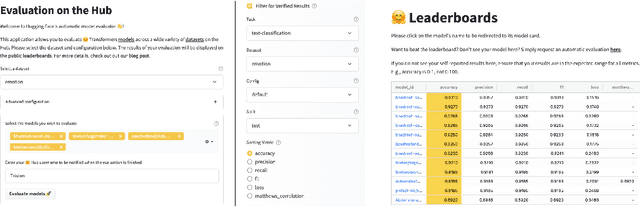
Evaluation is a key part of machine learning (ML), yet there is a lack of support and tooling to enable its informed and systematic practice. We introduce Evaluate and Evaluation on the Hub --a set of tools to facilitate the evaluation of models and datasets in ML. Evaluate is a library to support best practices for measurements, metrics, and comparisons of data and models. Its goal is to support reproducibility of evaluation, centralize and document the evaluation process, and broaden evaluation to cover more facets of model performance. It includes over 50 efficient canonical implementations for a variety of domains and scenarios, interactive documentation, and the ability to easily share implementations and outcomes. The library is available at https://github.com/huggingface/evaluate. In addition, we introduce Evaluation on the Hub, a platform that enables the large-scale evaluation of over 75,000 models and 11,000 datasets on the Hugging Face Hub, for free, at the click of a button. Evaluation on the Hub is available at https://huggingface.co/autoevaluate.
Training Transformers Together
Jul 07, 2022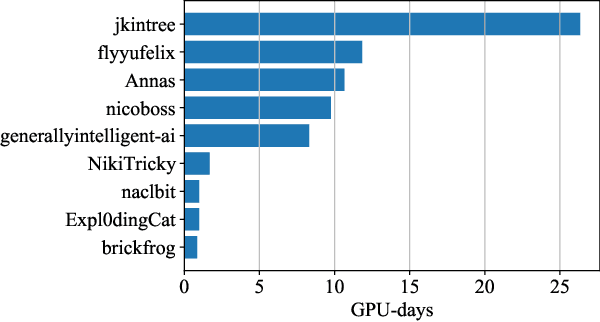
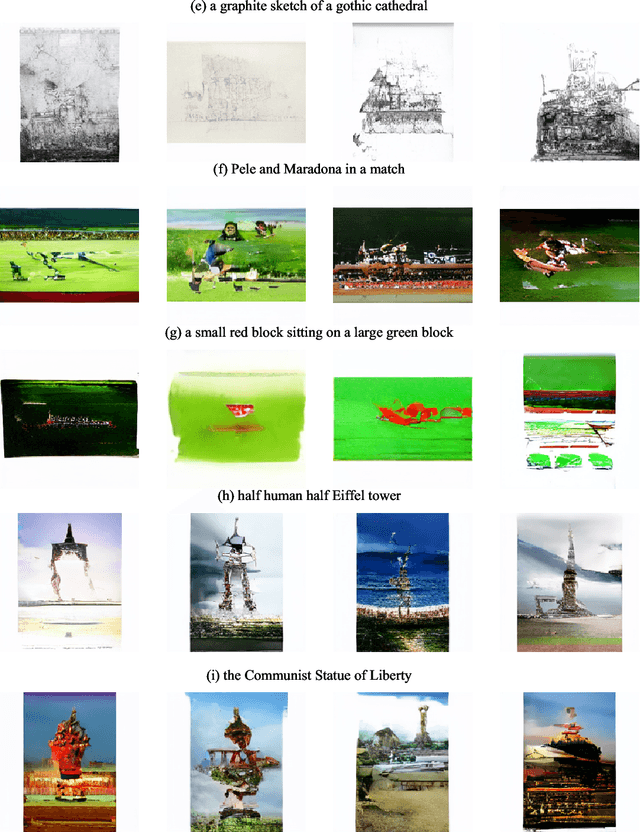
The infrastructure necessary for training state-of-the-art models is becoming overly expensive, which makes training such models affordable only to large corporations and institutions. Recent work proposes several methods for training such models collaboratively, i.e., by pooling together hardware from many independent parties and training a shared model over the Internet. In this demonstration, we collaboratively trained a text-to-image transformer similar to OpenAI DALL-E. We invited the viewers to join the ongoing training run, showing them instructions on how to contribute using the available hardware. We explained how to address the engineering challenges associated with such a training run (slow communication, limited memory, uneven performance between devices, and security concerns) and discussed how the viewers can set up collaborative training runs themselves. Finally, we show that the resulting model generates images of reasonable quality on a number of prompts.
Multitask Prompted Training Enables Zero-Shot Task Generalization
Oct 15, 2021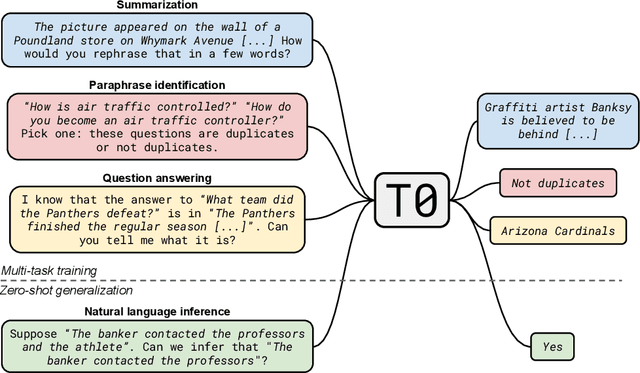

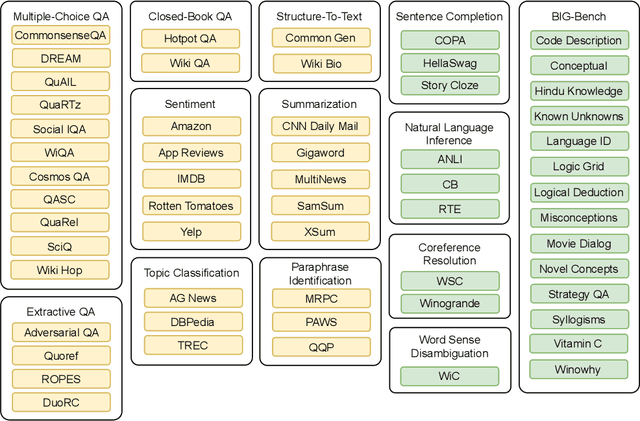
Large language models have recently been shown to attain reasonable zero-shot generalization on a diverse set of tasks. It has been hypothesized that this is a consequence of implicit multitask learning in language model training. Can zero-shot generalization instead be directly induced by explicit multitask learning? To test this question at scale, we develop a system for easily mapping general natural language tasks into a human-readable prompted form. We convert a large set of supervised datasets, each with multiple prompts using varying natural language. These prompted datasets allow for benchmarking the ability of a model to perform completely unseen tasks specified in natural language. We fine-tune a pretrained encoder-decoder model on this multitask mixture covering a wide variety of tasks. The model attains strong zero-shot performance on several standard datasets, often outperforming models 16x its size. Further, our approach attains strong performance on a subset of tasks from the BIG-Bench benchmark, outperforming models 6x its size. All prompts and trained models are available at github.com/bigscience-workshop/promptsource/.