 Add to Chrome
 Add to Firefox
 Add to Edge
A Single Revision Step Improves Token-Efficient LLM Reasoning
Feb 02, 2026
Large language models (LLMs) achieve higher accuracy on challenging reasoning tasks by scaling test-time compute through multiple trajectory sampling. However, standard aggregation methods like majority voting or individual confidence-based filtering face a fundamental "blind spot": they evaluate each trace in isolation. As problems scale in difficulty, models often generate hallucinated paths that exhibit misleadingly high confidence, causing the true solution to be suppressed by a narrow margin in traditional voting. We ask: can we enable traces to "peer-review" each other to resolve these near-miss errors? We introduce Packet-Conditioned Revision (PACER), a training-free, inference-only framework that enables reasoning traces to revise their conclusions through a structured coordination step. After a preliminary screening of generated traces, PACER constructs a compact consensus packet containing (i) unique candidate answers, (ii) their aggregated confidence scores, and (iii) representative reasoning summaries for each candidate answer. Individual traces then perform a targeted self-review conditioned on this packet, allowing them to identify specific logical junctions where they diverged from the broader consensus and pivot if their original reasoning is found to be flawed. Final predictions are obtained via confidence-weighted voting over these revised trajectories. On challenging competitive math benchmarks such as AIME and BRUMO, PACER matches or exceeds the accuracy of 256-sample majority voting, significantly outperforming raw ensemble baselines by transforming simple consensus into a collaborative logical refinement process.

Knowledge Distillation and Dataset Distillation of Large Language Models: Emerging Trends, Challenges, and Future Directions
Apr 20, 2025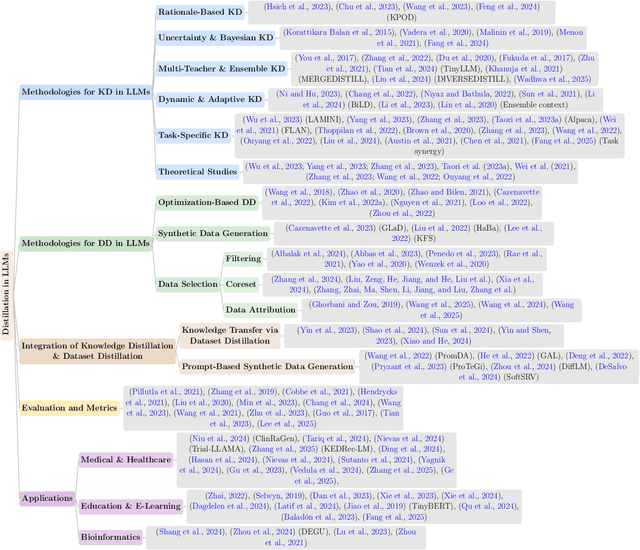

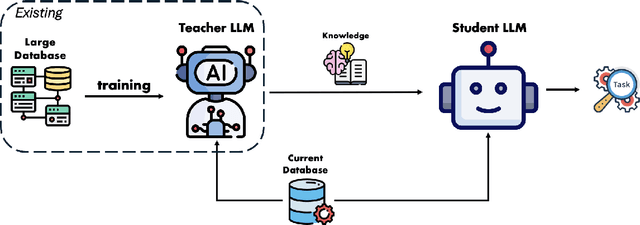
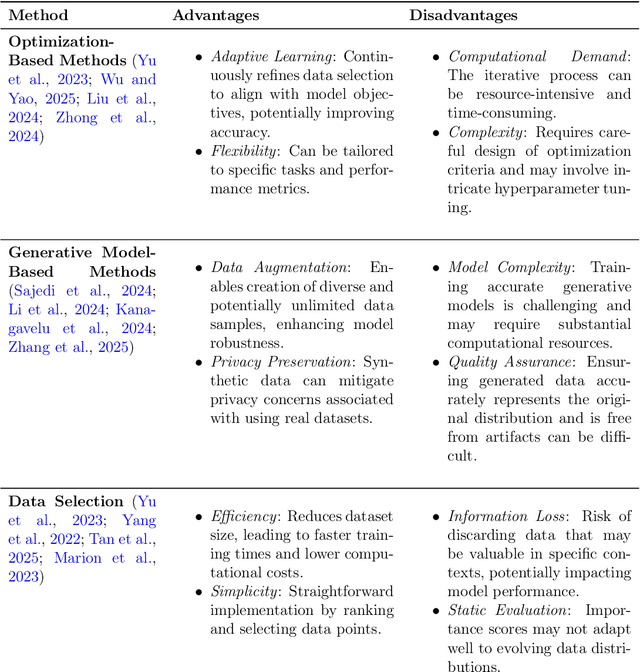
The exponential growth of Large Language Models (LLMs) continues to highlight the need for efficient strategies to meet ever-expanding computational and data demands. This survey provides a comprehensive analysis of two complementary paradigms: Knowledge Distillation (KD) and Dataset Distillation (DD), both aimed at compressing LLMs while preserving their advanced reasoning capabilities and linguistic diversity. We first examine key methodologies in KD, such as task-specific alignment, rationale-based training, and multi-teacher frameworks, alongside DD techniques that synthesize compact, high-impact datasets through optimization-based gradient matching, latent space regularization, and generative synthesis. Building on these foundations, we explore how integrating KD and DD can produce more effective and scalable compression strategies. Together, these approaches address persistent challenges in model scalability, architectural heterogeneity, and the preservation of emergent LLM abilities. We further highlight applications across domains such as healthcare and education, where distillation enables efficient deployment without sacrificing performance. Despite substantial progress, open challenges remain in preserving emergent reasoning and linguistic diversity, enabling efficient adaptation to continually evolving teacher models and datasets, and establishing comprehensive evaluation protocols. By synthesizing methodological innovations, theoretical foundations, and practical insights, our survey charts a path toward sustainable, resource-efficient LLMs through the tighter integration of KD and DD principles.
Large Language Models for Bioinformatics
Jan 10, 2025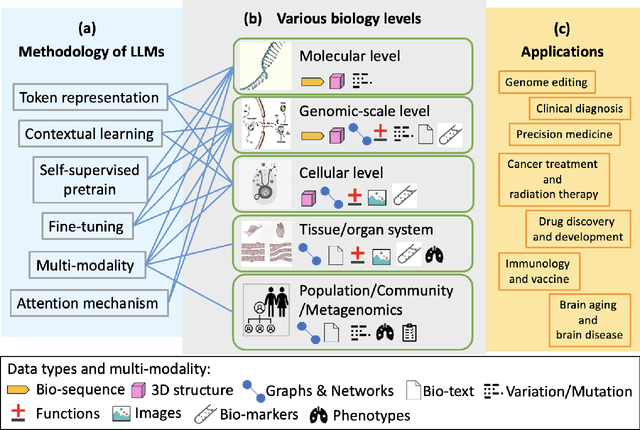
With the rapid advancements in large language model (LLM) technology and the emergence of bioinformatics-specific language models (BioLMs), there is a growing need for a comprehensive analysis of the current landscape, computational characteristics, and diverse applications. This survey aims to address this need by providing a thorough review of BioLMs, focusing on their evolution, classification, and distinguishing features, alongside a detailed examination of training methodologies, datasets, and evaluation frameworks. We explore the wide-ranging applications of BioLMs in critical areas such as disease diagnosis, drug discovery, and vaccine development, highlighting their impact and transformative potential in bioinformatics. We identify key challenges and limitations inherent in BioLMs, including data privacy and security concerns, interpretability issues, biases in training data and model outputs, and domain adaptation complexities. Finally, we highlight emerging trends and future directions, offering valuable insights to guide researchers and clinicians toward advancing BioLMs for increasingly sophisticated biological and clinical applications.