 Add to Chrome
 Add to Firefox
 Add to Edge
LoRA-Enhanced Vision Transformer for Single Image based Morphing Attack Detection via Knowledge Distillation from EfficientNet
Nov 16, 2025
Face Recognition Systems (FRS) are critical for security but remain vulnerable to morphing attacks, where synthetic images blend biometric features from multiple individuals. We propose a novel Single-Image Morphing Attack Detection (S-MAD) approach using a teacher-student framework, where a CNN-based teacher model refines a ViT-based student model. To improve efficiency, we integrate Low-Rank Adaptation (LoRA) for fine-tuning, reducing computational costs while maintaining high detection accuracy. Extensive experiments are conducted on a morphing dataset built from three publicly available face datasets, incorporating ten different morphing generation algorithms to assess robustness. The proposed method is benchmarked against six state-of-the-art S-MAD techniques, demonstrating superior detection performance and computational efficiency.

Introducing Nylon Face Mask Attacks: A Dataset for Evaluating Generalised Face Presentation Attack Detection
Nov 11, 2025Face recognition systems are increasingly deployed across a wide range of applications, including smartphone authentication, access control, and border security. However, these systems remain vulnerable to presentation attacks (PAs), which can significantly compromise their reliability. In this work, we introduce a new dataset focused on a novel and realistic presentation attack instrument called Nylon Face Masks (NFMs), designed to simulate advanced 3D spoofing scenarios. NFMs are particularly concerning due to their elastic structure and photorealistic appearance, which enable them to closely mimic the victim's facial geometry when worn by an attacker. To reflect real-world smartphone-based usage conditions, we collected the dataset using an iPhone 11 Pro, capturing 3,760 bona fide samples from 100 subjects and 51,281 NFM attack samples across four distinct presentation scenarios involving both humans and mannequins. We benchmark the dataset using five state-of-the-art PAD methods to evaluate their robustness under unseen attack conditions. The results demonstrate significant performance variability across methods, highlighting the challenges posed by NFMs and underscoring the importance of developing PAD techniques that generalise effectively to emerging spoofing threats.
Empowering Morphing Attack Detection using Interpretable Image-Text Foundation Model
Aug 13, 2025Morphing attack detection has become an essential component of face recognition systems for ensuring a reliable verification scenario. In this paper, we present a multimodal learning approach that can provide a textual description of morphing attack detection. We first show that zero-shot evaluation of the proposed framework using Contrastive Language-Image Pretraining (CLIP) can yield not only generalizable morphing attack detection, but also predict the most relevant text snippet. We present an extensive analysis of ten different textual prompts that include both short and long textual prompts. These prompts are engineered by considering the human understandable textual snippet. Extensive experiments were performed on a face morphing dataset that was developed using a publicly available face biometric dataset. We present an evaluation of SOTA pre-trained neural networks together with the proposed framework in the zero-shot evaluation of five different morphing generation techniques that are captured in three different mediums.
Second Competition on Presentation Attack Detection on ID Card
Jul 27, 2025This work summarises and reports the results of the second Presentation Attack Detection competition on ID cards. This new version includes new elements compared to the previous one. (1) An automatic evaluation platform was enabled for automatic benchmarking; (2) Two tracks were proposed in order to evaluate algorithms and datasets, respectively; and (3) A new ID card dataset was shared with Track 1 teams to serve as the baseline dataset for the training and optimisation. The Hochschule Darmstadt, Fraunhofer-IGD, and Facephi company jointly organised this challenge. 20 teams were registered, and 74 submitted models were evaluated. For Track 1, the "Dragons" team reached first place with an Average Ranking and Equal Error rate (EER) of AV-Rank of 40.48% and 11.44% EER, respectively. For the more challenging approach in Track 2, the "Incode" team reached the best results with an AV-Rank of 14.76% and 6.36% EER, improving on the results of the first edition of 74.30% and 21.87% EER, respectively. These results suggest that PAD on ID cards is improving, but it is still a challenging problem related to the number of images, especially of bona fide images.
First Competition on Presentation Attack Detection on ID Card
Aug 31, 2024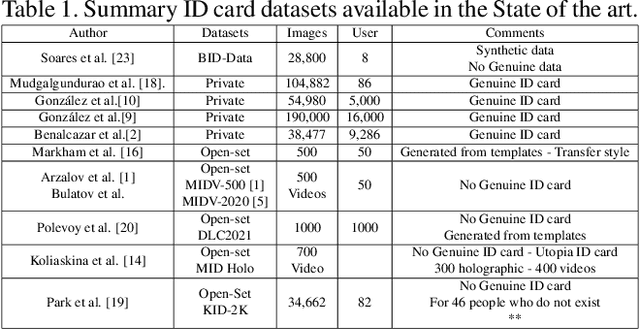

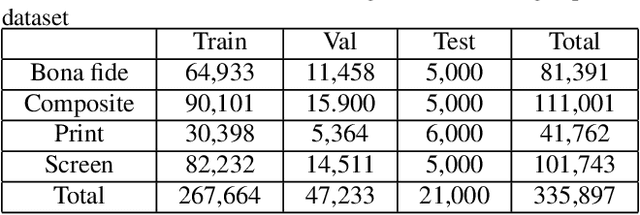

This paper summarises the Competition on Presentation Attack Detection on ID Cards (PAD-IDCard) held at the 2024 International Joint Conference on Biometrics (IJCB2024). The competition attracted a total of ten registered teams, both from academia and industry. In the end, the participating teams submitted five valid submissions, with eight models to be evaluated by the organisers. The competition presented an independent assessment of current state-of-the-art algorithms. Today, no independent evaluation on cross-dataset is available; therefore, this work determined the state-of-the-art on ID cards. To reach this goal, a sequestered test set and baseline algorithms were used to evaluate and compare all the proposals. The sequestered test dataset contains ID cards from four different countries. In summary, a team that chose to be "Anonymous" reached the best average ranking results of 74.80%, followed very closely by the "IDVC" team with 77.65%.
NTIRE 2024 Challenge on Image Super-Resolution ($\times$4): Methods and Results
Apr 15, 2024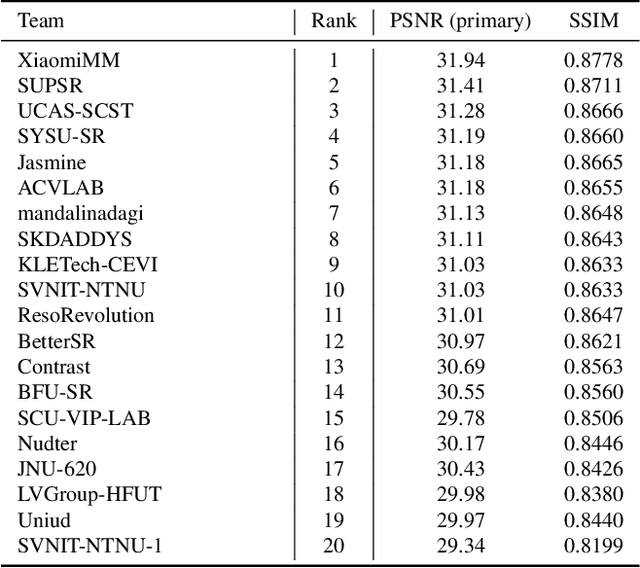


This paper reviews the NTIRE 2024 challenge on image super-resolution ($\times$4), highlighting the solutions proposed and the outcomes obtained. The challenge involves generating corresponding high-resolution (HR) images, magnified by a factor of four, from low-resolution (LR) inputs using prior information. The LR images originate from bicubic downsampling degradation. The aim of the challenge is to obtain designs/solutions with the most advanced SR performance, with no constraints on computational resources (e.g., model size and FLOPs) or training data. The track of this challenge assesses performance with the PSNR metric on the DIV2K testing dataset. The competition attracted 199 registrants, with 20 teams submitting valid entries. This collective endeavour not only pushes the boundaries of performance in single-image SR but also offers a comprehensive overview of current trends in this field.