 Add to Chrome
 Add to Firefox
 Add to Edge
What You Ask is What You Ground: Bridging Question Intent to Temporal Evidence for Grounded VideoQA
Aug 16, 2026
We study a critical yet overlooked failure mode in Grounded Video Question Answering: question-invariant grounding, where models predict nearly identical temporal segments for different questions about the same video. We trace this behavior to two structural limitations in prior common designs: (i) modality isolation that fixes video representations before they receive question semantics, and (ii) weak question injection inside the grounding module. To address this, we propose GroundFormer, which conditions video features on question intent before localization via learnable communication tokens that mediate directed visuo-lingual interaction. On top of the question-conditioned features, a factorized MIL cross-attention couples answer selection with temporal evidence under candidate-level supervision, while Gaussian smoothing converts peaked attention into temporally coherent segments. We further introduce a hierarchical multi-modal contrastive loss that aligns video, question, and answer embeddings across a two-pass training pipeline. GroundFormer achieves state-of-the-art grounded VideoQA performance on NExT-GQA and STAR, substantially improving question-discriminative temporal grounding.

RoME: Robust Mixture of Low-Rank Experts against Multiple Adversarial Perturbations
Jul 07, 2026Multi-perturbation adversarial training (MAT) aims to achieve robustness against multiple $\ell_p$ perturbations but suffers from robustness trade-offs between different threats. To address this, we employ a mixture of experts (MoE) to route different threats through distinct model pathways. However, naive application of MoE encounters two critical challenges: experts tend to overlook threat-specific features and redundantly capture features shared across threats, and gating networks suffer from threat-agnostic routing where they learn nearly identical routing patterns across threats, thus preventing the construction of threat-specific model pathways. To this end, we propose Robust Mixture of Low-Rank Experts (RoME), where each expert is a low-rank additive update to the shared backbone, allowing it to capture threat-common features while experts focus on threat-specific information. To address threat-agnostic routing, RoME introduces (i) dual-scale gating that exploits threat-discriminative signals from local and global level features, and (ii) threat-guided gating diversification that enforces diverse expert utilization across threats. Extensive experiments demonstrate that RoME outperforms existing state-of-the-art MAT in union robustness and natural accuracy and improves robustness against unseen threats. Codes are available at https://github.com/wkim97/RoME.
Distilling Collaborative Dynamics into Latent Space for Implicit Coordination in Decentralized Multi-Agent Manipulation
Jun 22, 2026Multi-arm manipulation demands precise spatiotemporal coordination, yet many centralized approaches scale poorly as team size increases. To address this, we propose CLS-DP, a decentralized multi-agent framework that enables implicit coordination under partial observability without shared global views, explicit state information, or inter-agent communication. Under the centralized training and decentralized execution (CTDE) paradigm, CLS-DP distills privileged multi-agent dynamics into a latent space. At deployment, each agent infers a collaborative latent from its local RGB observation and a shared task instruction; it then conditions the diffusion denoising process on this latent. This design enables implicit coordination with a per-agent cost independent of team size. Across six RoboFactory benchmark tasks spanning two to four agents, CLS-DP achieves a 38% mean success rate, outperforming the best centralized baseline (20%) and a decentralized ablation without the collaborative latent (9%). It also maintains superior parameter efficiency across all agent configurations. Attribution maps show that an agent conditioned on the collaborative latent places high attribution on the joints and grippers of both itself and its teammates throughout execution. This suggests that the learned latent efficiently encodes collaborative dynamics from local observation, which facilitates implicit coordination in realistic settings characterized by partial observability.
Beyond the Patch: Exploring Vulnerabilities of Visuomotor Policies via Viewpoint-Consistent 3D Adversarial Object
Mar 05, 2026Neural network-based visuomotor policies enable robots to perform manipulation tasks but remain susceptible to perceptual attacks. For example, conventional 2D adversarial patches are effective under fixed-camera setups, where appearance is relatively consistent; however, their efficacy often diminishes under dynamic viewpoints from moving cameras, such as wrist-mounted setups, due to perspective distortions. To proactively investigate potential vulnerabilities beyond 2D patches, this work proposes a viewpoint-consistent adversarial texture optimization method for 3D objects through differentiable rendering. As optimization strategies, we employ Expectation over Transformation (EOT) with a Coarse-to-Fine (C2F) curriculum, exploiting distance-dependent frequency characteristics to induce textures effective across varying camera-object distances. We further integrate saliency-guided perturbations to redirect policy attention and design a targeted loss that persistently drives robots toward adversarial objects. Our comprehensive experiments show that the proposed method is effective under various environmental conditions, while confirming its black-box transferability and real-world applicability.
Radiometrically Consistent Gaussian Surfels for Inverse Rendering
Mar 02, 2026Inverse rendering with Gaussian Splatting has advanced rapidly, but accurately disentangling material properties from complex global illumination effects, particularly indirect illumination, remains a major challenge. Existing methods often query indirect radiance from Gaussian primitives pre-trained for novel-view synthesis. However, these pre-trained Gaussian primitives are supervised only towards limited training viewpoints, thus lack supervision for modeling indirect radiances from unobserved views. To address this issue, we introduce radiometric consistency, a novel physically-based constraint that provides supervision towards unobserved views by minimizing the residual between each Gaussian primitive's learned radiance and its physically-based rendered counterpart. Minimizing the residual for unobserved views establishes a self-correcting feedback loop that provides supervision from both physically-based rendering and novel-view synthesis, enabling accurate modeling of inter-reflection. We then propose Radiometrically Consistent Gaussian Surfels (RadioGS), an inverse rendering framework built upon our principle by efficiently integrating radiometric consistency by utilizing Gaussian surfels and 2D Gaussian ray tracing. We further propose a finetuning-based relighting strategy that adapts Gaussian surfel radiances to new illuminations within minutes, achieving low rendering cost (<10ms). Extensive experiments on existing inverse rendering benchmarks show that RadioGS outperforms existing Gaussian-based methods in inverse rendering, while retaining the computational efficiency.
Pose-free 3D Gaussian splatting via shape-ray estimation
May 29, 2025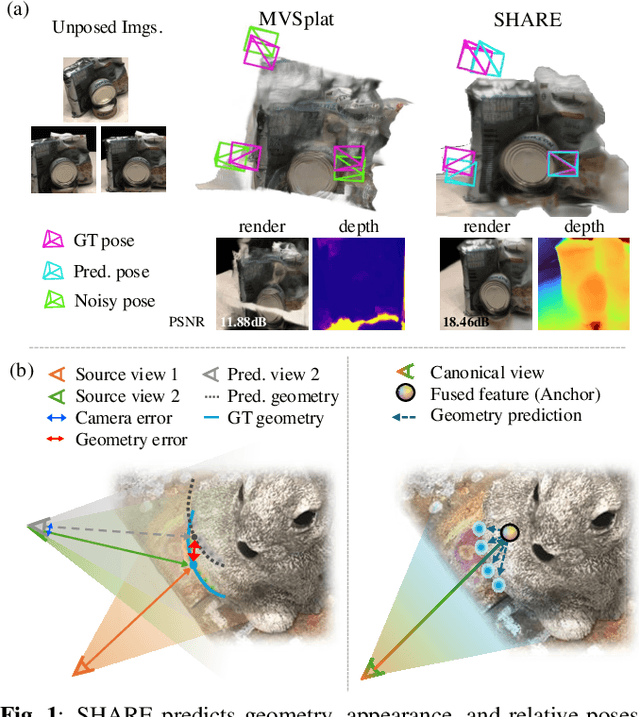
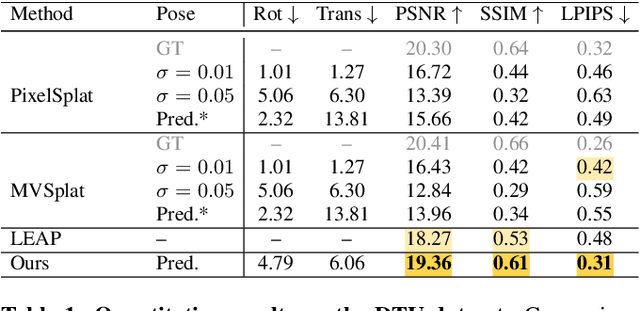
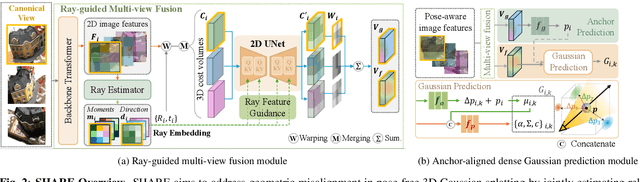
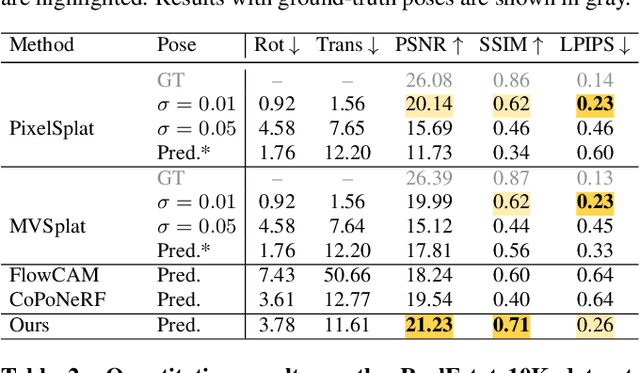
While generalizable 3D Gaussian splatting enables efficient, high-quality rendering of unseen scenes, it heavily depends on precise camera poses for accurate geometry. In real-world scenarios, obtaining accurate poses is challenging, leading to noisy pose estimates and geometric misalignments. To address this, we introduce SHARE, a pose-free, feed-forward Gaussian splatting framework that overcomes these ambiguities by joint shape and camera rays estimation. Instead of relying on explicit 3D transformations, SHARE builds a pose-aware canonical volume representation that seamlessly integrates multi-view information, reducing misalignment caused by inaccurate pose estimates. Additionally, anchor-aligned Gaussian prediction enhances scene reconstruction by refining local geometry around coarse anchors, allowing for more precise Gaussian placement. Extensive experiments on diverse real-world datasets show that our method achieves robust performance in pose-free generalizable Gaussian splatting.
AdvPaint: Protecting Images from Inpainting Manipulation via Adversarial Attention Disruption
Mar 13, 2025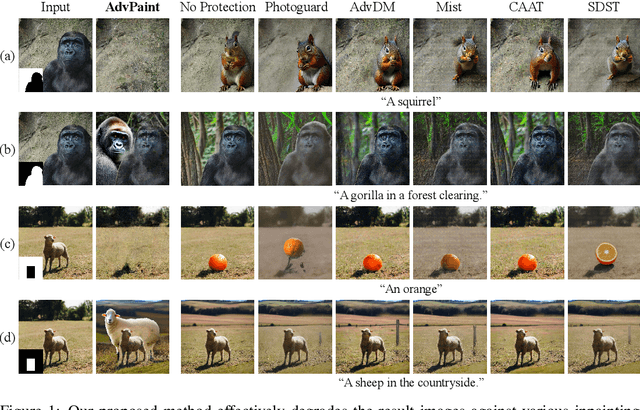
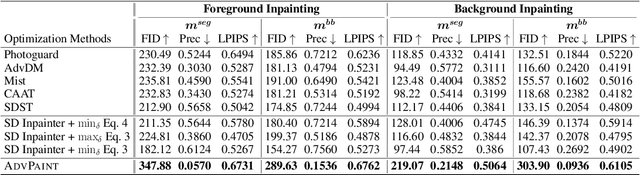
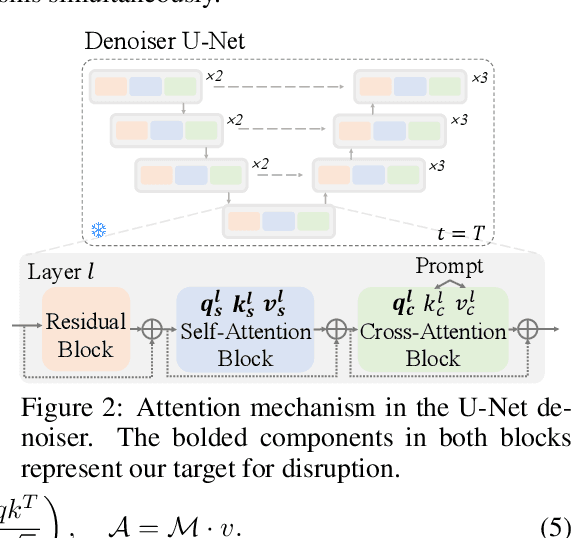

The outstanding capability of diffusion models in generating high-quality images poses significant threats when misused by adversaries. In particular, we assume malicious adversaries exploiting diffusion models for inpainting tasks, such as replacing a specific region with a celebrity. While existing methods for protecting images from manipulation in diffusion-based generative models have primarily focused on image-to-image and text-to-image tasks, the challenge of preventing unauthorized inpainting has been rarely addressed, often resulting in suboptimal protection performance. To mitigate inpainting abuses, we propose ADVPAINT, a novel defensive framework that generates adversarial perturbations that effectively disrupt the adversary's inpainting tasks. ADVPAINT targets the self- and cross-attention blocks in a target diffusion inpainting model to distract semantic understanding and prompt interactions during image generation. ADVPAINT also employs a two-stage perturbation strategy, dividing the perturbation region based on an enlarged bounding box around the object, enhancing robustness across diverse masks of varying shapes and sizes. Our experimental results demonstrate that ADVPAINT's perturbations are highly effective in disrupting the adversary's inpainting tasks, outperforming existing methods; ADVPAINT attains over a 100-point increase in FID and substantial decreases in precision.
UFORecon: Generalizable Sparse-View Surface Reconstruction from Arbitrary and UnFavOrable Sets
Mar 11, 2024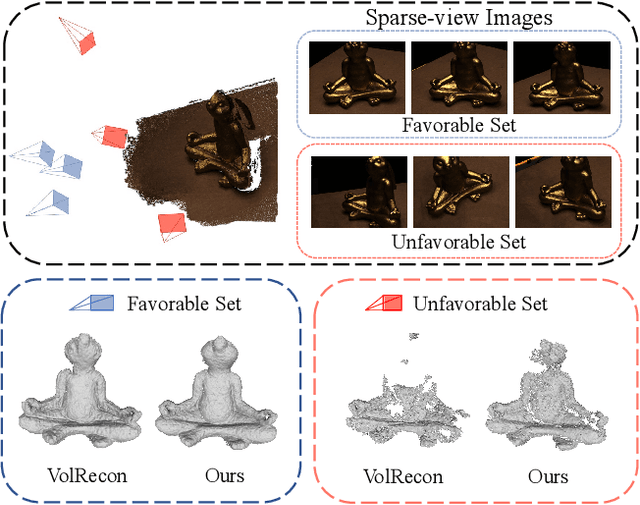
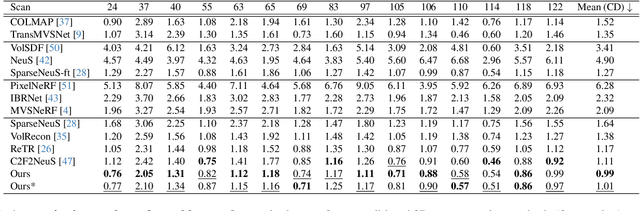
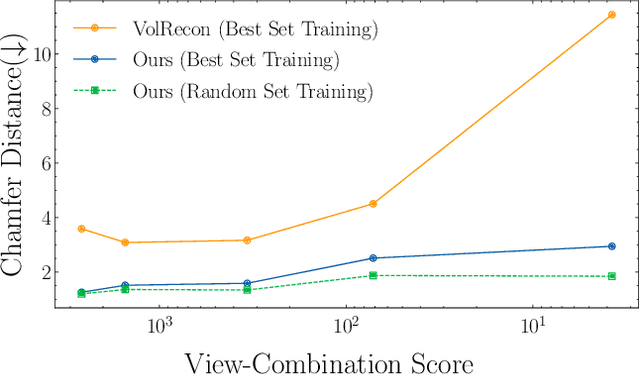

Generalizable neural implicit surface reconstruction aims to obtain an accurate underlying geometry given a limited number of multi-view images from unseen scenes. However, existing methods select only informative and relevant views using predefined scores for training and testing phases. This constraint renders the model impractical in real-world scenarios, where the availability of favorable combinations cannot always be ensured. We introduce and validate a view-combination score to indicate the effectiveness of the input view combination. We observe that previous methods output degenerate solutions under arbitrary and unfavorable sets. Building upon this finding, we propose UFORecon, a robust view-combination generalizable surface reconstruction framework. To achieve this, we apply cross-view matching transformers to model interactions between source images and build correlation frustums to capture global correlations. Additionally, we explicitly encode pairwise feature similarities as view-consistent priors. Our proposed framework significantly outperforms previous methods in terms of view-combination generalizability and also in the conventional generalizable protocol trained with favorable view-combinations. The code is available at https://github.com/Youngju-Na/UFORecon.
Take a Prior from Other Tasks for Severe Blur Removal
Feb 14, 2023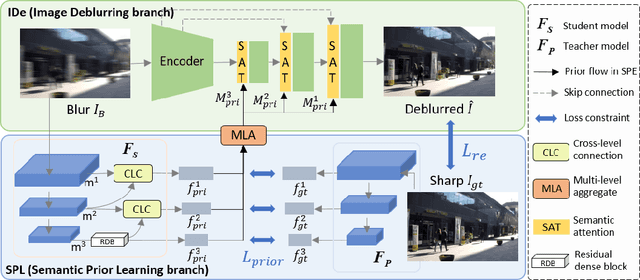
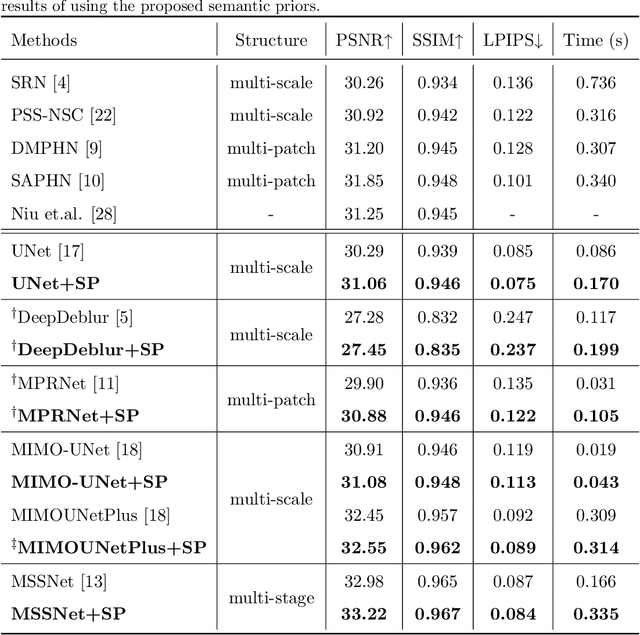
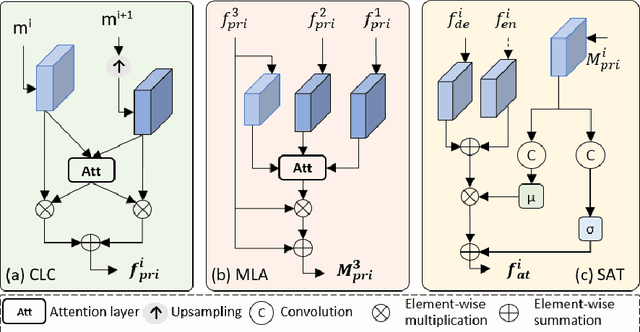
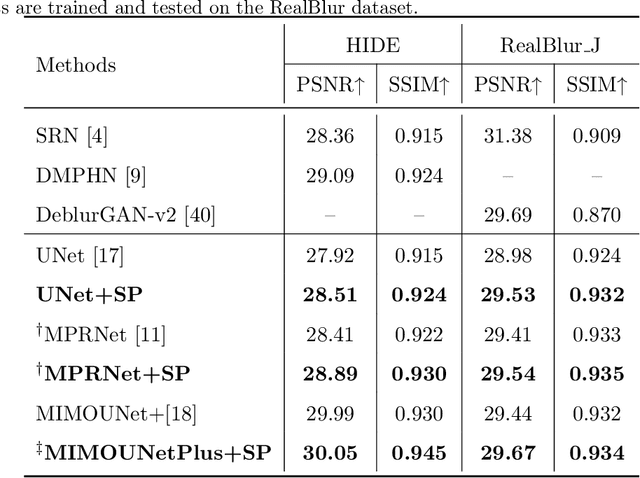
Recovering clear structures from severely blurry inputs is a challenging problem due to the large movements between the camera and the scene. Although some works apply segmentation maps on human face images for deblurring, they cannot handle natural scenes because objects and degradation are more complex, and inaccurate segmentation maps lead to a loss of details. For general scene deblurring, the feature space of the blurry image and corresponding sharp image under the high-level vision task is closer, which inspires us to rely on other tasks (e.g. classification) to learn a comprehensive prior in severe blur removal cases. We propose a cross-level feature learning strategy based on knowledge distillation to learn the priors, which include global contexts and sharp local structures for recovering potential details. In addition, we propose a semantic prior embedding layer with multi-level aggregation and semantic attention transformation to integrate the priors effectively. We introduce the proposed priors to various models, including the UNet and other mainstream deblurring baselines, leading to better performance on severe blur removal. Extensive experiments on natural image deblurring benchmarks and real-world images, such as GoPro and RealBlur datasets, demonstrate our method's effectiveness and generalization ability.
A Method for Estimating Reflectance map and Material using Deep Learning with Synthetic Dataset
Jan 15, 2020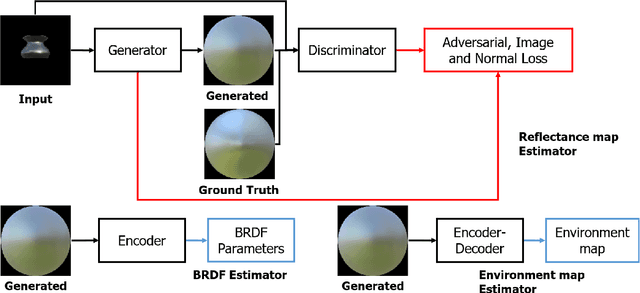
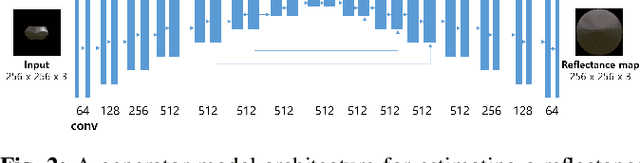
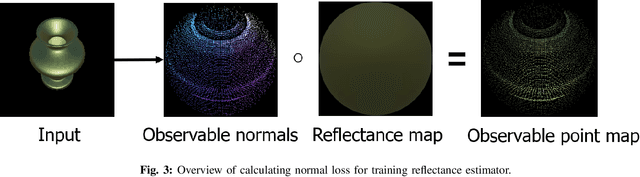
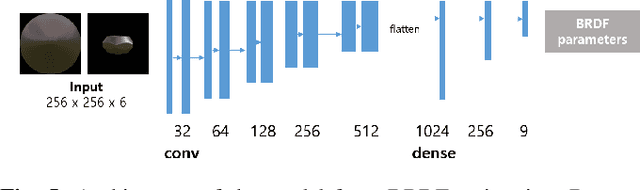
The process of decomposing target images into their internal properties is a difficult task due to the inherent ill-posed nature of the problem. The lack of data required to train a network is a one of the reasons why the decomposing appearance task is difficult. In this paper, we propose a deep learning-based reflectance map prediction system for material estimation of target objects in the image, so as to alleviate the ill-posed problem that occurs in this image decomposition operation. We also propose a network architecture for Bidirectional Reflectance Distribution Function (BRDF) parameter estimation, environment map estimation. We also use synthetic data to solve the lack of data problems. We get out of the previously proposed Deep Learning-based network architecture for reflectance map, and we newly propose to use conditional Generative Adversarial Network (cGAN) structures for estimating the reflectance map, which enables better results in many applications. To improve the efficiency of learning in this structure, we newly utilized the loss function using the normal map of the target object.