 Add to Chrome
 Add to Firefox
 Add to Edge
What You Ask is What You Ground: Bridging Question Intent to Temporal Evidence for Grounded VideoQA
Aug 16, 2026
We study a critical yet overlooked failure mode in Grounded Video Question Answering: question-invariant grounding, where models predict nearly identical temporal segments for different questions about the same video. We trace this behavior to two structural limitations in prior common designs: (i) modality isolation that fixes video representations before they receive question semantics, and (ii) weak question injection inside the grounding module. To address this, we propose GroundFormer, which conditions video features on question intent before localization via learnable communication tokens that mediate directed visuo-lingual interaction. On top of the question-conditioned features, a factorized MIL cross-attention couples answer selection with temporal evidence under candidate-level supervision, while Gaussian smoothing converts peaked attention into temporally coherent segments. We further introduce a hierarchical multi-modal contrastive loss that aligns video, question, and answer embeddings across a two-pass training pipeline. GroundFormer achieves state-of-the-art grounded VideoQA performance on NExT-GQA and STAR, substantially improving question-discriminative temporal grounding.

Radiometrically Consistent Gaussian Surfels for Inverse Rendering
Mar 02, 2026Inverse rendering with Gaussian Splatting has advanced rapidly, but accurately disentangling material properties from complex global illumination effects, particularly indirect illumination, remains a major challenge. Existing methods often query indirect radiance from Gaussian primitives pre-trained for novel-view synthesis. However, these pre-trained Gaussian primitives are supervised only towards limited training viewpoints, thus lack supervision for modeling indirect radiances from unobserved views. To address this issue, we introduce radiometric consistency, a novel physically-based constraint that provides supervision towards unobserved views by minimizing the residual between each Gaussian primitive's learned radiance and its physically-based rendered counterpart. Minimizing the residual for unobserved views establishes a self-correcting feedback loop that provides supervision from both physically-based rendering and novel-view synthesis, enabling accurate modeling of inter-reflection. We then propose Radiometrically Consistent Gaussian Surfels (RadioGS), an inverse rendering framework built upon our principle by efficiently integrating radiometric consistency by utilizing Gaussian surfels and 2D Gaussian ray tracing. We further propose a finetuning-based relighting strategy that adapts Gaussian surfel radiances to new illuminations within minutes, achieving low rendering cost (<10ms). Extensive experiments on existing inverse rendering benchmarks show that RadioGS outperforms existing Gaussian-based methods in inverse rendering, while retaining the computational efficiency.
Object Discovery via Contrastive Learning for Weakly Supervised Object Detection
Aug 16, 2022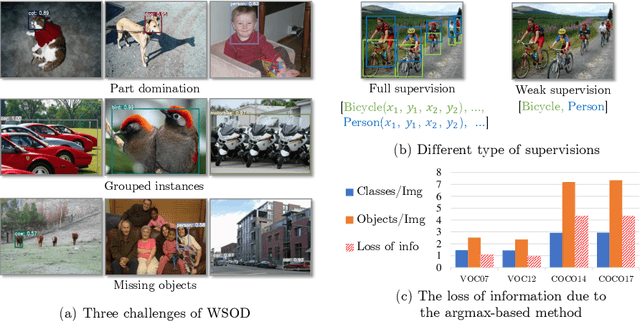
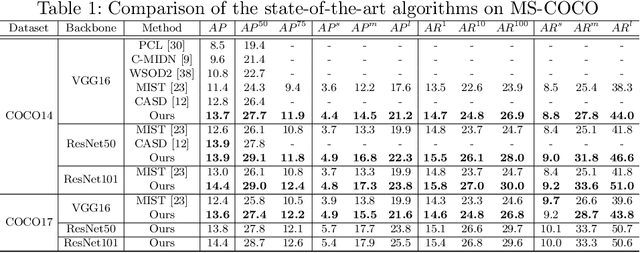
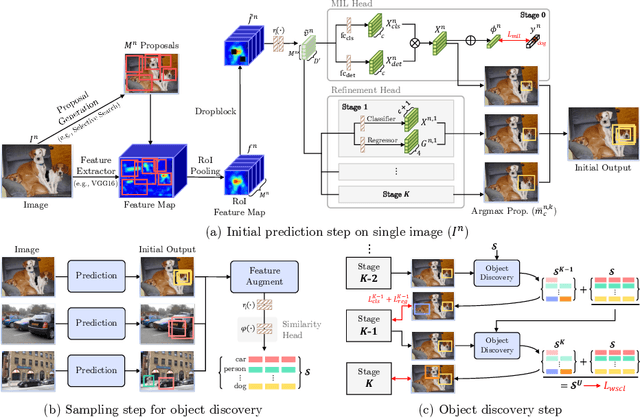
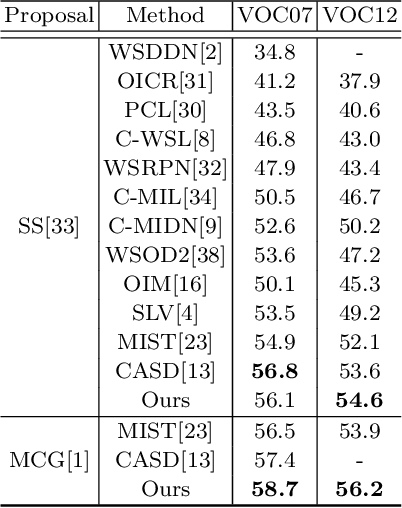
Weakly Supervised Object Detection (WSOD) is a task that detects objects in an image using a model trained only on image-level annotations. Current state-of-the-art models benefit from self-supervised instance-level supervision, but since weak supervision does not include count or location information, the most common ``argmax'' labeling method often ignores many instances of objects. To alleviate this issue, we propose a novel multiple instance labeling method called object discovery. We further introduce a new contrastive loss under weak supervision where no instance-level information is available for sampling, called weakly supervised contrastive loss (WSCL). WSCL aims to construct a credible similarity threshold for object discovery by leveraging consistent features for embedding vectors in the same class. As a result, we achieve new state-of-the-art results on MS-COCO 2014 and 2017 as well as PASCAL VOC 2012, and competitive results on PASCAL VOC 2007.
LID 2020: The Learning from Imperfect Data Challenge Results
Oct 17, 2020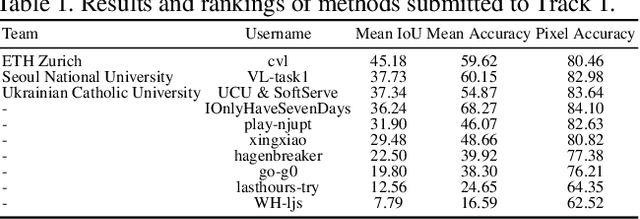
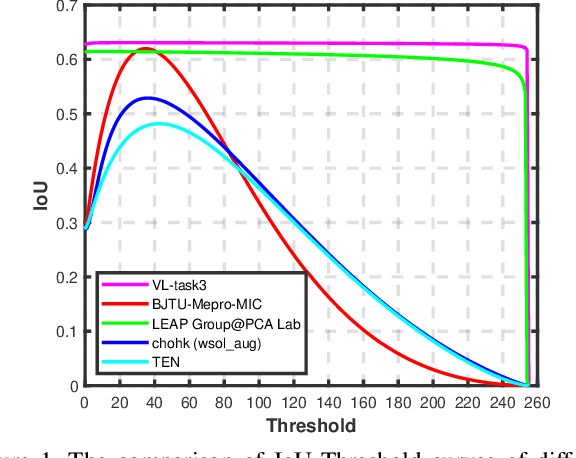
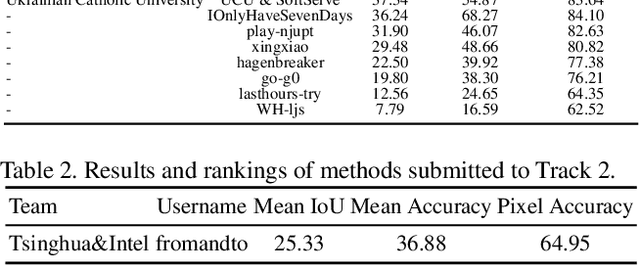
Learning from imperfect data becomes an issue in many industrial applications after the research community has made profound progress in supervised learning from perfectly annotated datasets. The purpose of the Learning from Imperfect Data (LID) workshop is to inspire and facilitate the research in developing novel approaches that would harness the imperfect data and improve the data-efficiency during training. A massive amount of user-generated data nowadays available on multiple internet services. How to leverage those and improve the machine learning models is a high impact problem. We organize the challenges in conjunction with the workshop. The goal of these challenges is to find the state-of-the-art approaches in the weakly supervised learning setting for object detection, semantic segmentation, and scene parsing. There are three tracks in the challenge, i.e., weakly supervised semantic segmentation (Track 1), weakly supervised scene parsing (Track 2), and weakly supervised object localization (Track 3). In Track 1, based on ILSVRC DET, we provide pixel-level annotations of 15K images from 200 categories for evaluation. In Track 2, we provide point-based annotations for the training set of ADE20K. In Track 3, based on ILSVRC CLS-LOC, we provide pixel-level annotations of 44,271 images for evaluation. Besides, we further introduce a new evaluation metric proposed by \cite{zhang2020rethinking}, i.e., IoU curve, to measure the quality of the generated object localization maps. This technical report summarizes the highlights from the challenge. The challenge submission server and the leaderboard will continue to open for the researchers who are interested in it. More details regarding the challenge and the benchmarks are available at https://lidchallenge.github.io