 Add to Chrome
 Add to Firefox
 Add to Edge
No Caption, No Problem: Caption-Free Membership Inference via Model-Fitted Embeddings
Feb 26, 2026
Latent diffusion models have achieved remarkable success in high-fidelity text-to-image generation, but their tendency to memorize training data raises critical privacy and intellectual property concerns. Membership inference attacks (MIAs) provide a principled way to audit such memorization by determining whether a given sample was included in training. However, existing approaches assume access to ground-truth captions. This assumption fails in realistic scenarios where only images are available and their textual annotations remain undisclosed, rendering prior methods ineffective when substituted with vision-language model (VLM) captions. In this work, we propose MoFit, a caption-free MIA framework that constructs synthetic conditioning inputs that are explicitly overfitted to the target model's generative manifold. Given a query image, MoFit proceeds in two stages: (i) model-fitted surrogate optimization, where a perturbation applied to the image is optimized to construct a surrogate in regions of the model's unconditional prior learned from member samples, and (ii) surrogate-driven embedding extraction, where a model-fitted embedding is derived from the surrogate and then used as a mismatched condition for the query image. This embedding amplifies conditional loss responses for member samples while leaving hold-outs relatively less affected, thereby enhancing separability in the absence of ground-truth captions. Our comprehensive experiments across multiple datasets and diffusion models demonstrate that MoFit consistently outperforms prior VLM-conditioned baselines and achieves performance competitive with caption-dependent methods.

AdvPaint: Protecting Images from Inpainting Manipulation via Adversarial Attention Disruption
Mar 13, 2025
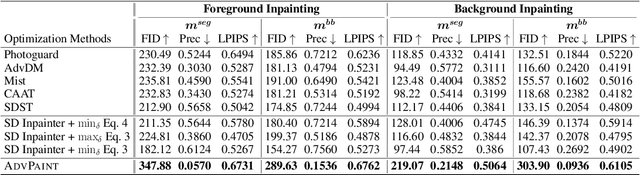
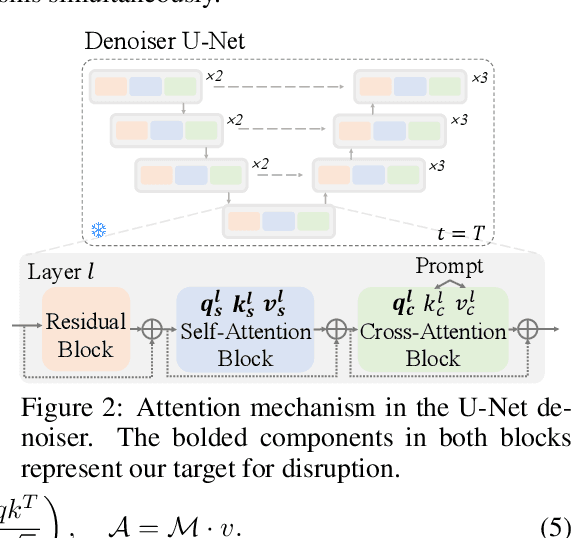

The outstanding capability of diffusion models in generating high-quality images poses significant threats when misused by adversaries. In particular, we assume malicious adversaries exploiting diffusion models for inpainting tasks, such as replacing a specific region with a celebrity. While existing methods for protecting images from manipulation in diffusion-based generative models have primarily focused on image-to-image and text-to-image tasks, the challenge of preventing unauthorized inpainting has been rarely addressed, often resulting in suboptimal protection performance. To mitigate inpainting abuses, we propose ADVPAINT, a novel defensive framework that generates adversarial perturbations that effectively disrupt the adversary's inpainting tasks. ADVPAINT targets the self- and cross-attention blocks in a target diffusion inpainting model to distract semantic understanding and prompt interactions during image generation. ADVPAINT also employs a two-stage perturbation strategy, dividing the perturbation region based on an enlarged bounding box around the object, enhancing robustness across diverse masks of varying shapes and sizes. Our experimental results demonstrate that ADVPAINT's perturbations are highly effective in disrupting the adversary's inpainting tasks, outperforming existing methods; ADVPAINT attains over a 100-point increase in FID and substantial decreases in precision.