 Add to Chrome
 Add to Firefox
 Add to Edge
Adaptive Self-training for Few-shot Neural Sequence Labeling
Oct 07, 2020
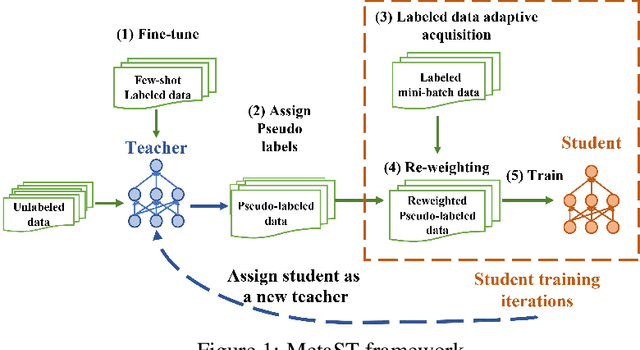
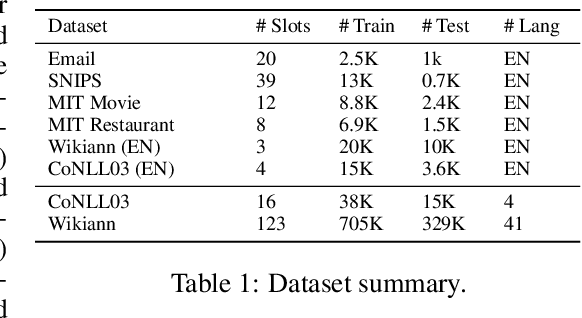
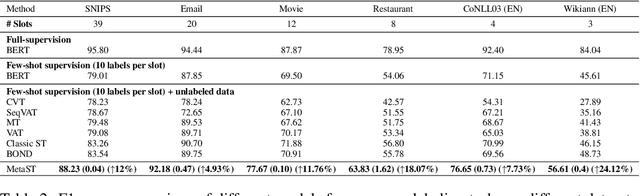
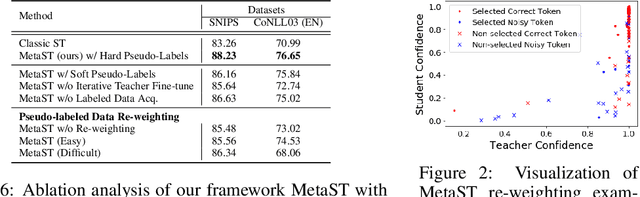
Neural sequence labeling is an important technique employed for many Natural Language Processing (NLP) tasks, such as Named Entity Recognition (NER), slot tagging for dialog systems and semantic parsing. Large-scale pre-trained language models obtain very good performance on these tasks when fine-tuned on large amounts of task-specific labeled data. However, such large-scale labeled datasets are difficult to obtain for several tasks and domains due to the high cost of human annotation as well as privacy and data access constraints for sensitive user applications. This is exacerbated for sequence labeling tasks requiring such annotations at token-level. In this work, we develop techniques to address the label scarcity challenge for neural sequence labeling models. Specifically, we develop self-training and meta-learning techniques for few-shot training of neural sequence taggers, namely MetaST. While self-training serves as an effective mechanism to learn from large amounts of unlabeled data -- meta-learning helps in adaptive sample re-weighting to mitigate error propagation from noisy pseudo-labels. Extensive experiments on six benchmark datasets including two massive multilingual NER datasets and four slot tagging datasets for task-oriented dialog systems demonstrate the effectiveness of our method with around 10% improvement over state-of-the-art systems for the 10-shot setting.

Uncertainty-aware Self-training for Text Classification with Few Labels
Jun 27, 2020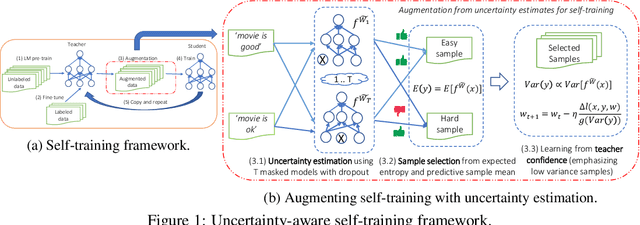
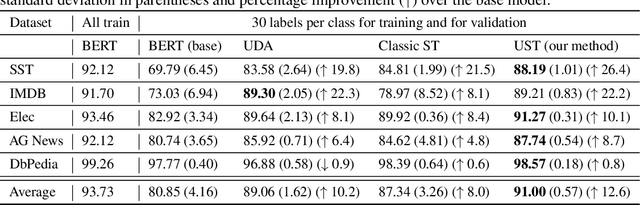
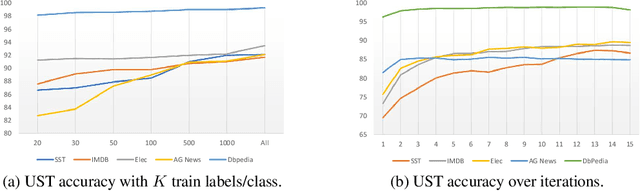
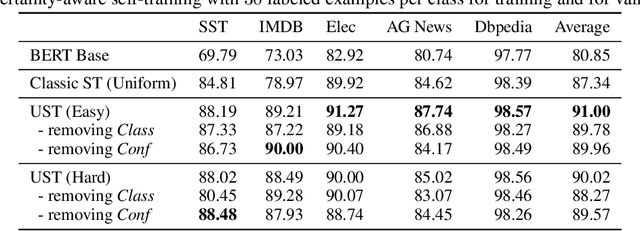
Recent success of large-scale pre-trained language models crucially hinge on fine-tuning them on large amounts of labeled data for the downstream task, that are typically expensive to acquire. In this work, we study self-training as one of the earliest semi-supervised learning approaches to reduce the annotation bottleneck by making use of large-scale unlabeled data for the target task. Standard self-training mechanism randomly samples instances from the unlabeled pool to pseudo-label and augment labeled data. In this work, we propose an approach to improve self-training by incorporating uncertainty estimates of the underlying neural network leveraging recent advances in Bayesian deep learning. Specifically, we propose (i) acquisition functions to select instances from the unlabeled pool leveraging Monte Carlo (MC) Dropout, and (ii) learning mechanism leveraging model confidence for self-training. As an application, we focus on text classification on five benchmark datasets. We show our methods leveraging only 20-30 labeled samples per class for each task for training and for validation can perform within 3% of fully supervised pre-trained language models fine-tuned on thousands of labeled instances with an aggregate accuracy of 91% and improving by upto 12% over baselines.
Learning with Weak Supervision for Email Intent Detection
May 26, 2020

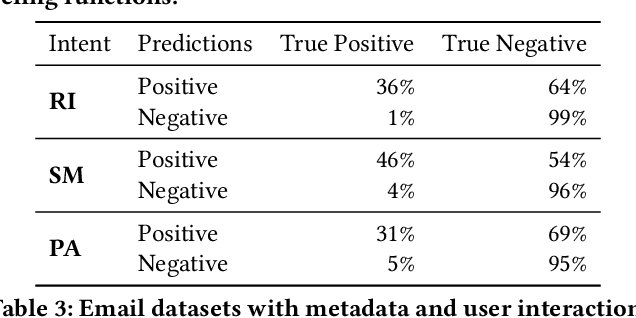
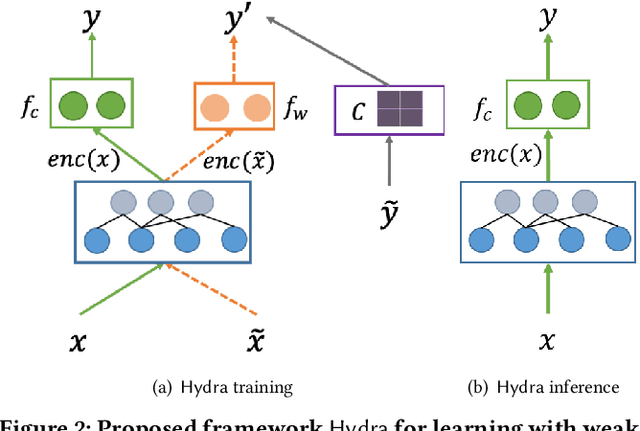
Email remains one of the most frequently used means of online communication. People spend a significant amount of time every day on emails to exchange information, manage tasks and schedule events. Previous work has studied different ways for improving email productivity by prioritizing emails, suggesting automatic replies or identifying intents to recommend appropriate actions. The problem has been mostly posed as a supervised learning problem where models of different complexities were proposed to classify an email message into a predefined taxonomy of intents or classes. The need for labeled data has always been one of the largest bottlenecks in training supervised models. This is especially the case for many real-world tasks, such as email intent classification, where large scale annotated examples are either hard to acquire or unavailable due to privacy or data access constraints. Email users often take actions in response to intents expressed in an email (e.g., setting up a meeting in response to an email with a scheduling request). Such actions can be inferred from user interaction logs. In this paper, we propose to leverage user actions as a source of weak supervision, in addition to a limited set of annotated examples, to detect intents in emails. We develop an end-to-end robust deep neural network model for email intent identification that leverages both clean annotated data and noisy weak supervision along with a self-paced learning mechanism. Extensive experiments on three different intent detection tasks show that our approach can effectively leverage the weakly supervised data to improve intent detection in emails.
* 10 pages, 3 figures
Smart To-Do : Automatic Generation of To-Do Items from Emails
May 05, 2020
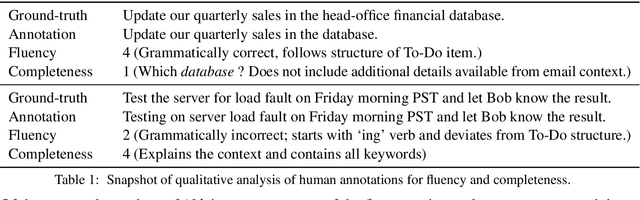
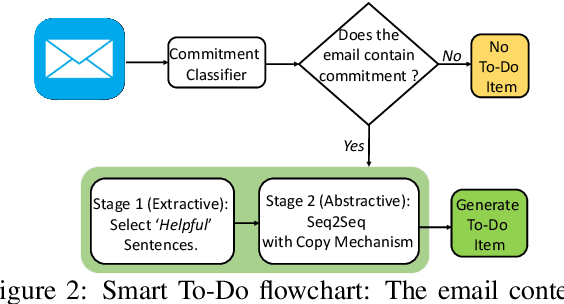
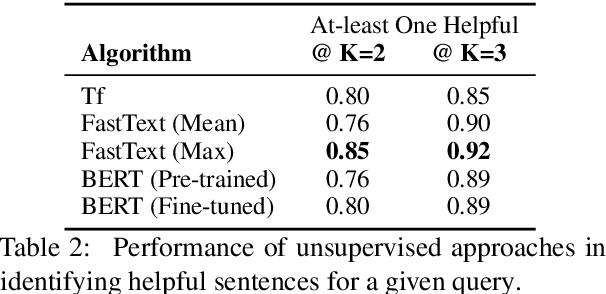
Intelligent features in email service applications aim to increase productivity by helping people organize their folders, compose their emails and respond to pending tasks. In this work, we explore a new application, Smart-To-Do, that helps users with task management over emails. We introduce a new task and dataset for automatically generating To-Do items from emails where the sender has promised to perform an action. We design a two-stage process leveraging recent advances in neural text generation and sequence-to-sequence learning, obtaining BLEU and ROUGE scores of 0:23 and 0:63 for this task. To the best of our knowledge, this is the first work to address the problem of composing To-Do items from emails.
XtremeDistil: Multi-stage Distillation for Massive Multilingual Models
May 05, 2020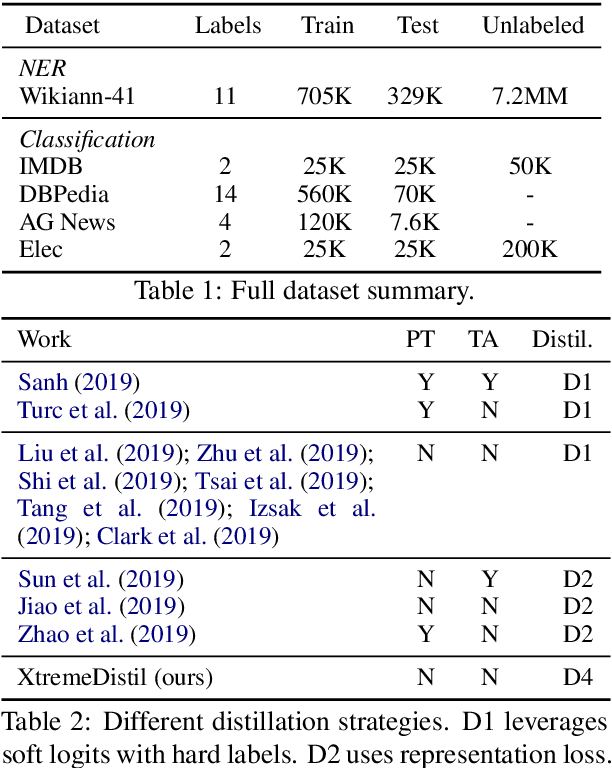
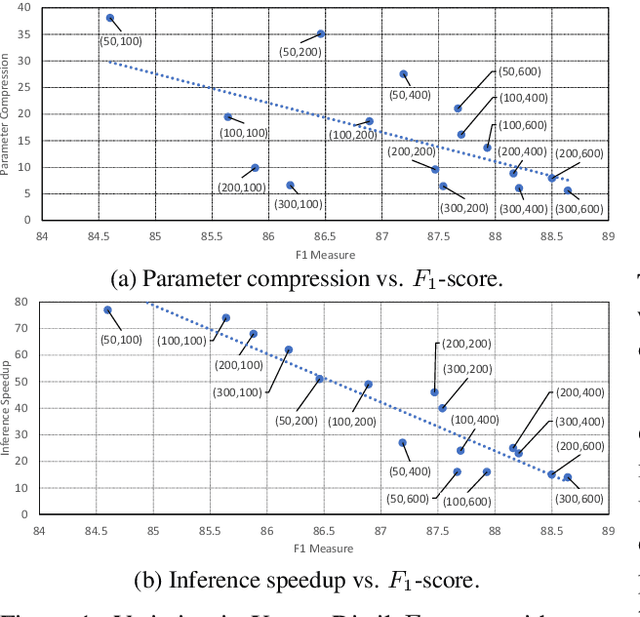
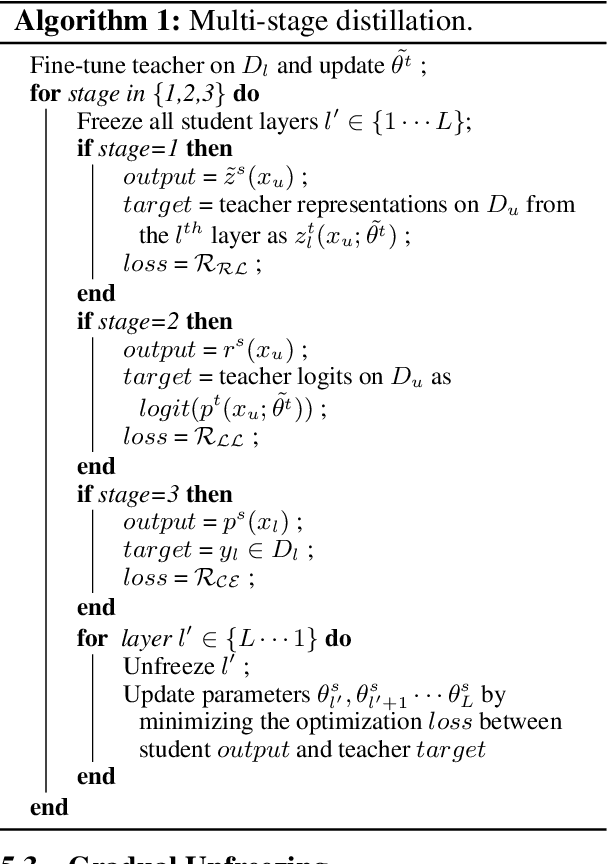
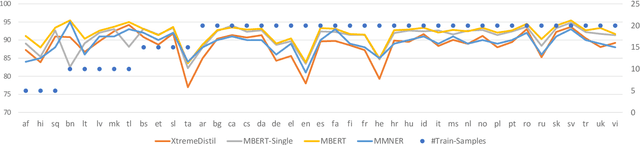
Deep and large pre-trained language models are the state-of-the-art for various natural language processing tasks. However, the huge size of these models could be a deterrent to use them in practice. Some recent and concurrent works use knowledge distillation to compress these huge models into shallow ones. In this work we study knowledge distillation with a focus on multi-lingual Named Entity Recognition (NER). In particular, we study several distillation strategies and propose a stage-wise optimization scheme leveraging teacher internal representations that is agnostic of teacher architecture and show that it outperforms strategies employed in prior works. Additionally, we investigate the role of several factors like the amount of unlabeled data, annotation resources, model architecture and inference latency to name a few. We show that our approach leads to massive compression of MBERT-like teacher models by upto 35x in terms of parameters and 51x in terms of latency for batch inference while retaining 95% of its F1-score for NER over 41 languages.
Gender Bias in Multilingual Embeddings and Cross-Lingual Transfer
May 02, 2020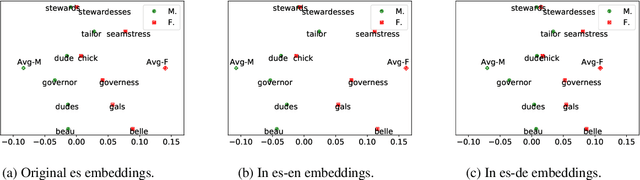
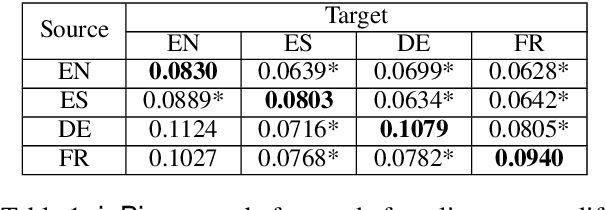
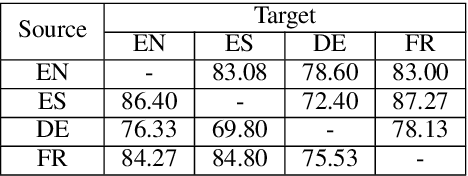
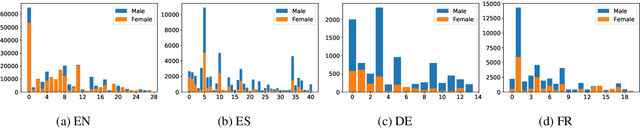
Multilingual representations embed words from many languages into a single semantic space such that words with similar meanings are close to each other regardless of the language. These embeddings have been widely used in various settings, such as cross-lingual transfer, where a natural language processing (NLP) model trained on one language is deployed to another language. While the cross-lingual transfer techniques are powerful, they carry gender bias from the source to target languages. In this paper, we study gender bias in multilingual embeddings and how it affects transfer learning for NLP applications. We create a multilingual dataset for bias analysis and propose several ways for quantifying bias in multilingual representations from both the intrinsic and extrinsic perspectives. Experimental results show that the magnitude of bias in the multilingual representations changes differently when we align the embeddings to different target spaces and that the alignment direction can also have an influence on the bias in transfer learning. We further provide recommendations for using the multilingual word representations for downstream tasks.
Leveraging Multi-Source Weak Social Supervision for Early Detection of Fake News
Apr 03, 2020
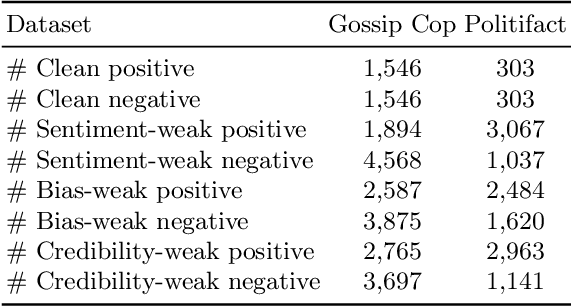
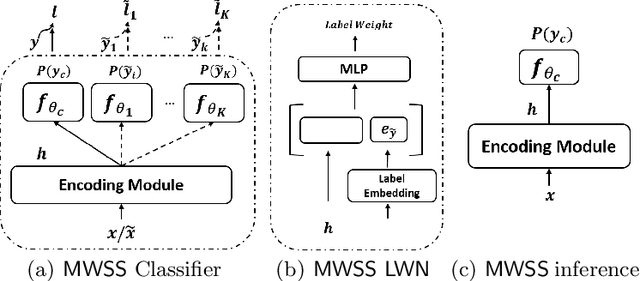
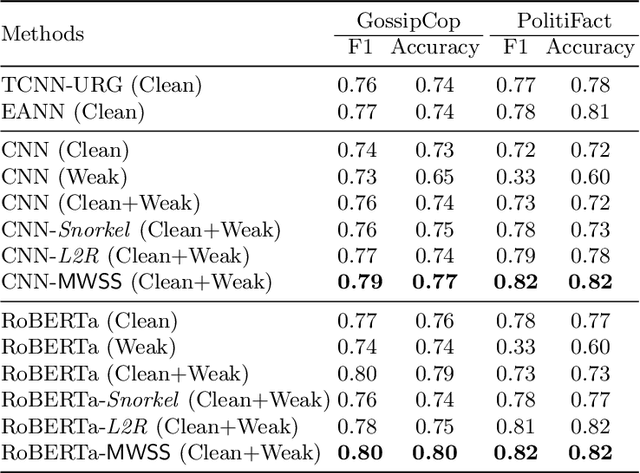
Social media has greatly enabled people to participate in online activities at an unprecedented rate. However, this unrestricted access also exacerbates the spread of misinformation and fake news online which might cause confusion and chaos unless being detected early for its mitigation. Given the rapidly evolving nature of news events and the limited amount of annotated data, state-of-the-art systems on fake news detection face challenges due to the lack of large numbers of annotated training instances that are hard to come by for early detection. In this work, we exploit multiple weak signals from different sources given by user and content engagements (referred to as weak social supervision), and their complementary utilities to detect fake news. We jointly leverage the limited amount of clean data along with weak signals from social engagements to train deep neural networks in a meta-learning framework to estimate the quality of different weak instances. Experiments on realworld datasets demonstrate that the proposed framework outperforms state-of-the-art baselines for early detection of fake news without using any user engagements at prediction time.
STANCY: Stance Classification Based on Consistency Cues
Oct 14, 2019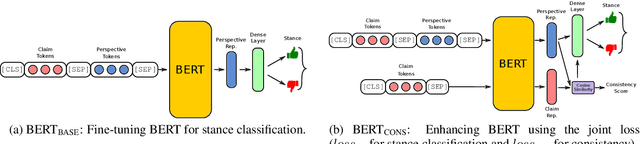
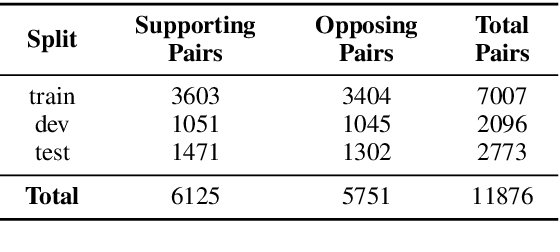
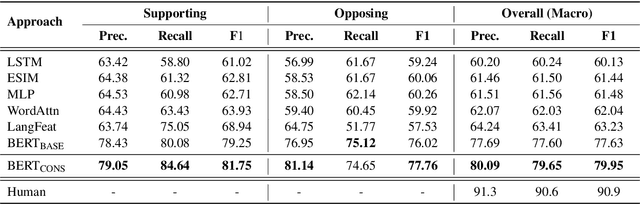
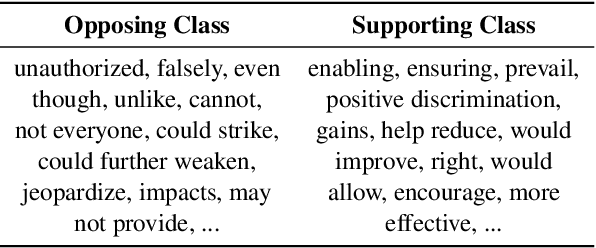
Controversial claims are abundant in online media and discussion forums. A better understanding of such claims requires analyzing them from different perspectives. Stance classification is a necessary step for inferring these perspectives in terms of supporting or opposing the claim. In this work, we present a neural network model for stance classification leveraging BERT representations and augmenting them with a novel consistency constraint. Experiments on the Perspectrum dataset, consisting of claims and users' perspectives from various debate websites, demonstrate the effectiveness of our approach over state-of-the-art baselines.
Distilling Transformers into Simple Neural Networks with Unlabeled Transfer Data
Oct 04, 2019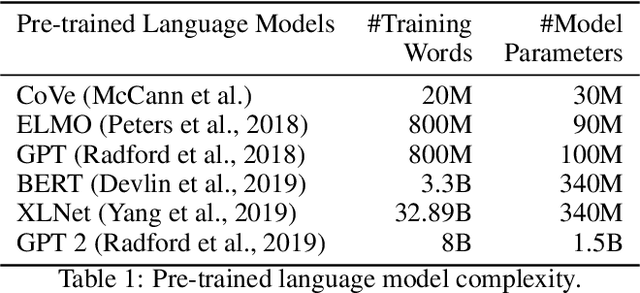
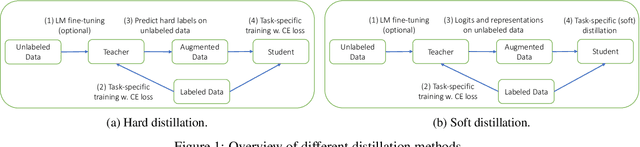
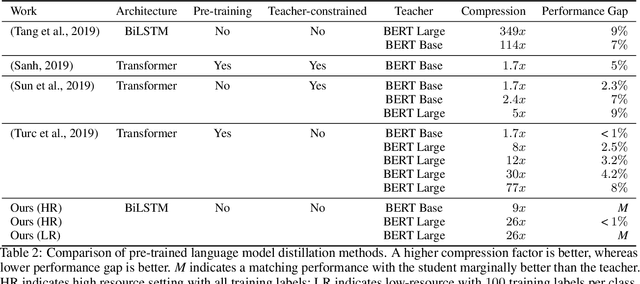
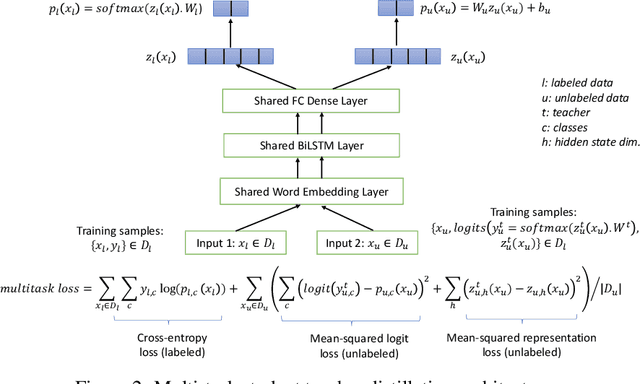
Recent advances in pre-training huge models on large amounts of text through self supervision have obtained state-of-the-art results in various natural language processing tasks. However, these huge and expensive models are difficult to use in practise for downstream tasks. Some recent efforts use knowledge distillation to compress these models. However, we see a gap between the performance of the smaller student models as compared to that of the large teacher. In this work, we leverage large amounts of in-domain unlabeled transfer data in addition to a limited amount of labeled training instances to bridge this gap. We show that simple RNN based student models even with hard distillation can perform at par with the huge teachers given the transfer set. The student performance can be further improved with soft distillation and leveraging teacher intermediate representations. We show that our student models can compress the huge teacher by up to 26x while still matching or even marginally exceeding the teacher performance in low-resource settings with small amount of labeled data.
OpenKI: Integrating Open Information Extraction and Knowledge Bases with Relation Inference
Apr 12, 2019
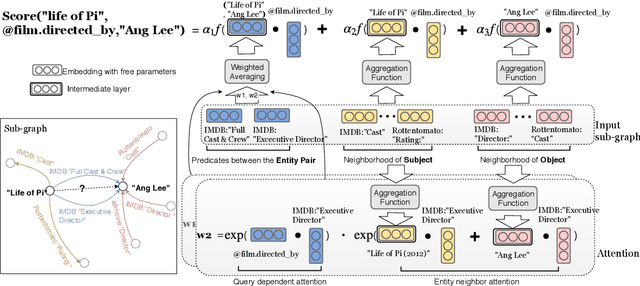
In this paper, we consider advancing web-scale knowledge extraction and alignment by integrating OpenIE extractions in the form of (subject, predicate, object) triples with Knowledge Bases (KB). Traditional techniques from universal schema and from schema mapping fall in two extremes: either they perform instance-level inference relying on embedding for (subject, object) pairs, thus cannot handle pairs absent in any existing triples; or they perform predicate-level mapping and completely ignore background evidence from individual entities, thus cannot achieve satisfying quality. We propose OpenKI to handle sparsity of OpenIE extractions by performing instance-level inference: for each entity, we encode the rich information in its neighborhood in both KB and OpenIE extractions, and leverage this information in relation inference by exploring different methods of aggregation and attention. In order to handle unseen entities, our model is designed without creating entity-specific parameters. Extensive experiments show that this method not only significantly improves state-of-the-art for conventional OpenIE extractions like ReVerb, but also boosts the performance on OpenIE from semi-structured data, where new entity pairs are abundant and data are fairly sparse.