 Add to Chrome
 Add to Firefox
 Add to Edge
DeRegiME: Deep Regime Mixtures for Probabilistic Forecasting under Distribution Shift
May 19, 2026
We introduce DeRegiME -- Deep Regime Mixture of Experts -- a direct multi-horizon probabilistic forecaster that separates latent uncertainty regimes from the underlying signal and softly assigns each forecast location to learned recurring regimes using a sparse variational Gaussian process (GP) whose nonstationary regime-mixing kernel and Student-t likelihood combine per-regime sub-kernels and noise processes via a shared gate. This yields a single sparse-GP posterior, not a mixture of GP experts. DeRegiME addresses a key limitation of neural forecasters: point forecasts discard residual uncertainty, and probabilistic heads -- whether single marginals, uninterpreted mixtures, quantile sets, or diffusion samples -- rarely expose the regime structure of the residual. Yet distribution shift in noisy heteroskedastic time series may be abrupt, gradual, or horizon-dependent and often appears in residual uncertainty rather than the conditional mean. DeRegiME yields an interpretable mean-residual-noise decomposition with a direct-sum feature-space representation that anchors regimes as clusters of residual similarity whose transitions surface as implicit changepoints. The effective number of regimes is pruned by the stick-breaking gate. We prove kernel validity and predictive-density propriety, and across ten benchmarks and three encoder grids DeRegiME improves negative log predictive density (NLPD) by 20.3% over the strongest encoder-matched baseline, a DeepAR/GluonTS-style dynamic Student-t head, with parallel gains on CRPS (3.0%) and MSE (4.7%). Improvements are consistent across all datasets, which span abrupt, gradual, and seasonal shifts.

Detecting Changes in Causal Dependence with Kernels and Copulas
May 07, 2026We propose a framework for determining whether the causal dependence of an outcome $Y$ on a covariate $X$ changes at a given time point, given confounders $\boldsymbol{Z}$. For instance, in financial markets, the effect of a market indicator on asset returns may causally change over time. While many existing measures of association can be used to detect changes in joint and marginal distributions, in the absence of strong assumptions on the data generating process none are suitable for detecting changes in the causal mechanism or in the strength of causal relationship. In this work we approach the problem from a fully non-parametric perspective, and treat the causal mechanism as well as the distribution of the data as unknown. We introduce a quantity based on the integrated difference between kernel mean embeddings of certain conditionals copula, which is provably equal to zero if the causal dependence does not change and strictly positive else. A near-linear time estimator for the quantity is proposed, with rates of convergence explicitly spelled out. Extensive experiments demonstrate that the proposed statistic achieves high accuracy on multiple synthetic and real-world datasets. We additionally show how the proposed statistic can be used for change point detection when the goal is to detect changes in causal dependence occurring at an unknown times.
Deep Learning for Financial Time Series: A Large-Scale Benchmark of Risk-Adjusted Performance
Mar 02, 2026We present a large scale benchmark of modern deep learning architectures for a financial time series prediction and position sizing task, with a primary focus on Sharpe ratio optimization. Evaluating linear models, recurrent networks, transformer based architectures, state space models, and recent sequence representation approaches, we assess out of sample performance on a daily futures dataset spanning commodities, equity indices, bonds, and FX spanning 2010 to 2025. Our evaluation goes beyond average returns and includes statistical significance, downside and tail risk measures, breakeven transaction cost analysis, robustness to random seed selection, and computational efficiency. We find that models explicitly designed to learn rich temporal representations consistently outperform linear benchmarks and generic deep learning models, which often lead the ranking in standard time series benchmarks. Hybrid models such as VSN with LSTM, a combination of Variable Selection Networks (VSN) and LSTMs, achieves the highest overall Sharpe ratio, while VSN with xLSTM and LSTM with PatchTST exhibit superior downside adjusted characteristics. xLSTM demonstrates the largest breakeven transaction cost buffer, indicating improved robustness to trading frictions.
DeePM: Regime-Robust Deep Learning for Systematic Macro Portfolio Management
Jan 09, 2026We propose DeePM (Deep Portfolio Manager), a structured deep-learning macro portfolio manager trained end-to-end to maximize a robust, risk-adjusted utility. DeePM addresses three fundamental challenges in financial learning: (1) it resolves the asynchronous "ragged filtration" problem via a Directed Delay (Causal Sieve) mechanism that prioritizes causal impulse-response learning over information freshness; (2) it combats low signal-to-noise ratios via a Macroeconomic Graph Prior, regularizing cross-asset dependence according to economic first principles; and (3) it optimizes a distributionally robust objective where a smooth worst-window penalty serves as a differentiable proxy for Entropic Value-at-Risk (EVaR) - a window-robust utility encouraging strong performance in the most adverse historical subperiods. In large-scale backtests from 2010-2025 on 50 diversified futures with highly realistic transaction costs, DeePM attains net risk-adjusted returns that are roughly twice those of classical trend-following strategies and passive benchmarks, solely using daily closing prices. Furthermore, DeePM improves upon the state-of-the-art Momentum Transformer architecture by roughly fifty percent. The model demonstrates structural resilience across the 2010s "CTA (Commodity Trading Advisor) Winter" and the post-2020 volatility regime shift, maintaining consistent performance through the pandemic, inflation shocks, and the subsequent higher-for-longer environment. Ablation studies confirm that strictly lagged cross-sectional attention, graph prior, principled treatment of transaction costs, and robust minimax optimization are the primary drivers of this generalization capability.
Few-Shot Learning Patterns in Financial Time-Series for Trend-Following Strategies
Oct 16, 2023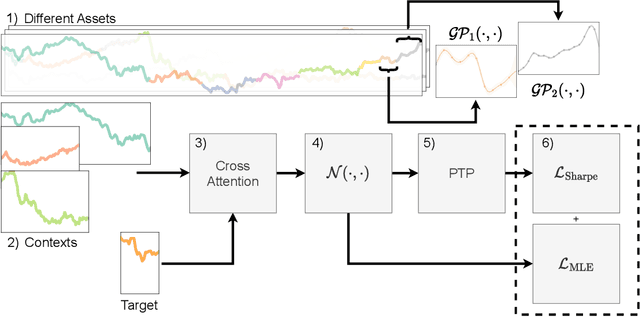
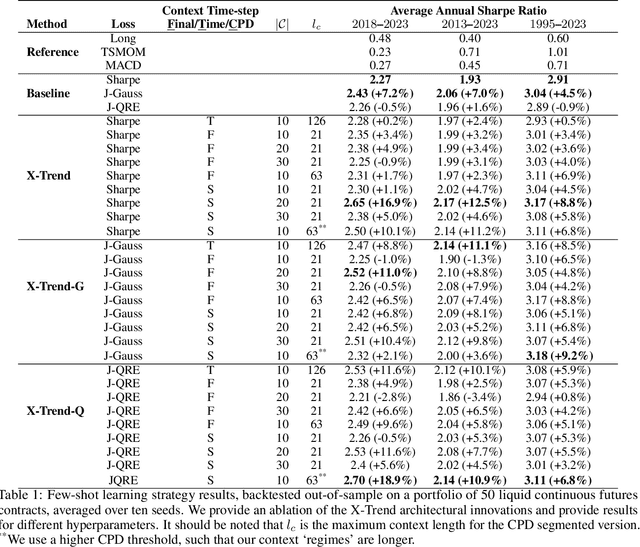


Forecasting models for systematic trading strategies do not adapt quickly when financial market conditions change, as was seen in the advent of the COVID-19 pandemic in 2020, when market conditions changed dramatically causing many forecasting models to take loss-making positions. To deal with such situations, we propose a novel time-series trend-following forecaster that is able to quickly adapt to new market conditions, referred to as regimes. We leverage recent developments from the deep learning community and use few-shot learning. We propose the Cross Attentive Time-Series Trend Network - X-Trend - which takes positions attending over a context set of financial time-series regimes. X-Trend transfers trends from similar patterns in the context set to make predictions and take positions for a new distinct target regime. X-Trend is able to quickly adapt to new financial regimes with a Sharpe ratio increase of 18.9% over a neural forecaster and 10-fold over a conventional Time-series Momentum strategy during the turbulent market period from 2018 to 2023. Our strategy recovers twice as quickly from the COVID-19 drawdown compared to the neural-forecaster. X-Trend can also take zero-shot positions on novel unseen financial assets obtaining a 5-fold Sharpe ratio increase versus a neural time-series trend forecaster over the same period. X-Trend both forecasts next-day prices and outputs a trading signal. Furthermore, the cross-attention mechanism allows us to interpret the relationship between forecasts and patterns in the context set.
Trading with the Momentum Transformer: An Intelligent and Interpretable Architecture
Dec 16, 2021Deep learning architectures, specifically Deep Momentum Networks (DMNs) [1904.04912], have been found to be an effective approach to momentum and mean-reversion trading. However, some of the key challenges in recent years involve learning long-term dependencies, degradation of performance when considering returns net of transaction costs and adapting to new market regimes, notably during the SARS-CoV-2 crisis. Attention mechanisms, or Transformer-based architectures, are a solution to such challenges because they allow the network to focus on significant time steps in the past and longer-term patterns. We introduce the Momentum Transformer, an attention-based architecture which outperforms the benchmarks, and is inherently interpretable, providing us with greater insights into our deep learning trading strategy. Our model is an extension to the LSTM-based DMN, which directly outputs position sizing by optimising the network on a risk-adjusted performance metric, such as Sharpe ratio. We find an attention-LSTM hybrid Decoder-Only Temporal Fusion Transformer (TFT) style architecture is the best performing model. In terms of interpretability, we observe remarkable structure in the attention patterns, with significant peaks of importance at momentum turning points. The time series is thus segmented into regimes and the model tends to focus on previous time-steps in alike regimes. We find changepoint detection (CPD) [2105.13727], another technique for responding to regime change, can complement multi-headed attention, especially when we run CPD at multiple timescales. Through the addition of an interpretable variable selection network, we observe how CPD helps our model to move away from trading predominantly on daily returns data. We note that the model can intelligently switch between, and blend, classical strategies - basing its decision on patterns in the data.
Slow Momentum with Fast Reversion: A Trading Strategy Using Deep Learning and Changepoint Detection
Jun 18, 2021Momentum strategies are an important part of alternative investments and are at the heart of commodity trading advisors (CTAs). These strategies have however been found to have difficulties adjusting to rapid changes in market conditions, such as during the 2020 market crash. In particular, immediately after momentum turning points, where a trend reverses from an uptrend (downtrend) to a downtrend (uptrend), time-series momentum (TSMOM) strategies are prone to making bad bets. To improve the response to regime change, we introduce a novel approach, where we insert an online change-point detection (CPD) module into a Deep Momentum Network (DMN) [1904.04912] pipeline, which uses an LSTM deep-learning architecture to simultaneously learn both trend estimation and position sizing. Furthermore, our model is able to optimise the way in which it balances 1) a slow momentum strategy which exploits persisting trends, but does not overreact to localised price moves, and 2) a fast mean-reversion strategy regime by quickly flipping its position, then swapping it back again to exploit localised price moves. Our CPD module outputs a changepoint location and severity score, allowing our model to learn to respond to varying degrees of disequilibrium, or smaller and more localised changepoints, in a data driven manner. Using a portfolio of 50, liquid, continuous futures contracts over the period 1990-2020, the addition of the CPD module leads to an improvement in Sharpe ratio of one-third. Even more notably, this module is especially beneficial in periods of significant nonstationarity, and in particular, over the most recent years tested (2015-2020) the performance boost is approximately two-thirds. This is especially interesting as traditional momentum strategies have been underperforming in this period.