 Add to Chrome
 Add to Firefox
 Add to Edge
RegionDet: A Benchmark for Region Detection Beyond Object Instances
Aug 07, 2026
Object detection is a fundamental task in computer vision and has achieved remarkable progress on standard benchmarks by localizing discrete and well-bounded object instances. However, many visual targets in real-world scenarios are not individual objects, but regions defined by visual states, scene context, object relations, and human activities, such as construction areas, damaged road regions, queues, group conversations, and vendor regions. Existing detection benchmarks are mainly built around object instances, providing limited support for systematically evaluating such region targets. To address this gap, we introduce Region Detection, a task that extends conventional object detection beyond object instances, and construct RegionDet, a benchmark for region target localization. RegionDet contains eight region categories, including Construction, Crossing, Damage, Queuing, Talking, Vendor, Waiting, and Walking, with COCO-style bounding-box annotations and evaluation protocols. We systematically evaluate representative closed-set and zero-shot/open-vocabulary detectors on RegionDet. Results show that closed-set detectors can partially learn region-level patterns under supervision, while zero-shot/open-vocabulary detectors struggle severely, revealing the strong object-centric bias of current vision-language detectors. Further analyses highlight key challenges in Region Detection, including weak boundary cues, strong context dependency, and insufficient relation-level region understanding. The RegionDet will be released.

VisionFM: a Multi-Modal Multi-Task Vision Foundation Model for Generalist Ophthalmic Artificial Intelligence
Oct 08, 2023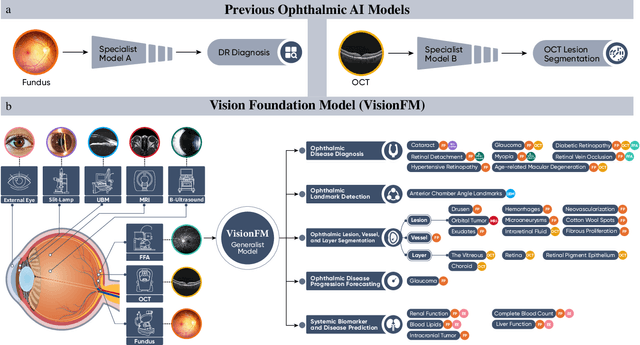
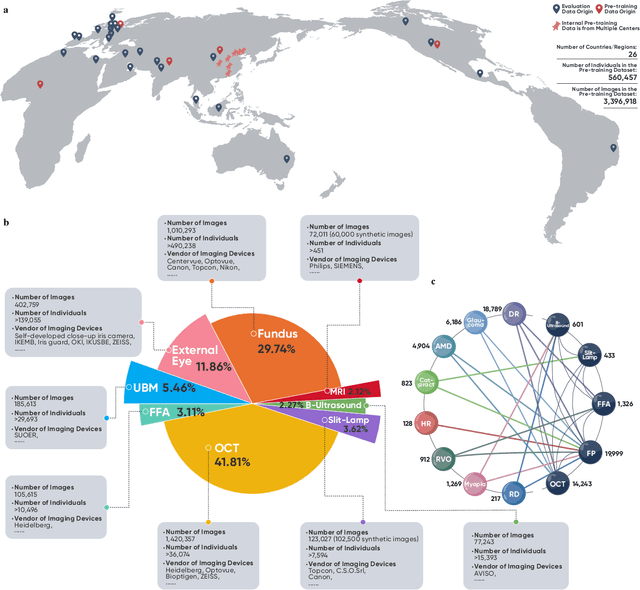
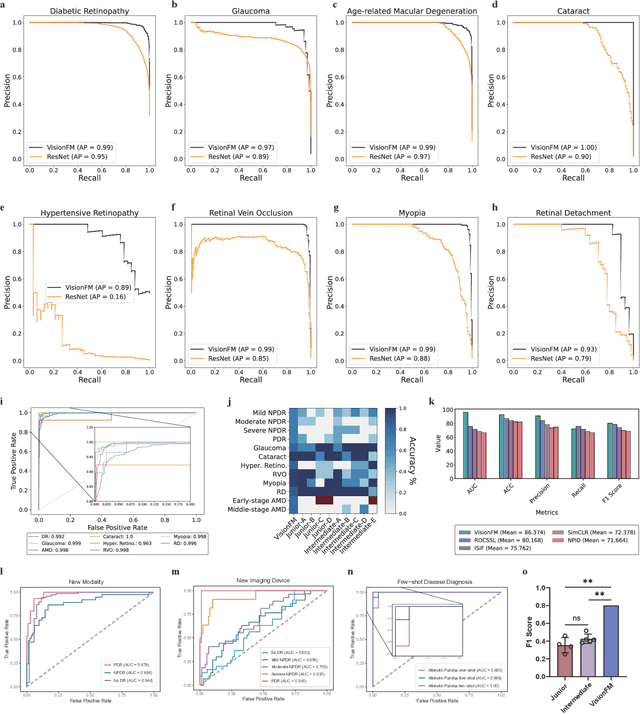
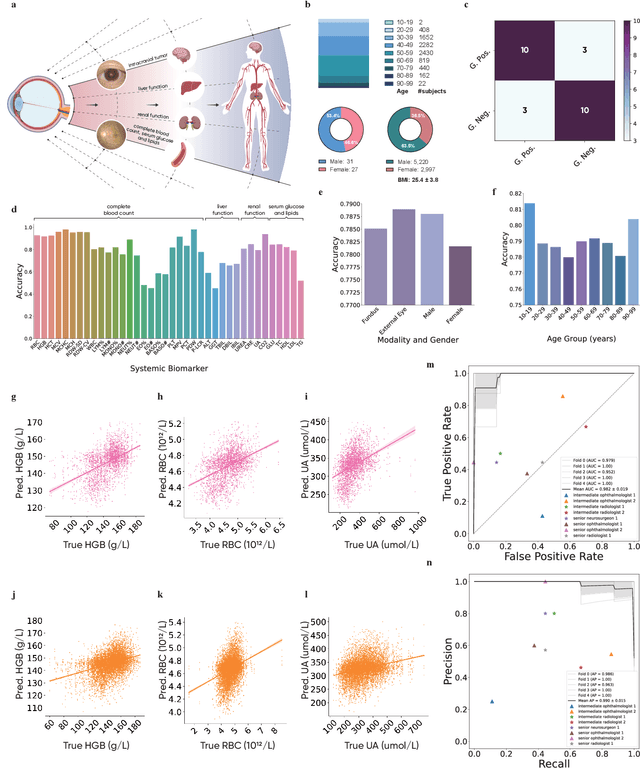
We present VisionFM, a foundation model pre-trained with 3.4 million ophthalmic images from 560,457 individuals, covering a broad range of ophthalmic diseases, modalities, imaging devices, and demography. After pre-training, VisionFM provides a foundation to foster multiple ophthalmic artificial intelligence (AI) applications, such as disease screening and diagnosis, disease prognosis, subclassification of disease phenotype, and systemic biomarker and disease prediction, with each application enhanced with expert-level intelligence and accuracy. The generalist intelligence of VisionFM outperformed ophthalmologists with basic and intermediate levels in jointly diagnosing 12 common ophthalmic diseases. Evaluated on a new large-scale ophthalmic disease diagnosis benchmark database, as well as a new large-scale segmentation and detection benchmark database, VisionFM outperformed strong baseline deep neural networks. The ophthalmic image representations learned by VisionFM exhibited noteworthy explainability, and demonstrated strong generalizability to new ophthalmic modalities, disease spectrum, and imaging devices. As a foundation model, VisionFM has a large capacity to learn from diverse ophthalmic imaging data and disparate datasets. To be commensurate with this capacity, in addition to the real data used for pre-training, we also generated and leveraged synthetic ophthalmic imaging data. Experimental results revealed that synthetic data that passed visual Turing tests, can also enhance the representation learning capability of VisionFM, leading to substantial performance gains on downstream ophthalmic AI tasks. Beyond the ophthalmic AI applications developed, validated, and demonstrated in this work, substantial further applications can be achieved in an efficient and cost-effective manner using VisionFM as the foundation.