 Add to Chrome
 Add to Firefox
 Add to Edge
Real-World LoRaWAN Performance and Propagation Modeling Using UAV, Helikite, and Vehicle-Based Measurements
Apr 07, 2026
This paper presents a field-based evaluation of Long Range Wide Area Network (LoRaWAN) signal propagation conducted at two locations within the Aerial Experimentation and Research Platform for Advanced Wireless (AERPAW) testbed: Lake Wheeler Field and NC State University's Centennial Campus. Three distinct transmission platforms were deployed, a ground vehicle, a multirotor drone at 50 meters, and a helikite at a steady altitude of 150 meters and 300 meters approximately. These platforms enabled a comparative study on how altitude, mobility, and terrain influence wireless signal reception across a LoRaWAN gateway network. We analyze received signal strength (RSSI) and signal-to-noise ratio (SNR) as functions of distance and spreading factor (SF). Three complementary metrics are visualized: SNR versus distance with demodulation thresholds, probability of successful reception, and SNR boxplots grouped by distance bins. These plots reveal link degradation patterns and demonstrate the role of adaptive SF selection in maintaining communication reliability. To characterize propagation behavior, we apply a log-distance path loss model to empirical data from the ground vehicle experiment, which encompass both rural and urban non-line-of-sight (NLOS) conditions. Model parameters are optimized through error minimization techniques. Our results show that the helikite platform, due to its stable high-altitude position, provided the most reliable and consistent link performance. Conversely, the drone and vehicle exhibited higher variability due to movement, obstructions, and terrain-induced multipath. These findings demonstrate the influence of platform dynamics and altitude on LoRaWAN reception performance, providing support for future aerial network planning efforts.

Modeling and Analysis of Air-to-Ground Cellular KPIs in a 5G Testbed using Android Smartphones
Apr 06, 2026The integration of cellular communication with Unmanned Aerial Vehicles (UAVs) extends the range of command and control and payload communications of autonomous UAV applications. Accurate modeling of this air-to-ground wireless environment aids UAV mission planning. Models built on and insights obtained from real-life experiments intricately capture the variations in air-to-ground link quality with UAV position, offering more fidelity for simulations and system design than those that rely on generic theoretical models designed for ground scenarios or ray-tracing simulations. In this work, we conduct aerial flights at the Aerial Experimentation and Research Platform for Advanced Wireless (AERPAW) Lake Wheeler testbed to study the variation in key performance indicators (KPIs) of a private 4G/5G cellular base station (BS) with the UAV's altitude, distance from the BS, elevation, and azimuth relative to the BS. Variations in 4G and 5G physical layer KPIs and application layer throughput are logged and analyzed, using two Android smartphones: a Keysight Nemo device, with enhanced KPI access, through a rooted operating system, and a standard smartphone running a custom application that utilizes open-source Android APIs. The observed signal strength measurements are compared to theoretical predictions from free space path loss models that incorporate the BS antenna radiation patterns. Mathematical model parameters for polynomial curve approximations are derived to fit the observed data. Light machine learning approaches, namely random forests, gradient boosting regressors and neural networks, are used to model KPI behaviour as a function of UAV position relative to the BS. The insights and models generated from real-life experiments in this study can serve as valuable tools in the design, simulation and deployment of cellular communication-based UAV systems.
Tackling the Sign Problem in the Doped Hubbard Model with Normalizing Flows
Mar 18, 2026The Hubbard model at finite chemical potential is a cornerstone for understanding doped correlated systems, but simulations are severely limited by the sign problem. In the auxiliary-field formulation, the spin basis mitigates the sign problem, yet severe ergodicity issues have limited its use. We extend recent advances with normalizing flows at half-filling to finite chemical potential by introducing an annealing scheme enabling ergodic sampling. Compared to state-of-the-art hybrid Monte Carlo in the charge basis, our approach accurately reproduces exact diagonalization results while reducing statistical uncertainties by an order of magnitude, opening a new path for simulations of doped correlated systems.
Toward Scalable Normalizing Flows for the Hubbard Model
Jan 26, 2026Normalizing flows have recently demonstrated the ability to learn the Boltzmann distribution of the Hubbard model, opening new avenues for generative modeling in condensed matter physics. In this work, we investigate the steps required to extend such simulations to larger lattice sizes and lower temperatures, with a focus on enhancing stability and efficiency. Additionally, we present the scaling behavior of stochastic normalizing flows and non-equilibrium Markov chain Monte Carlo methods for this fermionic system.
BONES: Near-Optimal Neural-Enhanced Video Streaming
Oct 15, 2023Accessing high-quality video content can be challenging due to insufficient and unstable network bandwidth. Recent advances in neural enhancement have shown promising results in improving the quality of degraded videos through deep learning. Neural-Enhanced Streaming (NES) incorporates this new approach into video streaming, allowing users to download low-quality video segments and then enhance them to obtain high-quality content without violating the playback of the video stream. We introduce BONES, an NES control algorithm that jointly manages the network and computational resources to maximize the quality of experience (QoE) of the user. BONES formulates NES as a Lyapunov optimization problem and solves it in an online manner with near-optimal performance, making it the first NES algorithm to provide a theoretical performance guarantee. Our comprehensive experimental results indicate that BONES increases QoE by 4% to 13% over state-of-the-art algorithms, demonstrating its potential to enhance the video streaming experience for users. Our code and data will be released to the public.
The AI Revolution: Opportunities and Challenges for the Finance Sector
Aug 31, 2023This report examines Artificial Intelligence (AI) in the financial sector, outlining its potential to revolutionise the industry and identify its challenges. It underscores the criticality of a well-rounded understanding of AI, its capabilities, and its implications to effectively leverage its potential while mitigating associated risks. The potential of AI potential extends from augmenting existing operations to paving the way for novel applications in the finance sector. The application of AI in the financial sector is transforming the industry. Its use spans areas from customer service enhancements, fraud detection, and risk management to credit assessments and high-frequency trading. However, along with these benefits, AI also presents several challenges. These include issues related to transparency, interpretability, fairness, accountability, and trustworthiness. The use of AI in the financial sector further raises critical questions about data privacy and security. A further issue identified in this report is the systemic risk that AI can introduce to the financial sector. Being prone to errors, AI can exacerbate existing systemic risks, potentially leading to financial crises. Regulation is crucial to harnessing the benefits of AI while mitigating its potential risks. Despite the global recognition of this need, there remains a lack of clear guidelines or legislation for AI use in finance. This report discusses key principles that could guide the formation of effective AI regulation in the financial sector, including the need for a risk-based approach, the inclusion of ethical considerations, and the importance of maintaining a balance between innovation and consumer protection. The report provides recommendations for academia, the finance industry, and regulators.
Heuristic Approach for Jointly Optimizing FeICIC and UAV Locations in Multi-Tier LTE-Advanced Public Safety HetNet
Dec 07, 2019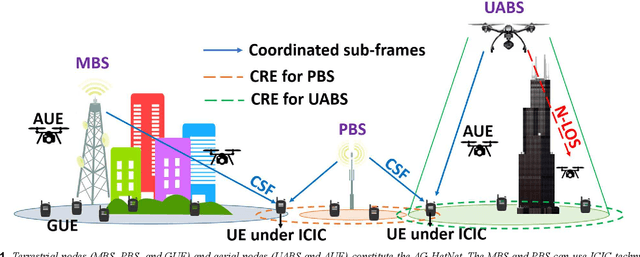
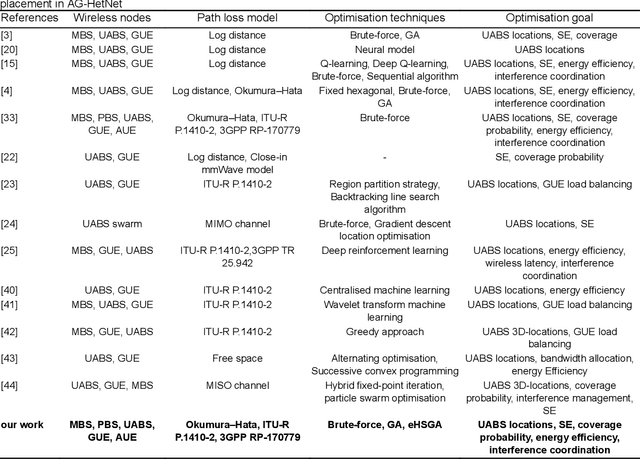
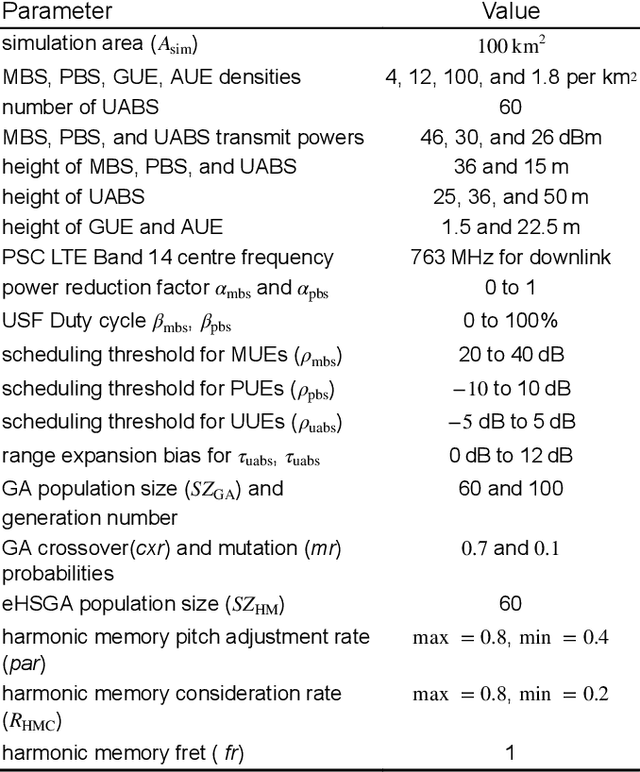
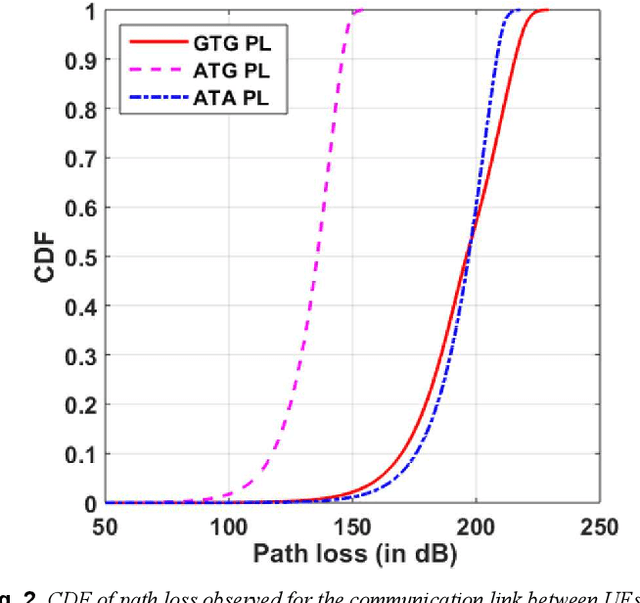
UAV enabled communications and networking can enhance wireless connectivity and support emerging services. However, this would require system-level understanding to modify and extend the existing terrestrial network infrastructure. In this paper, we integrate UAVs both as user equipment and base stations into existing LTE-Advanced heterogeneous network (HetNet) and provide system-level insights of this three-tier LTE-Advanced air-ground HetNet (AG-HetNet). This AG-HetNet leverages cell range expansion (CRE), ICIC, 3D beamforming, and enhanced support for UAVs. Using system-level understanding and through brute-force technique and heuristics algorithms, we evaluate the performance of AG-HetNet in terms of fifth percentile spectral efficiency (5pSE) and coverage probability. We compare 5pSE and coverage probability, when aerial base-stations (UABS) are deployed on a fixed hexagonal grid and when their locations are optimized using genetic algorithm (GA) and elitist harmony search algorithm based on genetic algorithm (eHSGA). Our simulation results show the heuristic algorithms outperform the brute-force technique and achieve better peak values of coverage probability and 5pSE. Simulation results also show that trade-off exists between peak values and computation time when using heuristic algorithms. Furthermore, the three-tier hierarchical structuring of FeICIC provides considerably better 5pSE and coverage probability than eICIC.