 Add to Chrome
 Add to Firefox
 Add to Edge
Modeling and Analysis of Air-to-Ground Cellular KPIs in a 5G Testbed using Android Smartphones
Apr 06, 2026
The integration of cellular communication with Unmanned Aerial Vehicles (UAVs) extends the range of command and control and payload communications of autonomous UAV applications. Accurate modeling of this air-to-ground wireless environment aids UAV mission planning. Models built on and insights obtained from real-life experiments intricately capture the variations in air-to-ground link quality with UAV position, offering more fidelity for simulations and system design than those that rely on generic theoretical models designed for ground scenarios or ray-tracing simulations. In this work, we conduct aerial flights at the Aerial Experimentation and Research Platform for Advanced Wireless (AERPAW) Lake Wheeler testbed to study the variation in key performance indicators (KPIs) of a private 4G/5G cellular base station (BS) with the UAV's altitude, distance from the BS, elevation, and azimuth relative to the BS. Variations in 4G and 5G physical layer KPIs and application layer throughput are logged and analyzed, using two Android smartphones: a Keysight Nemo device, with enhanced KPI access, through a rooted operating system, and a standard smartphone running a custom application that utilizes open-source Android APIs. The observed signal strength measurements are compared to theoretical predictions from free space path loss models that incorporate the BS antenna radiation patterns. Mathematical model parameters for polynomial curve approximations are derived to fit the observed data. Light machine learning approaches, namely random forests, gradient boosting regressors and neural networks, are used to model KPI behaviour as a function of UAV position relative to the BS. The insights and models generated from real-life experiments in this study can serve as valuable tools in the design, simulation and deployment of cellular communication-based UAV systems.

Air-to-Air Channel Characterization for UAV Communications at 3.4 GHz
Apr 02, 2026Uncrewed Aerial Vehicle (UAV) networks require accurate Air-to-Air (A2A) channel models, but most existing work focuses on Air-to-Ground links and leaves the sub-6 GHz A2A channel poorly characterized. We present preliminary 3.4 GHz A2A channel measurements collected with a lightweight, reconfigurable, open-source channel sounder built from USRP B210 software-defined radios and a high-precision GNSS-disciplined oscillator mounted on two UAVs. Measurements were conducted at the AERPAW Lake Wheeler testbed using a spherical flight trajectory around a second drone to capture channel behavior over varying altitudes, elevation angles, and relative headings. From these data, we analyze fundamental channel properties, extract channel impulse responses, model fading behavior as a function of link geometry, and characterize fading statistics including RMS delay spread. The resulting dataset and analysis provide a more realistic basis for the design, emulation, and evaluation of physical-layer and MAC protocols for next-generation UAV communication networks.
Digital Twins for Supporting AI Research with Autonomous Vehicle Networks
Apr 01, 2024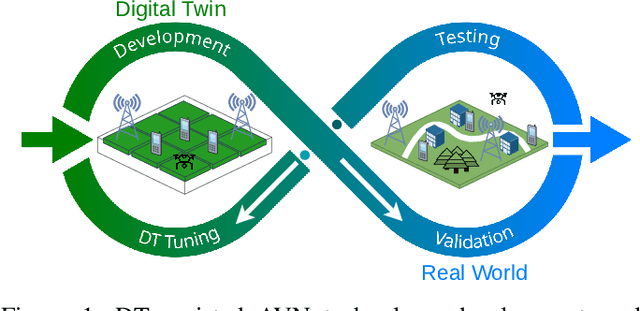
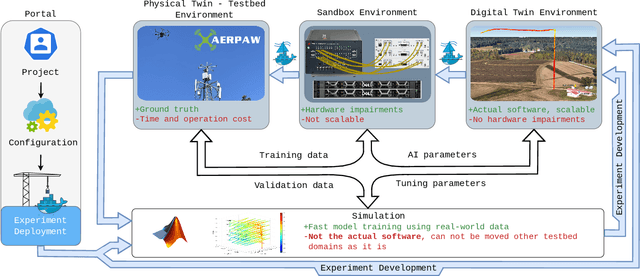
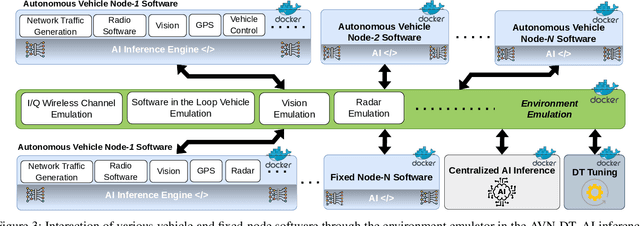
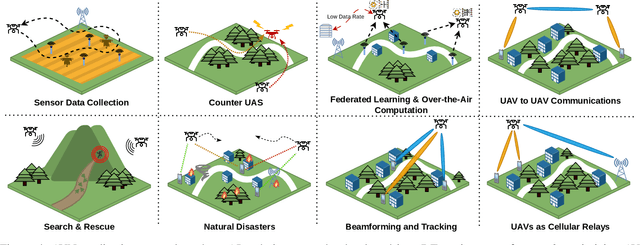
Digital twins (DTs), which are virtual environments that simulate, predict, and optimize the performance of their physical counterparts, are envisioned to be essential technologies for advancing next-generation wireless networks. While DTs have been studied extensively for wireless networks, their use in conjunction with autonomous vehicles with programmable mobility remains relatively under-explored. In this paper, we study DTs used as a development environment to design, deploy, and test artificial intelligence (AI) techniques that use real-time observations, e.g. radio key performance indicators, for vehicle trajectory and network optimization decisions in an autonomous vehicle networks (AVN). We first compare and contrast the use of simulation, digital twin (software in the loop (SITL)), sandbox (hardware-in-the-loop (HITL)), and physical testbed environments for their suitability in developing and testing AI algorithms for AVNs. We then review various representative use cases of DTs for AVN scenarios. Finally, we provide an example from the NSF AERPAW platform where a DT is used to develop and test AI-aided solutions for autonomous unmanned aerial vehicles for localizing a signal source based solely on link quality measurements. Our results in the physical testbed show that SITL DTs, when supplemented with data from real-world (RW) measurements and simulations, can serve as an ideal environment for developing and testing innovative AI solutions for AVNs.