 Add to Chrome
 Add to Firefox
 Add to Edge
DishSeg24k: A Large-Scale Benchmark for Food Segmentation with Stochastic Expert Decoding
Jul 25, 2026
Food segmentation is essential for applications such as intelligent catering, dietary assessment, and recommendation. However, existing benchmarks fail to capture the complexity of real-world dining scenes. The challenges of dense inter-dish overlap, fine-grained class similarity, and extreme long-tail class distributions exceed the fidelity of current datasets. To fill this gap, we introduce \textbf{DishSeg24k}, a large-scale dish-level segmentation benchmark with 24,096 images, 112,281 instances, and 278 fine-grained categories in real-world dining environments. Based on DishSeg24k, we further propose \textbf{Food Expert-Adaptive Segmentation Transformers (FEAST)} to address these challenges. FEAST models query-based decoding as a Markov Decision Process (MDP), where each decoder layer update is treated as a sequential decision step that explores uncertainty along dish boundaries. We further redesign the decoder with a reinforcement learning (RL)-guided Mixture-of-Experts (MoE) module, in which a dual-critic decoupled optimization scheme separates task-oriented query refinement from structure-aware expert routing. This design promotes expert specialization and prevents expert collapse under long-tail category distributions. Finally, extensive experiments on DishSeg24k demonstrate the state-of-the-art performance of FEAST, which outperforms previous methods by {+3.21\%} mIoU, {+3.68\%} mDice, and {+4.00\%} mAcc, respectively. We further validate the effectiveness of FEAST on FoodSeg103. The dataset and code will be publicly released.

RFHNet: Relational and Frequency-Aware Hashing Network for Large-Scale Fine-Grained Food Image Retrieval
Jul 07, 2026Fine-grained food image retrieval is a key task in computational gastronomy, with applications in food traceability, dietary monitoring, and smart catering systems. Although hashing-based retrieval is attractive for large-scale search due to its storage efficiency and fast Hamming-distance computation, existing methods often perform poorly in fine-grained food scenarios, where subtle local semantics and frequency-sensitive visual cues are essential. To address this challenge, we propose RFHNet, a cascaded hierarchical hashing network that captures both global structure and fine-grained local details through multi-level representations. RFHNet includes three components: (1) Fine-grained Relation Modeling (FRM) to capture subtle visual differences among similar food components; (2) Multi-Frequency Modulated Fusion (MFMF) to extract informative multi-frequency features; and (3) Hierarchical Semantic Synergy (HSS) to adaptively integrate multi-level representations and generate discriminative hash codes. Experiments on six food-specific benchmarks show that RFHNet consistently outperforms state-of-the-art hashing methods, with mAP gains of 4.44\% to 17.20\% at 12 bits. These results validate the effectiveness of RFHNet for large-scale visual food retrieval and smart catering applications. The source code will be released upon publication.
* 10 pages, 6 figures. Published in ACM ICMR 2026
Structured-Condensed Prompt Tuning in Vision-Language Models for Fine-grained Image Recognition
Jul 07, 2026Fine-grained image recognition poses a significant challenge due to the substantial expertise and effort required for manual annotation. Vision-language models (VLMs) like CLIP provide a compelling zero-shot alternative, reducing reliance on extensive labeled data. However, their ability to capture subtle distinctions remains limited, leading to subpar recognition performance. While prompt tuning has proven effective for adapting VLMs, most existing methods treat class labels as isolated, discrete entities, overlooking the rich semantic relationships between them. This oversimplified assumption limits the model's ability to capture hierarchical dependencies and inter-class correlations -- both critical for distinguishing visually similar categories. The problem is especially acute in fine-grained classification, where accurate recognition depends on understanding complex label semantics. To address this, we propose Structured-Condensed Prompt Tuning (SCPT), which enhances semantic structure modeling in prompt learning. Specifically, we introduce Semantic Relation Encoding (SRE) to explicitly model inter-class semantic topology and encode structured label relationships. In parallel, we design a Semantic Condensation loss (ScLoss) to suppress redundant supervision and extract discriminative components from the global semantic space. Together, these components significantly improve semantic alignment and fine-grained discrimination. Extensive experiments on 14 fine-grained benchmarks show that SCPT effectively mitigates semantic ambiguity and achieves state-of-the-art performance in both few-shot and base-to-novel generalization settings.
GA-VLN: Geometry-Aware BEV Representation for Efficient Vision-Language Navigation
May 21, 2026Despite significant progress in Vision-Language Navigation (VLN), existing approaches still rely on dense RGB videos that produce excessive patch tokens and lack explicit spatial structure, resulting in substantial computational overhead and limited spatial reasoning. To address these issues, we introduce the Geometry-Aware BEV (GA-BEV) - a compact, 3D-grounded feature representation that integrates both explicit and implicit geometric cues into multimodal large language model (MLLM) - based navigation systems. We construct BEV spatial maps from RGB-D inputs by projecting visual features into 3D space and aggregating them into an agent-centric layout that preserves geometric consistency while reducing token redundancy. To further enrich geometric understanding, we incorporate features from a pretrained 3D foundation model into the BEV space, injecting structural priors learned from large-scale 3D reconstruction tasks. Together, these complementary cues - explicit depth-based projection and implicit learned priors - yield compact yet spatially expressive representations that substantially improve navigation efficiency and performance. Experiments show that our method achieves state-of-the-art results using only navigation data, without DAgger augmentation or mixed VQA training, demonstrating the robustness and data efficiency of the proposed GA-VLN framework.
Multi-Scale Gaussian-Language Map for Zero-shot Embodied Navigation and Reasoning
May 03, 2026Understanding the geometric and semantic structure of environments is essential for embodied navigation and reasoning. Existing semantic mapping methods trade off between explicit geometry and multi-scale semantics, and lack a native interface for large models, thus requiring additional training of feature projection for semantic alignment. To this end, we propose the multi-scale Gaussian-Language Map (GLMap), which introduces three key designs: (1) explicit geometry, (2) multi-scale semantics covering both instance and region concepts, and (3) a dual-modality interface where each semantic unit jointly stores a natural language description and a 3D Gaussian representation. The 3D Gaussians enable compact storage and fast rendering of task-relevant images via Gaussian splatting. To enable efficient incremental construction, we further propose a Gaussian Estimator that analytically derives Gaussian parameters from dense point clouds without gradient-based optimization. Experiments on ObjectNav, InstNav, and SQA tasks show that GLMap effectively enhances target navigation and contextual reasoning, while remaining compatible with large-model-based methods in a zero-shot manner. The code is available at https://github.com/sx-zhang/GLMap.
TrajRAG: Retrieving Geometric-Semantic Experience for Zero-Shot Object Navigation
May 03, 2026Existing zero-shot Object Goal Navigation (ObjectNav) methods often exploit commonsense knowledge from large language or vision-language models to guide navigation. However, such knowledge arises from internet-scale text rather than embodied 3D experience, and episodic observations collected during navigation are typically discarded, preventing the accumulation of lifelong experience. To this end, we propose Trajectory RAG (TrajRAG), a retrieval-augmented generation framework that enhances large-model reasoning by retrieving geometric-semantic experiences. TrajRAG incrementally accumulates episodic observations from past navigation episodes. To structure these observations, we propose a topological-polar (topo-polar) trajectory representation that compactly encodes spatial layouts and semantic contexts, effectively removing redundancies in raw episodic observations. A hierarchical chunking structure further organizes similar topo-polar trajectories into unified summaries, enabling coarse-to-fine retrieval. During navigation, candidate frontiers generate multiple trajectory hypotheses that query TrajRAG for similar past trajectories, guiding large-model reasoning for waypoint selection. New experiences are continually consolidated into TrajRAG, enabling the accumulation of lifelong navigation experience. Experiments on MP3D, HM3D-v1, and HM3D-v2 show that TrajRAG effectively retrieves relevant geometric-semantic experiences and improves zero-shot ObjectNav performance.
OmniFood8K: Single-Image Nutrition Estimation via Hierarchical Frequency-Aligned Fusion
Apr 14, 2026Accurate estimation of food nutrition plays a vital role in promoting healthy dietary habits and personalized diet management. Most existing food datasets primarily focus on Western cuisines and lack sufficient coverage of Chinese dishes, which restricts accurate nutritional estimation for Chinese meals. Moreover, many state-of-the-art nutrition prediction methods rely on depth sensors, restricting their applicability in daily scenarios. To address these limitations, we introduce OmniFood8K, a comprehensive multimodal dataset comprising 8,036 food samples, each with detailed nutritional annotations and multi-view images. In addition, to enhance models' capability in nutritional prediction, we construct NutritionSynth-115K, a large-scale synthetic dataset that introduces compositional variations while preserving precise nutritional labels. Moreover, we propose an end-to-end framework for nutritional prediction from a single RGB image. First, we predict a depth map from a single RGB image and design the Scale-Shift Residual Adapter (SSRA) to refine it for global scale consistency and local structural preservation. Second, we propose the Frequency-Aligned Fusion Module (FAFM) to hierarchically align and fuse RGB and depth features in the frequency domain. Finally, we design a Mask-based Prediction Head (MPH) to emphasize key ingredient regions via dynamic channel selection for more accurate prediction. Extensive experiments on multiple datasets demonstrate the superiority of our method over existing approaches. Project homepage: https://yudongjian.github.io/OmniFood8K-food/
Embodied Arena: A Comprehensive, Unified, and Evolving Evaluation Platform for Embodied AI
Sep 18, 2025Embodied AI development significantly lags behind large foundation models due to three critical challenges: (1) lack of systematic understanding of core capabilities needed for Embodied AI, making research lack clear objectives; (2) absence of unified and standardized evaluation systems, rendering cross-benchmark evaluation infeasible; and (3) underdeveloped automated and scalable acquisition methods for embodied data, creating critical bottlenecks for model scaling. To address these obstacles, we present Embodied Arena, a comprehensive, unified, and evolving evaluation platform for Embodied AI. Our platform establishes a systematic embodied capability taxonomy spanning three levels (perception, reasoning, task execution), seven core capabilities, and 25 fine-grained dimensions, enabling unified evaluation with systematic research objectives. We introduce a standardized evaluation system built upon unified infrastructure supporting flexible integration of 22 diverse benchmarks across three domains (2D/3D Embodied Q&A, Navigation, Task Planning) and 30+ advanced models from 20+ worldwide institutes. Additionally, we develop a novel LLM-driven automated generation pipeline ensuring scalable embodied evaluation data with continuous evolution for diversity and comprehensiveness. Embodied Arena publishes three real-time leaderboards (Embodied Q&A, Navigation, Task Planning) with dual perspectives (benchmark view and capability view), providing comprehensive overviews of advanced model capabilities. Especially, we present nine findings summarized from the evaluation results on the leaderboards of Embodied Arena. This helps to establish clear research veins and pinpoint critical research problems, thereby driving forward progress in the field of Embodied AI.
Sim-to-Real Transfer via 3D Feature Fields for Vision-and-Language Navigation
Jun 14, 2024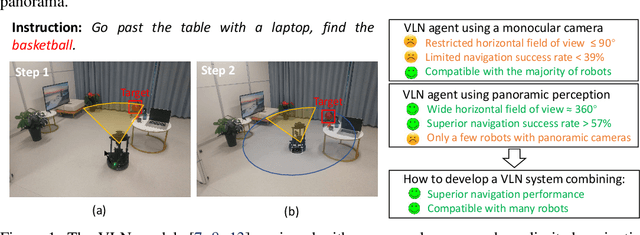
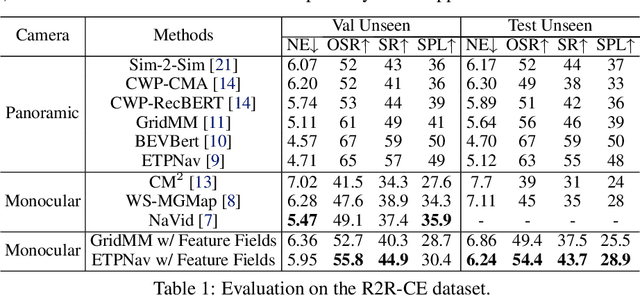


Vision-and-language navigation (VLN) enables the agent to navigate to a remote location in 3D environments following the natural language instruction. In this field, the agent is usually trained and evaluated in the navigation simulators, lacking effective approaches for sim-to-real transfer. The VLN agents with only a monocular camera exhibit extremely limited performance, while the mainstream VLN models trained with panoramic observation, perform better but are difficult to deploy on most monocular robots. For this case, we propose a sim-to-real transfer approach to endow the monocular robots with panoramic traversability perception and panoramic semantic understanding, thus smoothly transferring the high-performance panoramic VLN models to the common monocular robots. In this work, the semantic traversable map is proposed to predict agent-centric navigable waypoints, and the novel view representations of these navigable waypoints are predicted through the 3D feature fields. These methods broaden the limited field of view of the monocular robots and significantly improve navigation performance in the real world. Our VLN system outperforms previous SOTA monocular VLN methods in R2R-CE and RxR-CE benchmarks within the simulation environments and is also validated in real-world environments, providing a practical and high-performance solution for real-world VLN.
FoodSky: A Food-oriented Large Language Model that Passes the Chef and Dietetic Examination
Jun 11, 2024

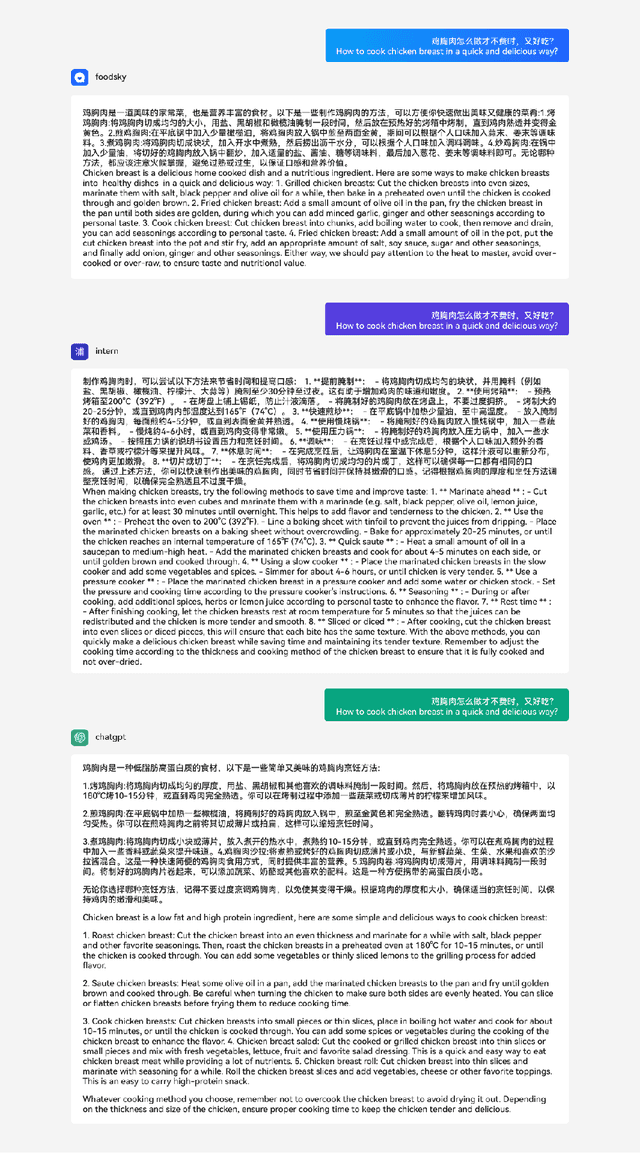

Food is foundational to human life, serving not only as a source of nourishment but also as a cornerstone of cultural identity and social interaction. As the complexity of global dietary needs and preferences grows, food intelligence is needed to enable food perception and reasoning for various tasks, ranging from recipe generation and dietary recommendation to diet-disease correlation discovery and understanding. Towards this goal, for powerful capabilities across various domains and tasks in Large Language Models (LLMs), we introduce Food-oriented LLM FoodSky to comprehend food data through perception and reasoning. Considering the complexity and typicality of Chinese cuisine, we first construct one comprehensive Chinese food corpus FoodEarth from various authoritative sources, which can be leveraged by FoodSky to achieve deep understanding of food-related data. We then propose Topic-based Selective State Space Model (TS3M) and the Hierarchical Topic Retrieval Augmented Generation (HTRAG) mechanism to enhance FoodSky in capturing fine-grained food semantics and generating context-aware food-relevant text, respectively. Our extensive evaluations demonstrate that FoodSky significantly outperforms general-purpose LLMs in both chef and dietetic examinations, with an accuracy of 67.2% and 66.4% on the Chinese National Chef Exam and the National Dietetic Exam, respectively. FoodSky not only promises to enhance culinary creativity and promote healthier eating patterns, but also sets a new standard for domain-specific LLMs that address complex real-world issues in the food domain. An online demonstration of FoodSky is available at http://222.92.101.211:8200.