 Add to Chrome
 Add to Firefox
 Add to Edge
Optimal Transmit Beamforming for MIMO ISAC with Unknown Target and User Locations
Feb 09, 2026
This paper studies a challenging scenario in a multiple-input multiple-output (MIMO) integrated sensing and communication (ISAC) system where the locations of the sensing target and the communication user are both unknown and random, while only their probability distribution information is known. In this case, how to fully utilize the spatial resources by designing the transmit beamforming such that both sensing and communication can achieve satisfactory performance statistically is a difficult problem, which motivates the study in this paper. Moreover, we aim to reveal if it is desirable to have similar probability distributions for the target and user locations in terms of the ISAC performance. Firstly, based on only probability distribution information, we establish communication and sensing performance metrics via deriving the expected rate or posterior Cramér-Rao bound (PCRB). Then, we formulate the transmit beamforming optimization problem to minimize the PCRB subject to the expected rate constraint, for which the optimal solution is derived. It is unveiled that the rank of the optimal transmit covariance matrix is upper bounded by the summation of MIMO communication channel matrices for all possible user locations. Furthermore, due to the need to cater to multiple target/user locations, we investigate whether dynamically employing different beamforming designs over different time slots improves the performance. It is proven that using a static beamforming strategy is sufficient for achieving the optimal performance. Numerical results validate our analysis, show that ISAC performance improves as the target/user location distributions become similar, and provide useful insights on the BS-user/-target association strategy.

Covariance-based Imaging and Multi-View Fusion for Networked Sensing
Nov 18, 2025This paper considers multi-view imaging in a sixth-generation (6G) integrated sensing and communication network, which consists of a transmit base-station (BS), multiple receive BSs connected to a central processing unit (CPU), and multiple extended targets. Our goal is to devise an effective multi-view imaging technique that can jointly leverage the targets' echo signals at all the receive BSs to precisely construct the image of these targets. To achieve this goal, we propose a two-phase approach. In Phase I, each receive BS recovers an individual image based on the sample covariance matrix of its received signals. Specifically, we propose a novel covariance-based imaging framework to jointly estimate effective scattering intensity and grid positions, which reduces the number of estimated parameters leveraging channel statistical properties and allows grid adjustment to conform to target geometry. In Phase II, the CPU fuses the individual images of all the receivers to construct a high-quality image of all the targets. Specifically, we design edge-preserving natural neighbor interpolation (EP-NNI) to map individual heterogeneous images onto common and finer grids, and then propose a joint optimization framework to estimate fused scattering intensity and BS fields of view. Extensive numerical results show that the proposed scheme significantly enhances imaging performance, facilitating high-quality environment reconstruction for future 6G networks.
Joint Transmit Beamforming and Reflection Optimization for Beyond Diagonal RIS Aided Multi-Cell MIMO Communication
Nov 17, 2025The sixth-generation (6G) wireless networks will rely on ultra-dense multi-cell deployment to meet the high rate and connectivity demands. However, frequency reuse leads to severe inter-cell interference, particularly for cell-edge users, which limits the communication performance. To overcome this challenge, we investigate a beyond diagonal reconfigurable intelligent surface (BD-RIS) aided multi-cell multi-user downlink MIMO communication system, where a BD-RIS is deployed to enhance desired signals and suppress both intra-cell and inter-cell interference.We formulate the joint optimization problem of the transmit beamforming matrices at the BSs and the BD-RIS reflection matrix to maximize the weighted sum rate of all users, subject to the challenging unitary constraint of the BD-RIS reflection matrix and transmit power constraints at the BSs. To tackle this non-convex and difficult problem, we apply the weighted minimum mean squared error (WMMSE) method to transform the problem into an equivalent tractable form, and propose an efficient alternating optimization (AO) based algorithm to iteratively update the transmit beamforming and BD-RIS reflection using Lagrange duality theory and manifold optimization. Numerical results demonstrate the superiority of the proposed design over various benchmark schemes, and provide useful practical insights on the BD-RIS deployment strategy for multi-cell systems.
On the Capacity of Pixel Antenna based MIMO Communication
Nov 17, 2025Pixel antenna is a promising technology to enhance the wireless communication data rate by adaptively reconfiguring each antenna's radiation pattern via a so-called antenna coding technique which controls the states of switches connected to multiple pixel ports. This paper studies a multiple-input multiple-output (MIMO) system where both the transmitter and the receiver are equipped with multiple pixel antennas. We aim to characterize the fundamental capacity limit of this MIMO system by jointly optimizing the transmit covariance matrix and the antenna coders at both the transmitter and the receiver. This problem is a mixed-integer non-linear program (MINLP) which is non-convex and particularly challenging to solve due to the binary-valued optimization variables corresponding to the antenna coders. We first propose an exhaustive search based method to obtain the optimal solution to this problem, which corresponds to the fundamental capacity limit. Then, we propose a branch-and-bound based iterative algorithm aiming to find a high-quality suboptimal solution with lower complexity than exhaustive search as the number of pixel ports becomes large. Finally, we devise an alternating optimization (AO) based algorithm with polynomial complexity. Numerical results show that our proposed algorithms achieve a flexible trade-off between performance and complexity. Moreover, equipping the transceivers with pixel antennas can enhance the achievable rate of MIMO communications.
Integrated Massive Communication and Target Localization in 6G Cell-Free Networks
Oct 16, 2025This paper presents an initial investigation into the combination of integrated sensing and communication (ISAC) and massive communication, both of which are largely regarded as key scenarios in sixth-generation (6G) wireless networks. Specifically, we consider a cell-free network comprising a large number of users, multiple targets, and distributed base stations (BSs). In each time slot, a random subset of users becomes active, transmitting pilot signals that can be scattered by the targets before reaching the BSs. Unlike conventional massive random access schemes, where the primary objectives are device activity detection and channel estimation, our framework also enables target localization by leveraging the multipath propagation effects introduced by the targets. However, due to the intricate dependency between user channels and target locations, characterizing the posterior distribution required for minimum mean-square error (MMSE) estimation presents significant computational challenges. To handle this problem, we propose a hybrid message passing-based framework that incorporates multiple approximations to mitigate computational complexity. Numerical results demonstrate that the proposed approach achieves high-accuracy device activity detection, channel estimation, and target localization simultaneously, validating the feasibility of embedding localization functionality into massive communication systems for future 6G networks.
Learning to Align, Aligning to Learn: A Unified Approach for Self-Optimized Alignment
Aug 11, 2025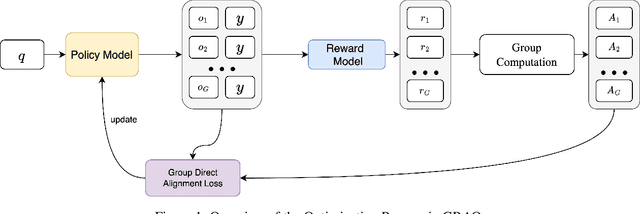
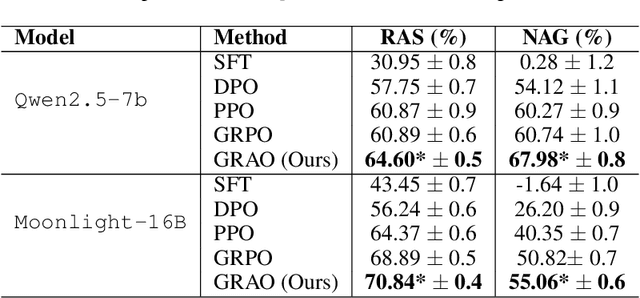
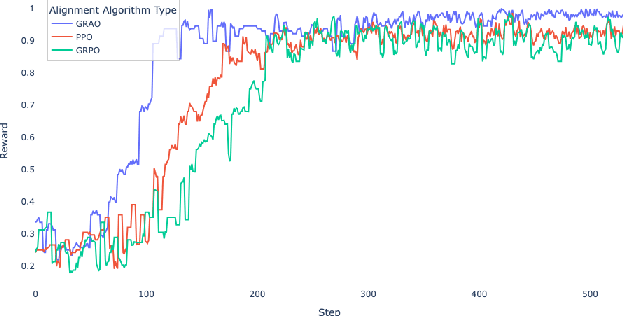
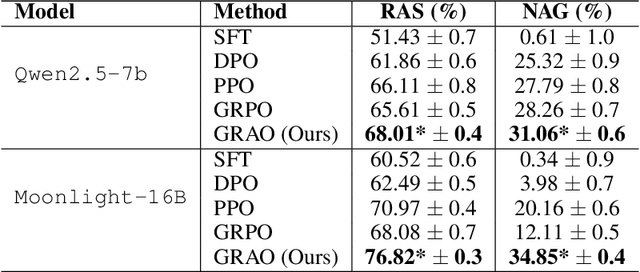
Alignment methodologies have emerged as a critical pathway for enhancing language model alignment capabilities. While SFT (supervised fine-tuning) accelerates convergence through direct token-level loss intervention, its efficacy is constrained by offline policy trajectory. In contrast, RL(reinforcement learning) facilitates exploratory policy optimization, but suffers from low sample efficiency and stringent dependency on high-quality base models. To address these dual challenges, we propose GRAO (Group Relative Alignment Optimization), a unified framework that synergizes the respective strengths of SFT and RL through three key innovations: 1) A multi-sample generation strategy enabling comparative quality assessment via reward feedback; 2) A novel Group Direct Alignment Loss formulation leveraging intra-group relative advantage weighting; 3) Reference-aware parameter updates guided by pairwise preference dynamics. Our theoretical analysis establishes GRAO's convergence guarantees and sample efficiency advantages over conventional approaches. Comprehensive evaluations across complex human alignment tasks demonstrate GRAO's superior performance, achieving 57.70\%,17.65\% 7.95\% and 5.18\% relative improvements over SFT, DPO, PPO and GRPO baselines respectively. This work provides both a theoretically grounded alignment framework and empirical evidence for efficient capability evolution in language models.
Hybrid Beamforming Optimization for MIMO ISAC Exploiting Prior Information: A PCRB-based Approach
Jun 09, 2025This paper considers a multiple-input multiple-output (MIMO) integrated sensing and communication (ISAC) system, where a multi-antenna base station (BS) with transceiver hybrid analog-digital arrays transmits dual-functional signals to communicate with a multi-antenna user and simultaneously sense the unknown and random location information of a target based on the reflected echo signals and the prior distribution information on the target's location. Under transceiver hybrid arrays, we characterize the sensing performance by deriving the posterior Cram\'{e}r-Rao bound (PCRB) of the mean-squared error which is a function of the transmit hybrid beamforming and receive analog beamforming. We study joint transmit hybrid beamforming and receive analog beamforming optimization to minimize the PCRB subject to a communication rate requirement. We first consider a sensing-only system and derive the optimal solution to each element in the transmit/receive analog beamforming matrices that minimizes the PCRB in closed form. Then, we develop an alternating optimization (AO) based algorithm. Next, we study a narrowband MIMO ISAC system and devise an efficient AO-based hybrid beamforming algorithm by leveraging weighted minimum mean-squared error and feasible point pursuit successive convex approximation methods. Furthermore, we extend the results for narrowband systems to a MIMO orthogonal frequency-division multiplexing (OFDM) ISAC system. Numerical results validate the effectiveness of our proposed hybrid beamforming designs. It is revealed that the number of receive RF chains has more significant impact on the sensing performance than its transmit counterpart. Under a given budget on the total number of transmit/receive RF chains at the BS, the optimal number of transmit RF chains increases as the communication rate target increases due to the non-trivial PCRB-rate trade-off.
Beyond Diagonal Intelligent Reflecting Surface Aided Integrated Sensing and Communication
May 22, 2025Beyond diagonal intelligent reflecting surface (BD-IRS) is a new promising IRS architecture for which the reflection matrix is not limited to the diagonal structure as for conventional IRS. In this paper, we study a BD-IRS aided uplink integrated sensing and communication (ISAC) system where sensing is performed in a device-based manner. Specifically, we aim to estimate the unknown and random location of an active target based on its uplink probing signals sent to a multi-antenna base station (BS) as well as the known prior distribution information of the target's location. Multiple communication users also simultaneously send uplink signals, resulting in a challenging mutual interference issue between sensing and communication. We first characterize the sensing performance metric by deriving the posterior Cram\'er-Rao bound (PCRB) of the mean-squared error (MSE) when prior information is available. Then, we formulate a BD-IRS reflection matrix optimization problem to maximize the minimum expected achievable rate among the multiple users subject to a constraint on the PCRB as well as the lossless and reciprocal constraints on the BD-IRS reflection matrix. The formulated problem is non-convex and challenging to solve. To tackle this problem, we propose a penalty dual decomposition (PDD) based algorithm which can find a high-quality suboptimal solution with polynomial-time complexity. In addition, we propose and optimize a time-division multiple access (TDMA) based scheme which removes the sensing-communication mutual interference. Numerical results verify the effectiveness of the proposed designs and provide useful design insights.
Base Station Placement Optimization for Networked Sensing Exploiting Target Location Distribution
May 22, 2025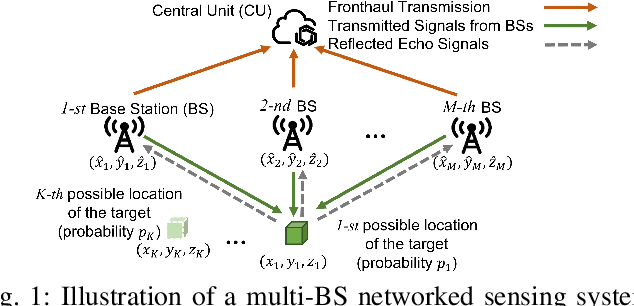
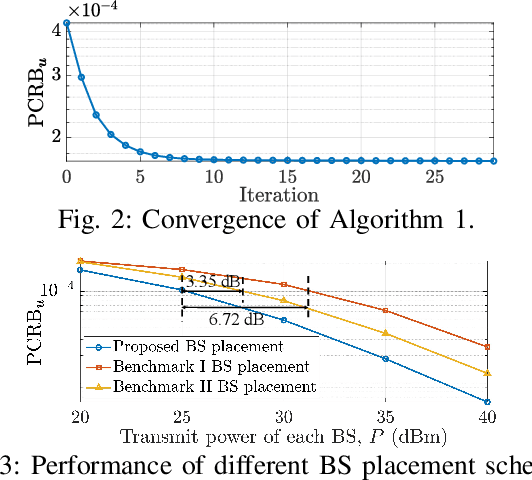
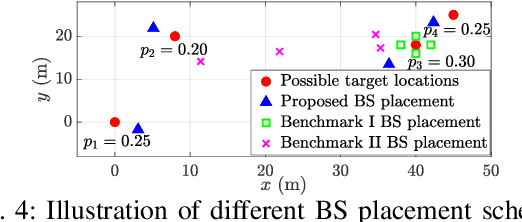
This paper studies a networked sensing system with multiple base stations (BSs), which collaboratively sense the unknown and random three-dimensional (3D) location of a target based on the target-reflected echo signals received at the BSs. Considering a practical scenario where the target location distribution is known a priori for exploitation, we aim to design the placement of the multiple BSs to optimize the networked sensing performance. Firstly, we characterize the posterior Cram\'er-Rao bound (PCRB) of the mean-squared error (MSE) in sensing the target's 3D location. Despite its complex form under networked sensing, we derive its closed-form expression in terms of the BS locations. Next, we formulate the BS placement optimization problem to minimize the sensing PCRB, which is non-convex and difficult to solve. By leveraging a series of equivalent transformations and the iterative inner approximation method, we devise an algorithm with polynomial-time complexity which is guaranteed to converge to a solution satisfying the Karush-Kuhn Tucker (KKT) conditions of the problem. Numerical results show that the proposed placement design significantly outperforms various benchmark designs.
Scalable Transceiver Design for Multi-User Communication in FDD Massive MIMO Systems via Deep Learning
Apr 15, 2025This paper addresses the joint transceiver design, including pilot transmission, channel feature extraction and feedback, as well as precoding, for low-overhead downlink massive multiple-input multiple-output (MIMO) communication in frequency-division duplex (FDD) systems. Although deep learning (DL) has shown great potential in tackling this problem, existing methods often suffer from poor scalability in practical systems, as the solution obtained in the training phase merely works for a fixed feedback capacity and a fixed number of users in the deployment phase. To address this limitation, we propose a novel DL-based framework comprised of choreographed neural networks, which can utilize one training phase to generate all the transceiver solutions used in the deployment phase with varying sizes of feedback codebooks and numbers of users. The proposed framework includes a residual vector-quantized variational autoencoder (RVQ-VAE) for efficient channel feedback and an edge graph attention network (EGAT) for robust multiuser precoding. It can adapt to different feedback capacities by flexibly adjusting the RVQ codebook sizes using the hierarchical codebook structure, and scale with the number of users through a feedback module sharing scheme and the inherent scalability of EGAT. Moreover, a progressive training strategy is proposed to further enhance data transmission performance and generalization capability. Numerical results on a real-world dataset demonstrate the superior scalability and performance of our approach over existing methods.