 Add to Chrome
 Add to Firefox
 Add to Edge
HODAgent: Towards On-Demand, Responsive Humanoids for Physical World Human Interaction
Aug 18, 2026
We propose HODAgent, a System-2 embodied agent for humanoid robots in service settings, addressing situated intent, responsive execution, task revision, and outcome verification. Its semi-duplex architecture integrates an Env-Interactor, Planner, Executor, and hierarchical Memory to maintain coherent interaction, planning, and task state during service episodes. This allows handling new requests during motion, retaining progress, revising actions, and grounding closure in execution outcomes. A shared interface connects simulation and physical robots (Unitree G1), isolating platform-specific control. In an interactive simulation with 164 cases, HODAgent achieves 84.8% and 91.5% Joint Success under two VLM backbones, outperforming baselines by 9.8 and 18.9 points. On physical robots, pass rates are 92% (atomic), 72% (composite), and 63.3% (complete tasks). On multiple embodied benchmarks, it improves over baselines by 0.7-9.0 points. Results show a unified System-2 agent enables adaptive humanoid service across simulation and reality.

DeepInsight II: One Trace from Benchmark to Robot
Aug 17, 2026Across a Physical AI stack, evaluation maturity is inversely aligned with deployment risk: foundation models enjoy mature, standardized harnesses, while the embodied layers on which deployment actually turns remain fragmented across benchmark-specific simulators, embodiments, and interfaces. The first DeepInsight report (v1) unified evaluation across this stack behind three abstractions---task, resource, and result---but its quantitative evidence centered on the foundation-model layer; navigation and manipulation (System 1) and whole-body control (System 0) remained simulation case studies, and physical execution was outside its empirical scope. DeepInsight II keeps that substrate fixed and quantifies the embodied half. First, it reproduces released-checkpoint references across two navigation and four manipulation benchmarks under their native protocols. Second, MotionBench places four released whole-body controllers under one workload and metric contract, then carries a qualified within-family cohort from parallel simulation to matched real-robot trials in which simulated and physical rollouts share a parent trace identity while retaining execution-domain-specific records, making the sim-to-real gap a native reduction rather than a reconciliation across toolchains. Third, a composed System 2--1--0 study extends trace localization into five evidence-grounded handoff labels, each mapped to a concrete repair action, with a measured repairability criterion and physical episodes testing the same attribution under hardware-observable state. The contribution is therefore not a new evaluation architecture, but empirical continuity from benchmark execution to matched robot evidence and repair-oriented diagnosis.
R2S-EGO: Dual-Proxy Refinement for Sparse-Capture Real-to-Sim
Aug 07, 2026Real-to-sim (R2S) depends on scene representations that render observations along robot ego trajectories, yet dense multi-view capture limits per-environment real-image capture-count efficiency, and sparse human capture can leave behavior-scoped robot views under-supported. Camera-controlled synthesis can fill missing views, but its use in R2S requires behavior-admissible queries and capture-anchored structural conditioning. We present R2S-EGO, which couples a simulator-derived robot proxy that represents the behavior-scoped executable query domain with a capture-anchored geometry proxy that supplies scene-specific structural conditions. Within this domain, fixed- budget selection targets current support deficits for which geometry support is available. The generated observations are assimilated as pseudo-observations to refine the visual asset, while real captures remain anchors. The fused geometry proxy also supplies the scene collision surface, which is refreshed between rounds. Together, these updates refine the existing simulation scene while its robot dynamics and control stack stay fixed. Across 48 frozen Unitree G1 ego views in three Replica scenes, six-view R2S-EGO reaches 19.062 dB PSNR, compared with 14.226 dB for the strongest reported R2S baseline. Across five paired policy-training seeds, R2S-EGO achieves 82.5% +/- 6.8% real-G1 sitting success, compared with 10.0% +/- 10.5% for GaussGym.
DeepInsight: A Unified Evaluation Infrastructure Across the Physical AI Stack
Jun 16, 2026Evaluating a Physical AI stack spans operators that differ by more than three orders of magnitude -- from a single foundation-model decoding step to thousands of physics ticks of whole-body control -- varying orthogonally in modality, reward semantics, and resource profile. No existing framework spans this range, so the stack is evaluated today by stitching together separate harnesses that share neither runtime nor scoring, preserving each segment's local validity but losing the shared identity needed to diagnose cross-layer regressions. We present DeepInsight, an evaluation infrastructure that serves this full spectrum on a single runtime. Rather than homogenize the regimes, it preserves their heterogeneity behind three narrow abstractions -- task, resource, and result -- each realized as one invariant shared by every subsystem: one episode driver, one resource-handle protocol implemented by every expensive backend (LLM inference and sandboxed runtimes alike), and one trace identity scheme under which every event is written. Deployed in production across all three layers of an embodied humanoid stack, this single set of invariants onboards new benchmarks largely by configuration. Where mature peer orchestrators exist -- at the foundation-model end -- it reproduces published references and peer-framework readings within their own spread, runs the same suites faster on a single node, and scales near-linearly across nodes. Its distinctive return is diagnostic: because every layer writes into one shared trace, a regression that begins in one layer and surfaces in another stays localizable on that trace -- a cross-layer payoff no federation of per-segment harnesses can reproduce.
TeleAntiFraud-28k: An Audio-Text Slow-Thinking Dataset for Telecom Fraud Detection
Apr 01, 2025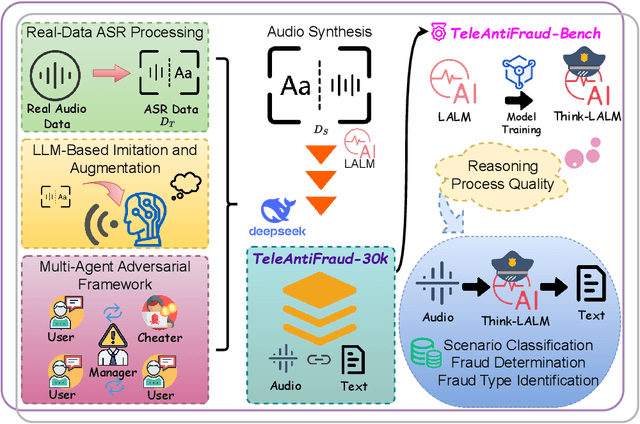
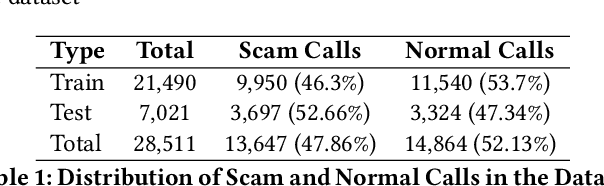
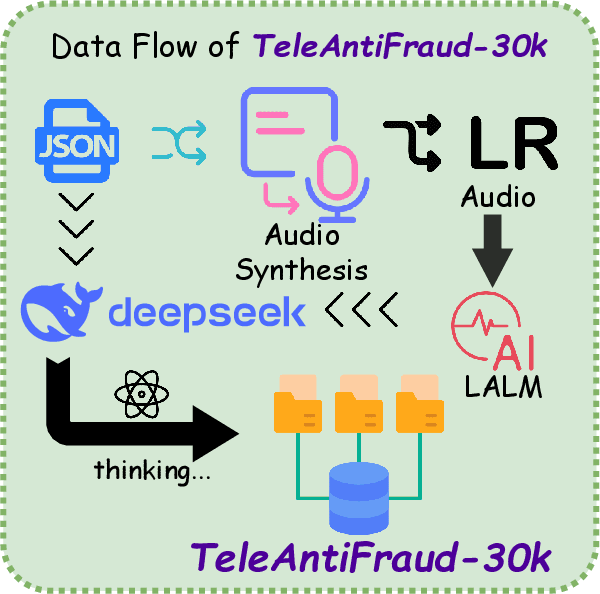
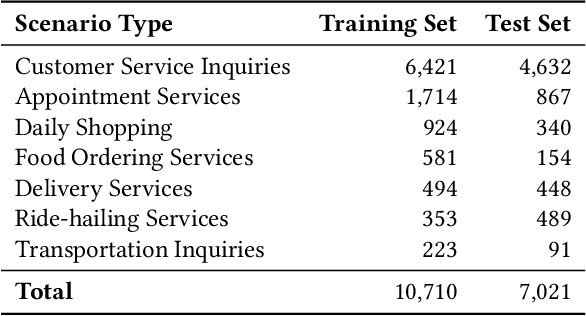
The detection of telecom fraud faces significant challenges due to the lack of high-quality multimodal training data that integrates audio signals with reasoning-oriented textual analysis. To address this gap, we present TeleAntiFraud-28k, the first open-source audio-text slow-thinking dataset specifically designed for automated telecom fraud analysis. Our dataset is constructed through three strategies: (1) Privacy-preserved text-truth sample generation using automatically speech recognition (ASR)-transcribed call recordings (with anonymized original audio), ensuring real-world consistency through text-to-speech (TTS) model regeneration; (2) Semantic enhancement via large language model (LLM)-based self-instruction sampling on authentic ASR outputs to expand scenario coverage; (3) Multi-agent adversarial synthesis that simulates emerging fraud tactics through predefined communication scenarios and fraud typologies. The generated dataset contains 28,511 rigorously processed speech-text pairs, complete with detailed annotations for fraud reasoning. The dataset is divided into three tasks: scenario classification, fraud detection, fraud type classification. Furthermore, we construct TeleAntiFraud-Bench, a standardized evaluation benchmark comprising proportionally sampled instances from the dataset, to facilitate systematic testing of model performance on telecom fraud detection tasks. We also contribute a production-optimized supervised fine-tuning (SFT) model trained on hybrid real/synthetic data, while open-sourcing the data processing framework to enable community-driven dataset expansion. This work establishes a foundational framework for multimodal anti-fraud research while addressing critical challenges in data privacy and scenario diversity. The project will be released at https://github.com/JimmyMa99/TeleAntiFraud.